Elateridae
Elateridae or click beetles are a family of beetles. Other names include elaters, snapping beetles, spring beetles or skipjacks. This family was defined by English zoologist William Elford Leach (1790–1836) in 1815. They are a cosmopolitan beetle family characterized by the unusual click mechanism they possess. There are a few other families of Elateroidea in which a few members have the same mechanism, but most elaterid subfamilies can click. A spine on the prosternum can be snapped into a corresponding notch on the mesosternum, producing a violent "click" that can bounce the beetle into the air. The evolutionary purpose of this click is debated: hypotheses include that the clicking noise deters predators or is used for communication, or that the click may allow the beetle to "pop" out of the substrate in which it is pupating. It is unlikely that the click is used for avoiding predators as it does not carry the beetle very far (<50 cm), and in practice click beetles usually play dead or flee normally. There are about 9300 known species worldwide, and 965 valid species in North America.

Sarefo · CC BY-SA 4.0 · via Wikipedia/Commons. May be a photograph of a specimen, or an artist’s reconstruction — an interpretation of a skeleton, since colour and soft tissue are almost never preserved.
On record
Recorded, not inferred- Also called
- click beetlePBDB
- Sits inside
- ElateroideaPBDB
- Motility
- actively mobilePBDB, for Arthropoda
- Environment
- terrestrialPBDB, for Insecta
Time the record covers
At least 241 million years on record.
The record covers at least 241.464 Mya to 11.7 ka. No occurrence read is dated outside 244.4 Mya to 0 Mya.
521 occurrences of Elateridae on record, most of them in the Late Jurassic. The Paleobiology Database records this as a living group. Bar height is expected occurrences, not a count: each fossil is spread across the span it is dated to, so a tall narrow bar means tight dating and a low wide one means loose.
When
521 occurrences- Middle Triassicunder 1%
- Late Triassic1%
- Early Jurassic2%
- Middle Jurassicunder 1%
- Late Jurassic35%
- Early Cretaceous6%
- Late Cretaceous2%
- Paleocene1%
- Eocene29%
- Oligoceneunder 1%
- Miocene6%
- Plioceneunder 1%
- Pleistocene14%
- Holocene1%
These are dates about fossils, not the animal: the record can only begin after it arose and end before it died out, so either end may reach further. Shares are expected occurrences: a fossil dated to a span is counted partly in each period it straddles. More on what this infers.
Found in
56 formations
- Karabastau Formation173
- Florissant Formation53
- Messel Formation32
- Eifel Formation26
- Highbury Silts and Sands Formation17
- Yixian Formation · Jehol Group11
Loading coastlines…
The named rock units Elateridae has been recovered from, largest first. Drawn where the rock is now, not where it formed. 32 further formations hold fewer occurrences each and are not listed. 93 occurrences have no formation on record, which is common for older literature.
Elateridae and its relatives
Late JurassicWhere Elateridae and its relatives were recorded in the Late Jurassic.
Found in the same rock
6,521 taxa- Stenus33 sites
- Aphodius32 sites
- Aleocharinae27 sites
- Carabidae24 sites
- Coleoptera23 sites
- Staphylinidae22 sites
- Helophorus19 sites
- Hydraena19 sites
- Bembidion18 sites
- Curculionidae16 sites
- Chrysomelidae15 sites
- Oulimnius tuberculatus15 sites
- Apion14 sites
- Oulimnius troglodytes14 sites
- Rhynchaenus quercus14 sites
- Donacia13 sites
- Dytiscidae13 sites
- Gyrinus13 sites
- Scarabaeidae13 sites
- Adelocera murina12 sites
- Bledius12 sites
- Dyschiriodes globosus12 sites
- Limnius volckmari12 sites
- Onthophagus12 sites
The Paleobiology Database records 212 sites for Elateridae, and this reads all of them. Of that, one read hit the database's own return limit, so every count below is a floor rather than a total. The number is how many of those sites it was catalogued from too. The 24 sharing the most are listed.
This is not a list of everything alive at the time. It is only what has come out of the same ground as this animal and been written down.
Entered from
124 references- Fossil click-beetles (Coleoptera, Elateridae) from the Upper Jurassic of Karatau135
- The fossil Elateridae of Florissant50
- A contribution to the systematics of Mesozoic click beetles (Coleoptera, Elateridae)30
- Systematik, Phylogenie, Taphonomie und Paläoökologie der Insekten aus dem Mittel-Eozän des Eckfelder Maares, Vulkaneifel24
- Eine neue Gattung der Elateridae (Insecta: Coleoptera) Macropunctum gen. n. aus der Messel-Formation des unteren Mittel-Eozän der Fundstätte Messel17
- Novye zhestkokrylye semeystva Elateridae iz baltiyskogo yantayra11
- Heer, 184710
- Marine Isotope Stage 9 environments of fluvial deposits at Hackney, north London, UK9
- Middle Pleistocene deposits at Frog Hall Pit, Stretton-on-Dunsmore, Warwickshire, English Midlands, and their implications for the age of the type Wolstonian9
- Catalogue of click–beetles (Coleoptera: Elateridae) of Latvia8
- Palaeoenvironmental interpretation of Middle and Late Wisconsinan fossil coleopteran assemblages from western Olympic Peninsula, Washington, USA8
- Fossile Schnellkäfer der Gattung Lanelater Arnett 1952 (Coleoptera, Pyrophorinae, Agrypnini) aus dem Eozän der Grube Messel bei Darmstadt8
Each of the 521 occurrences read was entered from one of these publications, ordered by how many each accounts for. This is not a search for papers mentioning the name. 112 further references are not listed. Entries link to doi.org where the Paleobiology Database holds an identifier, and to its own record where it does not. Relayed as the Paleobiology Database holds them, not checked against what they resolve to.
Media and terms
Media content3

Picture of Elateridae
- Source
- Wikipedia/Commons
- Credit
- Sarefo
- Licence
- CC BY-SA 4.0
- Commercial use
- the licence allows it

Photogrammetry
- Source
- MorphoSource
- Licence
- not stated by the source
- Commercial use
- cannot be read from the licence given — check the record
- Specimen
- Elateridae indet. · ypm:ent:620618
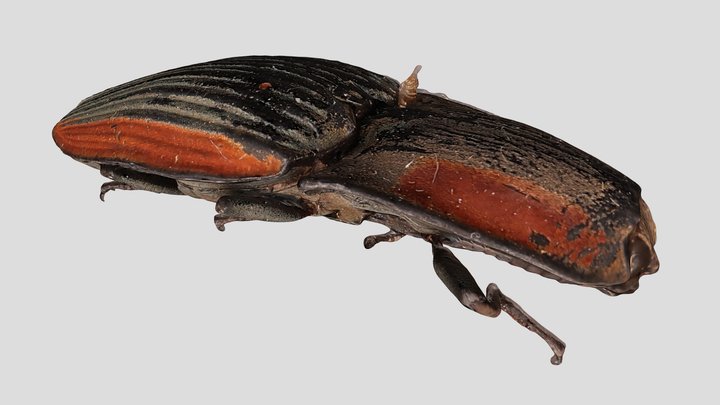
3D model
- Source
- Sketchfab
- Credit
- Yale Peabody Museum
- Licence
- CC Attribution
- Commercial use
- cannot be read from the licence given — check the record
The description on this site
- Licence
- CC BY-SA 4.0
This is what the site found, which is not the same as what exists.
Keep going
What may have been alongside itElateroidea through timeFormations of the Late JurassicThe world it lived on
Occurrence data from the Paleobiology Database, CC BY 4.0. Leach 1815