Aleocharinae
The Aleocharinae are one of the largest subfamilies of rove beetles, containing over 12,000 species. Previously subject to large-scale debate whether the subfamily deserved the familial status, it is now considered one of the largest subfamilies of rove beetles.

Udo Schmidt from Deutschland · CC BY-SA 2.0 · via Wikipedia/Commons. May be a photograph of a specimen, or an artist’s reconstruction — an interpretation of a skeleton, since colour and soft tissue are almost never preserved.
On record
Recorded, not inferred- Sits inside
- StaphylinidaePBDB
- Motility
- actively mobilePBDB, for Arthropoda
- Environment
- terrestrialPBDB, for Insecta
Time the record covers
At least 113 million years on record.
The record covers at least 113.2 Mya to 129 ka. No occurrence read is dated outside 121.4 Mya to 11.7 ka.
106 occurrences of Aleocharinae on record, most of them in the Pleistocene. The Paleobiology Database records this as a living group. Bar height is expected occurrences, not a count: each fossil is spread across the span it is dated to, so a tall narrow bar means tight dating and a low wide one means loose.
When
106 occurrences- Early Cretaceous2%
- Late Cretaceous5%
- Eocene16%
- Oligoceneunder 1%
- Miocene9%
- Pliocene2%
- Pleistocene65%
These are dates about fossils, not the animal: the record can only begin after it arose and end before it died out, so either end may reach further. Shares are expected occurrences: a fossil dated to a span is counted partly in each period it straddles. More on what this infers.
Found in
9 formations
- Titusville Till Formation11
- Highbury Silts and Sands Formation9
- Kap København Formation7
- Green River Formation3
- Quadra Sand Formation2
- Florissant Formation1
Loading coastlines…
The named rock units Aleocharinae has been recovered from, largest first. Drawn where the rock is now, not where it formed. 70 occurrences have no formation on record, which is common for older literature.
Aleocharinae and its relatives
PleistoceneWhere Aleocharinae and its relatives were recorded in the Pleistocene.
Found in the same rock
3,288 taxa- Stenus44 sites
- Aphodius26 sites
- Helophorus24 sites
- Agathidium17 sites
- Arpedium cribratum17 sites
- Bembidion17 sites
- Bledius16 sites
- Elateridae16 sites
- Chrysomelidae15 sites
- Scydmaeninae15 sites
- Dytiscidae14 sites
- Hydraena13 sites
- Carabidae12 sites
- Dyschiriodes globosus12 sites
- Dyschirius12 sites
- Oxytelus laqueatus12 sites
- Staphylinidae12 sites
- Staphylininae12 sites
- Sthereus quadrituberculatus12 sites
- Anotylus rugosus11 sites
- Apion11 sites
- Carpelimus11 sites
- Olophrum consimile11 sites
- Euaesthetinae10 sites
The Paleobiology Database records 84 sites for Aleocharinae, and this reads all of them. Of that, one read hit the database's own return limit, so every count below is a floor rather than a total. The number is how many of those sites it was catalogued from too. The 24 sharing the most are listed.
This is not a list of everything alive at the time. It is only what has come out of the same ground as this animal and been written down.
Entered from
37 references- Palaeoenvironmental interpretation of Middle and Late Wisconsinan fossil coleopteran assemblages from western Olympic Peninsula, Washington, USA20
- Fossil Beetle Evidence for a Short Warm Interval near 40,000 yr B.P. at Titusville, Pennsylvania11
- Marine Isotope Stage 9 environments of fluvial deposits at Hackney, north London, UK9
- Late Devensian river deposits beneath the floodplain terrace of the River Thames at Abingdon, Berkshire, England9
- Palaeoentomology of the Kap København Formation, a Plio-Pleistocene sequence in Peary Land, North Greenland7
- New species of termitophilous Trichopseniinae (Coleoptera: Staphylinidae) found with Mastotermes darwiniensis in Australia and in Dominican amber6
- Environmental interpretation of fossil insect assemblages from MIS 5 at Ziegler Reservoir, Snowmass Village, Colorado5
- A new genus and new species of Staphylinidae (Coleoptera) from Baltic amber3
- Fossil Staphylinidae in Tertiary Mexican amber (Coleoptera)3
- Phylogeny of the rove beetle tribe Gymnusini sensu n. (Coleoptera: Staphylinidae: Aleocharinae): implications for the early branching events of the subfamily2
- Fossils of Staphylinidae from Baltic amber: a new genus and three new species (Insecta, Coleoptera, Staphylinidae)2
- A new fossil staphylinid genus and species from Baltic amber (Coleoptera, Staphylinidae, Aleocharinae, Gymnusini)2
Each of the 106 occurrences read was entered from one of these publications, ordered by how many each accounts for. This is not a search for papers mentioning the name. 25 further references are not listed. Entries link to doi.org where the Paleobiology Database holds an identifier, and to its own record where it does not. Relayed as the Paleobiology Database holds them, not checked against what they resolve to.
Media and terms
Media content1
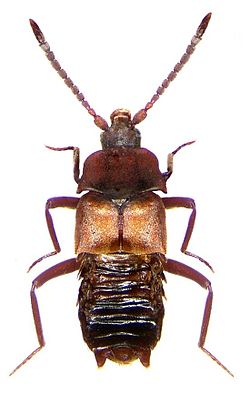
Picture of Aleocharinae
- Source
- Wikipedia/Commons
- Credit
- Udo Schmidt from Deutschland
- Licence
- CC BY-SA 2.0
- Commercial use
- the licence allows it
No 3D scan of Aleocharinae was found in Sketchfab.
Smithsonian Open Access and MorphoSource were not reached for this taxon, so this list is what the others held rather than everything there is.
The description on this site
- Licence
- CC BY-SA 4.0
This is what the site found, which is not the same as what exists.
Keep going
What may have been alongside itStaphylinidae through timeFormations of the PleistoceneThe world it lived on
Occurrence data from the Paleobiology Database, CC BY 4.0. (Fleming 1821)