Curculionidae
The Curculionidae are a family of weevils, commonly called snout beetles or true weevils. At the present state of documentation, they are the largest animal family with approximately 6,000 genera and 77,000 species described worldwide. They are the sister group to the family Brentidae.

Charles J. Sharp · CC BY-SA 4.0 · via Wikipedia/Commons. May be a photograph of a specimen, or an artist’s reconstruction — an interpretation of a skeleton, since colour and soft tissue are almost never preserved.
On record
Recorded, not inferred- Also called
- snout beetlePBDB
- Sits inside
- CurculionoideaPBDB
- Motility
- actively mobilePBDB, for Arthropoda
- Environment
- terrestrialPBDB, for Insecta
Time the record covers
At least 241 million years on record.
The record covers at least 241.464 Mya to 11.7 ka. No occurrence read is dated outside 244.4 Mya to 0 Mya.
1,767 occurrences of Curculionidae on record, most of them in the Pleistocene. The Paleobiology Database records this as a living group. Bar height is expected occurrences, not a count: each fossil is spread across the span it is dated to, so a tall narrow bar means tight dating and a low wide one means loose.
When
1,767 occurrences- Middle Triassicunder 1%
- Early Jurassicunder 1%
- Middle Jurassicunder 1%
- Early Cretaceousunder 1%
- Late Cretaceous1%
- Paleocene2%
- Eocene31%
- Oligocene9%
- Miocene14%
- Plioceneunder 1%
- Pleistocene39%
- Holocene2%
These are dates about fossils, not the animal: the record can only begin after it arose and end before it died out, so either end may reach further. Shares are expected occurrences: a fossil dated to a span is counted partly in each period it straddles. More on what this infers.
Found in
74 formations
- Florissant Formation216
- Green River Formation124
- Highbury Silts and Sands Formation105
- Niveau du gypse d'Aix Formation79
- Kap København Formation47
- Keremesit Formation42
Loading coastlines…
The named rock units Curculionidae has been recovered from, largest first. Drawn where the rock is now, not where it formed. 50 further formations hold fewer occurrences each and are not listed. 813 occurrences have no formation on record, which is common for older literature.
Curculionidae and its relatives
PleistoceneWhere Curculionidae and its relatives were recorded in the Pleistocene.
Found in the same rock
5,978 taxa- Carabidae29 sites
- Coleoptera21 sites
- Entimini20 sites
- Pterostichus (Cryobius)19 sites
- Formicidae18 sites
- Aphodius17 sites
- Staphylinidae16 sites
- Bembidion14 sites
- Acrididae12 sites
- Curtonotus alpinus12 sites
- Morychus viridis12 sites
- Agabus11 sites
- Bibionidae11 sites
- Cerambycidae11 sites
- Cholevinus sibiricus11 sites
- Hydrophilidae11 sites
- Phyllobius11 sites
- Plecia11 sites
- Stephanocleonus eruditus11 sites
- Apioninae10 sites
- Chrysolina rufilabris10 sites
- Chrysomelidae10 sites
- Cleonini10 sites
- Diptera10 sites
The Paleobiology Database records 440 sites for Curculionidae, and this reads 240 of them. Of that, one read hit the database's own return limit, so every count below is a floor rather than a total. The number is how many of those sites it was catalogued from too. The 24 sharing the most are listed.
This is not a list of everything alive at the time. It is only what has come out of the same ground as this animal and been written down.
Entered from
266 references- Late Cenozoic insects of northern Eurasia244
- Tertiary Rhynchophorous Coleoptera of the United States190
- Marine Isotope Stage 9 environments of fluvial deposits at Hackney, north London, UK105
- Palaeoenvironmental interpretation of Middle and Late Wisconsinan fossil coleopteran assemblages from western Olympic Peninsula, Washington, USA94
- Palaeoentomology of the Kap København Formation, a Plio-Pleistocene sequence in Peary Land, North Greenland47
- Recherches sur les insectes fossiles des terrains Tertiaires de la France, deuxième partie, insectes fossiles d'Aix en Provence41
- On some fossil rhynchophorous Coleoptera from Florissant, Colorado35
- New Cryptorhynchinae (Coleoptera: Curculionidae) in Dominican amber30
- Scolytidae and Platypodidae (Coleoptera) from Dominican Republic Amber28
- Late Devensian river deposits beneath the floodplain terrace of the River Thames at Abingdon, Berkshire, England28
- Fossil Coleoptera from the Wilson Ranch near Florissant, Colorado28
- Les insectes fossiles des terrains oligocènes de France26
Each of the 1,767 occurrences read was entered from one of these publications, ordered by how many each accounts for. This is not a search for papers mentioning the name. 254 further references are not listed. Entries link to doi.org where the Paleobiology Database holds an identifier, and to its own record where it does not. Relayed as the Paleobiology Database holds them, not checked against what they resolve to.
Media and terms
Media content2
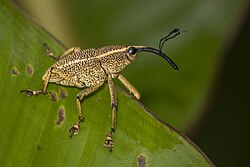
Picture of Curculionidae
- Source
- Wikipedia/Commons
- Credit
- Charles J. Sharp
- Licence
- CC BY-SA 4.0
- Commercial use
- the licence allows it
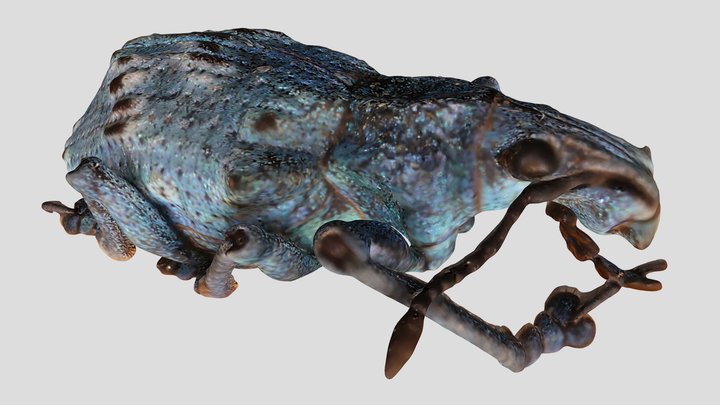
3D model
- Source
- Sketchfab
- Credit
- Yale Peabody Museum
- Licence
- CC Attribution
- Commercial use
- cannot be read from the licence given — check the record
Smithsonian Open Access and MorphoSource were not reached for this taxon, so this list is what the others held rather than everything there is.
The description on this site
- Licence
- CC BY-SA 4.0
This is what the site found, which is not the same as what exists.
Keep going
What may have been alongside itCurculionoidea through timeFormations of the PleistoceneThe world it lived on
Occurrence data from the Paleobiology Database, CC BY 4.0. Latreille 1802