Cerambycidae

Uncredited · via Wikidata/Commons. May be a photograph of a specimen, or an artist’s reconstruction — an interpretation of a skeleton, since colour and soft tissue are almost never preserved.
On record
Recorded, not inferred- Also called
- longhorned beetlePBDB
- Sits inside
- ChrysomeloideaPBDB
- Motility
- actively mobilePBDB, for Arthropoda
- Environment
- terrestrialPBDB, for Insecta
Time the record covers
At least 145 million years on record.
The record covers at least 145.06 Mya to 11.7 ka. No occurrence read is dated outside 149.2 Mya to 0 Mya.
232 occurrences of Cerambycidae on record, most of them in the Eocene. The Paleobiology Database records this as a living group. Bar height is expected occurrences, not a count: each fossil is spread across the span it is dated to, so a tall narrow bar means tight dating and a low wide one means loose.
When
232 occurrences- Late Jurassicunder 1%
- Early Cretaceousunder 1%
- Late Cretaceousunder 1%
- Paleocene5%
- Eocene45%
- Oligocene8%
- Miocene30%
- Pliocene6%
- Pleistocene2%
- Holocene3%
These are dates about fossils, not the animal: the record can only begin after it arose and end before it died out, so either end may reach further. Shares are expected occurrences: a fossil dated to a span is counted partly in each period it straddles. More on what this infers.
Found in
20 formations
- Shanwang Formation38
- Florissant Formation34
- Upper Freshwater-Molasse Formation12
- Rott Formation11
- Eifel Formation10
- Menat Formation9
Loading coastlines…
The named rock units Cerambycidae has been recovered from, largest first. Drawn where the rock is now, not where it formed. 99 occurrences have no formation on record, which is common for older literature.
Cerambycidae and its relatives
EoceneWhere Cerambycidae and its relatives were recorded in the Eocene.
Found in the same rock
3,958 taxa- Coleoptera8 sites
- Curculionidae8 sites
- Lygaeidae7 sites
- Apioninae6 sites
- Tettigoniidae6 sites
- Aphaenogaster mayri5 sites
- Apidae5 sites
- Araneae5 sites
- Archaea paradoxa5 sites
- Buprestinae5 sites
- Buprestis5 sites
- Calosoma maderae5 sites
- Carabidae5 sites
- Coraebini5 sites
- Curculionini5 sites
- Gesomyrmex hoernesi5 sites
- Limois shanwangensis5 sites
- Liometopum miocenicum5 sites
- Miomyrmex impactus5 sites
- Protazteca elongata5 sites
- Scarabaeoidea5 sites
- Anisoptera4 sites
- Anomala furva4 sites
- Balticophasma4 sites
The Paleobiology Database records 89 sites for Cerambycidae, and this reads all of them. Of that, one read hit the database's own return limit, so every count below is a floor rather than a total. The number is how many of those sites it was catalogued from too. The 24 sharing the most are listed.
This is not a list of everything alive at the time. It is only what has come out of the same ground as this animal and been written down.
Entered from
106 references- Zhang et al., 199418
- Zhang, 198917
- New Miocene Coleoptera from Florissant11
- Systematik, Phylogenie, Taphonomie und Paläoökologie der Insekten aus dem Mittel-Eozän des Eckfelder Maares, Vulkaneifel10
- Die Bockkäfer (Cerambycidae) von Willershausen10
- Coleoptera Longicornia aus der Berentschen Bernsteinsammlung10
- Heer, 18647
- Six new fossil Cerambycids included in Baltic and Saxon amber (Coleoptera Cerambycidae)6
- Piton, 19406
- Fünf neue fossile Cerambyciden-Arten aus den mitteloligocänen Ablagerungen von Rott am Siebengebirge5
- Twenty new Coleoptera from the Florissant Shales5
- New and little-known Lepturinae from succinite (Coleoptera Cerambycidae)4
Each of the 232 occurrences read was entered from one of these publications, ordered by how many each accounts for. This is not a search for papers mentioning the name. 94 further references are not listed. Entries link to doi.org where the Paleobiology Database holds an identifier, and to its own record where it does not. Relayed as the Paleobiology Database holds them, not checked against what they resolve to.
Media and terms
Media content2
Picture of Cerambycidae
- Source
- Wikidata/Commons
- Credit
- nobody named on the record
- Licence
- not stated by the source
- Commercial use
- cannot be read from the licence given — check the record
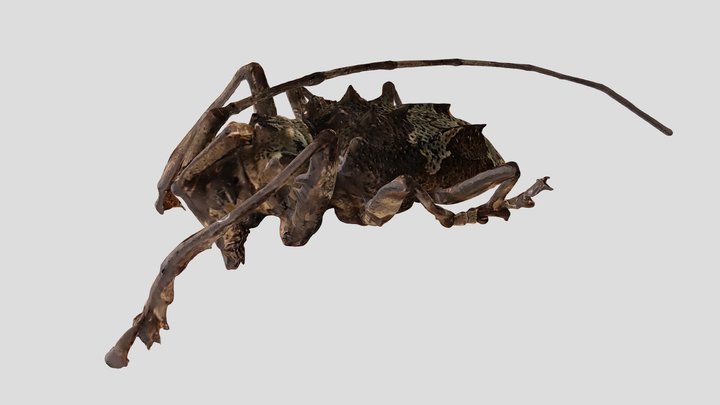
3D model
- Source
- Sketchfab
- Credit
- Yale Peabody Museum
- Licence
- CC Attribution
- Commercial use
- cannot be read from the licence given — check the record
Smithsonian Open Access and MorphoSource were not reached for this taxon, so this list is what the others held rather than everything there is.
This is what the site found, which is not the same as what exists.
Keep going
What may have been alongside itChrysomeloidea through timeFormations of the EoceneThe world it lived on
Occurrence data from the Paleobiology Database, CC BY 4.0. Latreille 1802