Centropomus
Centropomus is a genus of predominantly marine fish comprising the family Centropomidae. The type species is Centropomus undecimalis, the common snook. Commonly known as snooks or róbalos, the Centropomus species are native to tropical and subtropical waters of the western Atlantic and eastern Pacific Oceans.

Uncredited · Public Domain · via Wikipedia/Commons. May be a photograph of a specimen, or an artist’s reconstruction — an interpretation of a skeleton, since colour and soft tissue are almost never preserved.
On record
Recorded, not inferred- Sits inside
- CentropomidaePBDB
- Motility
- actively mobilePBDB, for Osteichthyes
Time the record covers
At least 25 million years on record.
The record covers at least 27.3 Mya to 1.8 Mya. No occurrence read is dated outside 33.9 Mya to 774 ka.
10 occurrences of Centropomus on record, most of them in the Miocene. The Paleobiology Database records this as a living group, and the chart stops with its fossils rather than at the present. Bar height is expected occurrences, not a count: each fossil is spread across the span it is dated to, so a tall narrow bar means tight dating and a low wide one means loose.
When
10 occurrences- Oligocene10%
- Miocene49%
- Pliocene18%
- Pleistocene24%
These are dates about fossils, not the animal: the record can only begin after it arose and end before it died out, so either end may reach further. Shares are expected occurrences: a fossil dated to a span is counted partly in each period it straddles. More on what this infers.
Found in
7 formations
- Bermont Formation2
- Bahía Inglesa Formation2
- Fleming Formation1
- Tamiami Formation1
- Alachua Formation1
- Alzey Formation1
Loading coastlines…
The named rock units Centropomus has been recovered from, largest first. Drawn where the rock is now, not where it formed. 1 occurrence has no formation on record, which is common for older literature.
Centropomus and its relatives
MioceneWhere Centropomus and its relatives were recorded in the Miocene.
Found in the same rock
652 taxa- Lepisosteus5 sites
- Atractosteus spatula4 sites
- Pogonias cromis4 sites
- Siren4 sites
- Alligator mississippiensis3 sites
- Carcharhinus leucas3 sites
- Carcharias taurus3 sites
- Carcharodon hastalis3 sites
- Dasyatis3 sites
- Dasypus bellus3 sites
- Equus3 sites
- Galeocerdo cuvier3 sites
- Geochelone3 sites
- Hemiauchenia macrocephala3 sites
- Hemipristis serra3 sites
- Kinosternon3 sites
- Labridae3 sites
- Macrochelys temminckii3 sites
- Negaprion brevirostris3 sites
- Nerodia3 sites
- Pristis3 sites
- Pseudemys3 sites
- Rana3 sites
- Rhynchobatus3 sites
The Paleobiology Database records 10 sites for Centropomus, and this reads all of them. The number is how many of those sites it was catalogued from too. The 24 sharing the most are listed.
This is not a list of everything alive at the time. It is only what has come out of the same ground as this animal and been written down.
Entered from
9 references- Neogene bony fishes from the Bahia Inglesa Formation, northern Chile2
- Die Alzey-Formation der klassichen Lokalitat Wlschberg bei Waldbockelheim (Rupelium, Oligozan, Mainzer Becken) - Ergebnisse neuer Grabungen1
- Giant-toothed White Sharks and Wide-toothed Mako (Lamnidae) from the Venezuela Neogene: Their Role in the Caribbean, Shallow-water Fish Assemblage1
- Chondrichthyes and Osteichthyes from the early Pleistocene Leisey Shell Pit local fauna, Hillsborough County, Florida1
- Lower vertebrates from an Arikareean (earliest Miocene) fauna near the Toledo Bend Dam, Newton County, Texas1
- Stratigraphy, paleoecology, and vertebrate fauna of the Leisey Shell Pit Local Fauna, early Pleistocene (Irvingtonian) of southwestern Florida1
- A new Cormohipparion (Mammalia, Equidae) from the Pliocene (latest Hemphillian and Blancan) of Florida1
- Fossil herons (Aves: Ardeidae) of the late Miocene and early Pliocene of Florida1
- Geology and paleontology of the Love Bone Bed from the Late Miocene of Florida1
Each of the 10 occurrences read was entered from one of these publications, ordered by how many each accounts for. This is not a search for papers mentioning the name. Entries link to doi.org where the Paleobiology Database holds an identifier, and to its own record where it does not. Relayed as the Paleobiology Database holds them, not checked against what they resolve to.
Media and terms
Media content1
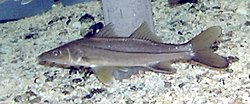
Picture of Centropomus
- Source
- Wikipedia/Commons
- Credit
- nobody named on the record
- Licence
- Public Domain
- Commercial use
- the licence allows it
No 3D scan of Centropomus was found in Smithsonian Open Access and Sketchfab.
MorphoSource was not reached for this taxon, so this list is what the others held rather than everything there is.
The description on this site
- Source
- Wikipedia, “Centropomus”
- Licence
- CC BY-SA 4.0
This is what the site found, which is not the same as what exists.
Keep going
What may have been alongside itCentropomidae through timeFormations of the MioceneThe world it lived on
Occurrence data from the Paleobiology Database, CC BY 4.0. Lacépède 1802