Negaprion brevirostris
The lemon shark is a species of requiem shark from the family Carcharhinidae, known for its yellowish skin, which inspires its common name.

Albert Kok ( talk ) · CC BY-SA 3.0 · via Wikipedia/Commons. May be a photograph of a specimen, or an artist’s reconstruction — an interpretation of a skeleton, since colour and soft tissue are almost never preserved.
On record
Recorded, not inferred- Also called
- lemon sharkPBDB
- Sits inside
- NegaprionPBDB
- Diet
- carnivorePBDB, for Carcharhiniformes
- Life habit
- nektonicPBDB, for Carcharhiniformes
- Motility
- actively mobilePBDB, for Carcharhiniformes
Time the record covers
At least 20 million years on record.
The record covers at least 20.45 Mya to 11.7 ka. No occurrence read is dated outside 23.04 Mya to 0 Mya.
58 occurrences of Negaprion brevirostris on record, most of them in the Miocene. The Paleobiology Database records this as a living group. Bar height is expected occurrences, not a count: each fossil is spread across the span it is dated to, so a tall narrow bar means tight dating and a low wide one means loose.
When
58 occurrences- Miocene71%
- Pliocene17%
- Pleistocene9%
- Holocene3%
These are dates about fossils, not the animal: the record can only begin after it arose and end before it died out, so either end may reach further. Shares are expected occurrences: a fossil dated to a span is counted partly in each period it straddles. More on what this infers.
Found in
24 formations
- Gatun Formation8
- Urumaco Formation6
- Statenville Formation4
- Tamiami Formation2
- Alachua Formation2
- Bermont Formation2
Loading coastlines…
The named rock units Negaprion brevirostris has been recovered from, largest first. Drawn where the rock is now, not where it formed. 11 occurrences have no formation on record, which is common for older literature.
Negaprion brevirostris and its relatives
MioceneWhere Negaprion brevirostris and its relatives were recorded in the Miocene.
Found in the same rock
1,146 taxa- Hemipristis serra42 sites
- Carcharhinus37 sites
- Otodus megalodon33 sites
- Carcharhinus leucas29 sites
- Galeocerdo cuvier27 sites
- Carcharias taurus25 sites
- Carcharodon hastalis21 sites
- Myliobatis20 sites
- Carcharodon carcharias16 sites
- Isurus oxyrinchus16 sites
- Carcharhinus obscurus15 sites
- Aetobatus narinari14 sites
- Pristis14 sites
- Physogaleus contortus13 sites
- Galeocerdo aduncus12 sites
- Rhizoprionodon12 sites
- Sphyrna zygaena12 sites
- Rhinoptera11 sites
- Aetobatus10 sites
- Carcharhinus plumbeus10 sites
- Pogonias cromis10 sites
- Carcharhinus brachyurus9 sites
- Rhynchobatus8 sites
- Sphyraena barracuda8 sites
The Paleobiology Database records 53 sites for Negaprion brevirostris, and this reads all of them. The number is how many of those sites it was catalogued from too. The 24 sharing the most are listed.
This is not a list of everything alive at the time. It is only what has come out of the same ground as this animal and been written down.
Entered from
30 references- Sawfishes and other elasmobranch assemblages from the Mio-Pliocene of the south Caribbean (Urumaco sequence, northwestern Venezuela)8
- Carcharocles megalodon unpublished collections from Natural History Museums around the world8
- Sharks and Rays (Chondrichthyes, Elasmobranchii) from the late Miocene Gatun Formation of Panama8
- Faunes ichthyologiques du Néogène supérieur d'Angola, leur âge, remarques sur le Pliocène marin en Afrique australe3
- South Brazil pre-colonial sharks: insights into biodiversity and species distributions2
- Lamniform and Carcharhiniform Sharks from the Pungo River and Yorktown Formations (Miocene-Pliocene) of the submerged continental shelf, Onslow Bay, North Carolina, USA2
- Late Miocene chondrichthyans from Lago Bayano, Panama: Functional diversity, environment and biogeography2
- The Neogene sharks, rays, and bony fishes from Lee Creek Mine, Aurora, North Carolina2
- Pleistocene (Rancholabrean) vertebrate faunas from coastal Georgia2
- The early Miocene elasmobranch assemblage from Zamaca (Chilcatay T Formation, Peru)1
- Taphonomy and palaeoecology of the lower Miocene marine vertebrate assemblage of Ullujaya (Chilcatay Formation, East Pisco Basin, southernPeru)1
- The occurrence of early Pleistocene marine fish remains from the Gulf Coast of Mobile County, Alabama, USA1
Each of the 58 occurrences read was entered from one of these publications, ordered by how many each accounts for. This is not a search for papers mentioning the name. 18 further references are not listed. Entries link to doi.org where the Paleobiology Database holds an identifier, and to its own record where it does not. Relayed as the Paleobiology Database holds them, not checked against what they resolve to.
Media and terms
Media content2

Picture of Negaprion brevirostris
- Source
- Wikipedia/Commons
- Credit
- Albert Kok ( talk )
- Licence
- CC BY-SA 3.0
- Commercial use
- the licence allows it
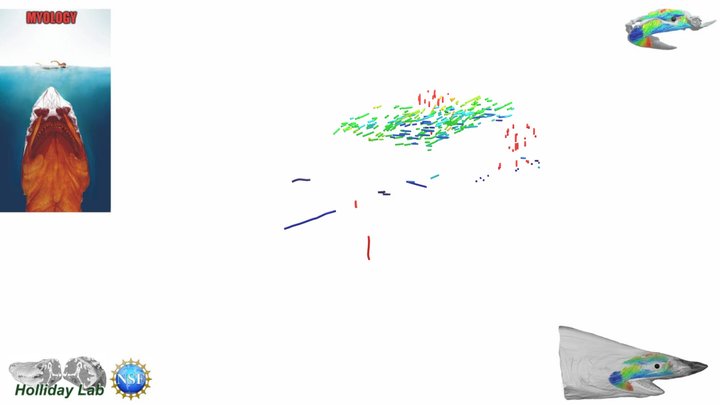
3D model
- Source
- Sketchfab
- Credit
- Holliday Lab
- Licence
- CC Attribution
- Commercial use
- cannot be read from the licence given — check the record
Smithsonian Open Access and MorphoSource were not reached for this taxon, so this list is what the others held rather than everything there is.
The description on this site
- Source
- Wikipedia, “Lemon shark”
- Licence
- CC BY-SA 4.0
This is what the site found, which is not the same as what exists.
Keep going
What may have been alongside itNegaprion through timeFormations of the MioceneThe world it lived on
Occurrence data from the Paleobiology Database, CC BY 4.0. (Poey 1868)