Rana
Rana is a genus of frogs commonly known as the Holarctic true frogs, pond frogs or brown frogs. Members of this genus are found through much of Eurasia and western North America. Many other genera were formerly included here. These true frogs are usually largish species characterized by their slim waists and wrinkled skin; many have thin ridges running along their backs, but they generally lack "warts" as in typical toads. They are excellent jumpers due to their long, slender legs. The typical webbing found on their hind feet allows for easy movement through water. Coloration is mostly greens and browns above, with darker and yellowish spots.

dariusz wozniak · CC BY-SA 3.0 · via Wikipedia/Commons. May be a photograph of a specimen, or an artist’s reconstruction — an interpretation of a skeleton, since colour and soft tissue are almost never preserved.
On record
Recorded, not inferred- Sits inside
- RanidaePBDB
- Diet
- carnivorePBDB, for Temnospondyli
- Life habit
- amphibiousPBDB, for Temnospondyli
- Motility
- actively mobilePBDB, for Temnospondyli
- Environment
- brackish,freshwater,terrestrialPBDB, for Tetrapoda
Time the record covers
At least 41 million years on record.
The record covers at least 41.03 Mya to 11.7 ka. No occurrence read is dated outside 48.07 Mya to 0 Mya.
412 occurrences of Rana on record, most of them in the Pleistocene. The Paleobiology Database records this as a living group. Bar height is expected occurrences, not a count: each fossil is spread across the span it is dated to, so a tall narrow bar means tight dating and a low wide one means loose.
When
412 occurrencesThese are dates about fossils, not the animal: the record can only begin after it arose and end before it died out, so either end may reach further. Shares are expected occurrences: a fossil dated to a span is counted partly in each period it straddles. More on what this infers.
Found in
46 formations
- Alamosa Formation22
- Rexroad Formation10
- Cromer Forest Bed Formation7
- Valentine Formation · Ogallala Group6
- Kingsdown Formation4
- Fleming Formation4
Loading coastlines…
The named rock units Rana has been recovered from, largest first. Drawn where the rock is now, not where it formed. 22 further formations hold fewer occurrences each and are not listed. 298 occurrences have no formation on record, which is common for older literature.
Rana and its relatives
PleistoceneWhere Rana and its relatives were recorded in the Pleistocene.
Found in the same rock
3,067 taxa- Bufo72 sites
- Bufo bufo54 sites
- Equus39 sites
- Lacerta36 sites
- Thamnophis35 sites
- Ambystoma tigrinum31 sites
- Anguis fragilis31 sites
- Natrix natrix30 sites
- Hyla29 sites
- Mimomys27 sites
- Elaphe26 sites
- Microtus24 sites
- Odocoileus virginianus23 sites
- Sorex22 sites
- Colubrinae21 sites
- Elaphe longissima20 sites
- Bufo viridis19 sites
- Emys orbicularis19 sites
- Eumeces19 sites
- Terrapene carolina19 sites
- Beremendia fissidens18 sites
- Chiroptera18 sites
- Natrix18 sites
- Thamnophis sirtalis18 sites
The Paleobiology Database records 303 sites for Rana, and this reads 240 of them. Of that, one read hit the database's own return limit, so every count below is a floor rather than a total. The number is how many of those sites it was catalogued from too. The 24 sharing the most are listed.
This is not a list of everything alive at the time. It is only what has come out of the same ground as this animal and been written down.
Entered from
158 references- Pleistocene Amphibians and Reptiles in Britain and Europe118
- Middle Pleistocene (late Irvingtonian: Nebraskan) climatic changes in south-central Colorado22
- Salientia12
- Pleistocene vertebrate faunas of Hungary12
- Frogs in Hemphillian deposits of Nebraska, with the description of a new species of Bufo6
- The Clark's Cave bone deposit and the Late Pleistocene paleoecology of the central Appalachian Mountains of Virginia6
- New diverse amphibian and reptile assemblages from the late Neogene of northern Greece provide novel insights into the emergence of extant herpetofaunas of the southern Balkans5
- Long-term climate record inferred from early-middle Pleistocene amphibian and squamate reptile assemblages at the Gran Dolina Cave, Atapuerca, Spain5
- A catalogue of late Quaternary vertebrates from California: Part One, nonmarine lower vertebrate and avian taxa5
- Amphibians and reptiles from the late Miocene and early Pliocene of the Ptolemais area (Western Macedonia, Greece)4
- The fossil herpetofauna (Pleistocene; Irvingtonian) of Hamilton Cave, Pendleton County, West Virginia4
- Quaternary vertebrates from Shiriya area, Shimokita Pininsula, northeastern Japan4
Each of the 412 occurrences read was entered from one of these publications, ordered by how many each accounts for. This is not a search for papers mentioning the name. 146 further references are not listed. Entries link to doi.org where the Paleobiology Database holds an identifier, and to its own record where it does not. Relayed as the Paleobiology Database holds them, not checked against what they resolve to.
Media and terms
Media content2

Picture of Rana
- Source
- Wikipedia/Commons
- Credit
- dariusz wozniak
- Licence
- CC BY-SA 3.0
- Commercial use
- the licence allows it
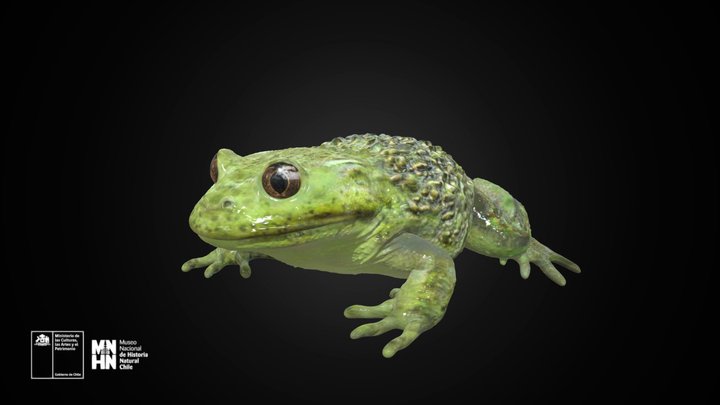
3D model
- Source
- Sketchfab
- Licence
- CC0 Public Domain
- Commercial use
- the licence allows it
Smithsonian Open Access and MorphoSource were not reached for this taxon, so this list is what the others held rather than everything there is.
The description on this site
- Licence
- CC BY-SA 4.0
This is what the site found, which is not the same as what exists.
Keep going
What may have been alongside itRanidae through timeFormations of the PleistoceneThe world it lived on
Occurrence data from the Paleobiology Database, CC BY 4.0. Linnaeus 1758