Colubrinae
The Colubrinae are a subfamily of snakes within the family Colubridae. It includes numerous genera, and although taxonomic sources often disagree on the exact number, the Reptile Database lists 717 species in 92 genera as of September 2019. It is the second largest subfamily of colubrids, after Dipsadinae. Many of the most commonly known snakes are members of this subfamily, including rat snakes, king snakes, milk snakes, vine snakes, and indigo snakes.

Atanas Grozdanov · CC BY 2.5 · via Wikipedia/Commons. May be a photograph of a specimen, or an artist’s reconstruction — an interpretation of a skeleton, since colour and soft tissue are almost never preserved.
On record
Recorded, not inferred- Sits inside
- ColubridaePBDB
- Diet
- carnivorePBDB, for Colubridae
- Life habit
- ground dwellingPBDB, for Colubridae
- Motility
- actively mobilePBDB, for Osteichthyes
- Environment
- terrestrialPBDB, for Amniota
Time the record covers
At least 33 million years on record.
The record covers at least 33.9 Mya to 11.7 ka. No occurrence read is dated outside 37.71 Mya to 0 Mya.
734 occurrences of Colubrinae on record, most of them in the Pleistocene. The Paleobiology Database records this as a living group. Bar height is expected occurrences, not a count: each fossil is spread across the span it is dated to, so a tall narrow bar means tight dating and a low wide one means loose.
When
734 occurrencesThese are dates about fossils, not the animal: the record can only begin after it arose and end before it died out, so either end may reach further. Shares are expected occurrences: a fossil dated to a span is counted partly in each period it straddles. More on what this infers.
Found in
66 formations
- Ash Hollow Formation21
- Kingsdown Formation18
- Valentine Formation · Ogallala Group16
- Rexroad Formation15
- Upper Freshwater Molasse Formation · Molasse Group13
- Arikaree Formation8
Loading coastlines…
The named rock units Colubrinae has been recovered from, largest first. Drawn where the rock is now, not where it formed. 42 further formations hold fewer occurrences each and are not listed. 504 occurrences have no formation on record, which is common for older literature.
Colubrinae and its relatives
PleistoceneWhere Colubrinae and its relatives were recorded in the Pleistocene.
Found in the same rock
3,378 taxa- Rana58 sites
- Thamnophis53 sites
- Bufo50 sites
- Coluber41 sites
- Elaphe41 sites
- Lacerta38 sites
- Ophisaurus34 sites
- Coluber constrictor32 sites
- Lampropeltis getulus31 sites
- Equus30 sites
- Rana pipiens30 sites
- Vipera30 sites
- Hyla28 sites
- Natricinae27 sites
- Natrix26 sites
- Lacertidae24 sites
- Eumeces23 sites
- Nerodia23 sites
- Sorex23 sites
- Crotalus22 sites
- Serpentes22 sites
- Pituophis21 sites
- Geochelone20 sites
- Heterodon platyrhinos20 sites
The Paleobiology Database records 362 sites for Colubrinae, and this reads 240 of them. The number is how many of those sites it was catalogued from too. The 24 sharing the most are listed.
This is not a list of everything alive at the time. It is only what has come out of the same ground as this animal and been written down.
Entered from
211 references- Pleistocene Amphibians and Reptiles in Britain and Europe52
- A succession of Pliocene and Pleistocene snake faunas from the High Plains of the United States45
- Fossil snakes from Poland25
- Hemphillian (late Miocene) snakes from Nebraska, with comments on Arikareean through Blancan snakes of midcontinental North America22
- A review of Neogene and Quaternary snakes of Central and Eastern Europe. Part I: Scolecophidia, Boidae, Colubrinae14
- Late Miocene snakes (Reptilia: Serpentes) form Polgárdi (Hungary): a second contribution13
- The fossil snakes of Florida13
- Fossil snake assemblages from the French Middle Miocene localities at La Grive (France)11
- Sabertooth cat, Smilodon floridanus (Leidy), and associated fauna from a Tennessee Cave (40 Dv 40), the First American Bank site11
- Fossil snakes of the Clarendonian (late Miocene) Pratt Slide local fauna of Nebraska, with the description of a new natricine colubrid10
- Anurans and squamates from the Lower Pliocene (MN 14) Osztramos 1 locality (Northern Hungary)10
- Pleistocene snakes of the Ozark Plateau10
Each of the 734 occurrences read was entered from one of these publications, ordered by how many each accounts for. This is not a search for papers mentioning the name. 199 further references are not listed. Entries link to doi.org where the Paleobiology Database holds an identifier, and to its own record where it does not. Relayed as the Paleobiology Database holds them, not checked against what they resolve to.
Media and terms
Media content1
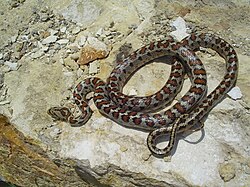
Picture of Colubrinae
- Source
- Wikipedia/Commons
- Credit
- Atanas Grozdanov
- Licence
- CC BY 2.5
- Commercial use
- the licence allows it
No 3D scan was found. Smithsonian Open Access, MorphoSource and Sketchfab were all searched.
The description on this site
- Source
- Wikipedia, “Colubrinae”
- Licence
- CC BY-SA 4.0
This is what the site found, which is not the same as what exists.
Keep going
What may have been alongside itColubridae through timeFormations of the PleistoceneThe world it lived on
Occurrence data from the Paleobiology Database, CC BY 4.0. (Oppel 1811)