Natrix
Natrix is a genus of Old World snakes found mainly across Eurasia in the subfamily Natricinae of the family Colubridae. They are commonly called grass snakes and water snakes, but some other snake species also known commonly as "grass snakes" and "water snakes" are not in the genus.

No machine-readable author provided. Fafner assumed (based on copyright claims). · CC BY-SA 3.0 · via Wikipedia/Commons. May be a photograph of a specimen, or an artist’s reconstruction — an interpretation of a skeleton, since colour and soft tissue are almost never preserved.
On record
Recorded, not inferred- Also called
- water snakePBDB
- Sits inside
- NatricidaePBDB
- Motility
- actively mobilePBDB, for Osteichthyes
- Environment
- terrestrialPBDB, for Amniota
Time the record covers
At least 27 million years on record.
The record covers at least 27.3 Mya to 11.7 ka. No occurrence read is dated outside 37.71 Mya to 0 Mya.
212 occurrences of Natrix on record, most of them in the Pleistocene. The Paleobiology Database records this as a living group. Bar height is expected occurrences, not a count: each fossil is spread across the span it is dated to, so a tall narrow bar means tight dating and a low wide one means loose.
When
212 occurrencesThese are dates about fossils, not the animal: the record can only begin after it arose and end before it died out, so either end may reach further. Shares are expected occurrences: a fossil dated to a span is counted partly in each period it straddles. More on what this infers.
Found in
19 formations
- Choremi Formation5
- Upper Freshwater Molasse Formation · Molasse Group4
- Lefkon Formation4
- Sajovolgyi Formation3
- Prolemais Formation3
- Most Formation2
Loading coastlines…
The named rock units Natrix has been recovered from, largest first. Drawn where the rock is now, not where it formed. 178 occurrences have no formation on record, which is common for older literature.
Natrix and its relatives
PleistoceneWhere Natrix and its relatives were recorded in the Pleistocene.
Found in the same rock
1,740 taxa- Rana63 sites
- Bufo bufo46 sites
- Lacerta45 sites
- Anguis fragilis41 sites
- Lacertidae36 sites
- Vipera36 sites
- Bufo viridis27 sites
- Anura26 sites
- Coluber25 sites
- Colubrinae25 sites
- Elaphe25 sites
- Coronella austriaca24 sites
- Pelobates24 sites
- Serpentes24 sites
- Mimomys23 sites
- Bufo22 sites
- Emys orbicularis22 sites
- Rana temporaria22 sites
- Apodemus21 sites
- Pelophylax21 sites
- Elaphe longissima20 sites
- Ophisaurus20 sites
- Pseudopus18 sites
- Beremendia fissidens17 sites
The Paleobiology Database records 170 sites for Natrix, and this reads all of them. The number is how many of those sites it was catalogued from too. The 24 sharing the most are listed.
This is not a list of everything alive at the time. It is only what has come out of the same ground as this animal and been written down.
Entered from
78 references- Pleistocene Amphibians and Reptiles in Britain and Europe46
- Schlüssel zur Bestimmung der Wirbel süddeutscher Ophidier und dessen Anwendung auf pleistozän/holozänes Reptilmaterial aus dem Euerwanger Bühl (Franken); (Key for the identification of the vertebrae of ophidians and it's use according to reptiles from the Pleistocene/Holocene of Euerwanger Buehl, Franken)17
- Fossil snakes from Poland16
- Fossil snake assemblages from the French Middle Miocene localities at La Grive (France)6
- Amphibians and Squamates from the Miocene of Felsőtárkány Basin, N-Hungary5
- Long-term climate record inferred from early-middle Pleistocene amphibian and squamate reptile assemblages at the Gran Dolina Cave, Atapuerca, Spain5
- Plio-Pleistocene fossil vertebrates of Monte Tuttavista (Orosei, Eastern Sardinia, Italy), an overview5
- Magneto- and cyclostratigraphy and mammal-fauna’s of the Pleistocene lacustrine Megalopolis Basin, Peloponnesos, Greece5
- Amphibians and squamate reptiles from the late Miocene of Fălciu (Eastern Romania)4
- Amphibians and reptiles from the late Miocene and early Pliocene of the Ptolemais area (Western Macedonia, Greece)4
- Biostratigraphy of amphibians, reptiles, birds and mammals in Corsica and the role of man in the Holocene faunal turnover4
- A very diverse amphibian and reptile assemblage from the late Middle Pleistocene of the Sierra de Atapuerca (Sima del Elefante, Burgos, Northwestern Spain)3
Each of the 212 occurrences read was entered from one of these publications, ordered by how many each accounts for. This is not a search for papers mentioning the name. 66 further references are not listed. Entries link to doi.org where the Paleobiology Database holds an identifier, and to its own record where it does not. Relayed as the Paleobiology Database holds them, not checked against what they resolve to.
Media and terms
Media content3
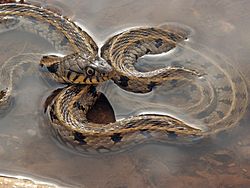
Picture of Natrix
- Source
- Wikipedia/Commons
- Credit
- No machine-readable author provided. Fafner assumed (based on copyright claims).
- Licence
- CC BY-SA 3.0
- Commercial use
- the licence allows it
CT scan
- Source
- MorphoSource
- Licence
- In Copyright
- Commercial use
- cannot be read from the licence given — check the record
- Specimen
- NATRIX NATRIX · UMMZ:Herps:65465
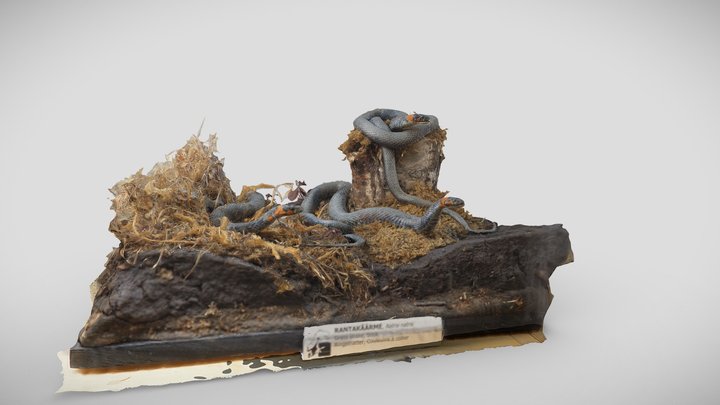
Smithsonian Open Access was not reached for this taxon, so this list is what the others held rather than everything there is.
The description on this site
- Source
- Wikipedia, “Natrix”
- Licence
- CC BY-SA 4.0
This is what the site found, which is not the same as what exists.
Keep going
What may have been alongside itNatricidae through timeFormations of the PleistoceneThe world it lived on
Occurrence data from the Paleobiology Database, CC BY 4.0. Laurenti 1768