Chiroptera
Bats are winged mammals, the only mammals capable of true and sustained flight. Bats are more agile in flight than most birds, using long, spread-out digits covered with a thin membrane or patagium. The smallest bat, and one of the smallest extant mammals, is Kitti's hog-nosed bat, which is 29–33 mm (1.1–1.3 in) in length, 150 mm (5.9 in) across the forearm and 2 g (0.071 oz) in mass. The largest bats are the flying foxes, with the giant golden-crowned flying fox reaching a weight of 1.5 kg (3.3 lb) and having a wingspan of 1.6 m.

PD-USGov, exact author unknown · Public Domain · via Wikipedia/Commons. May be a photograph of a specimen, or an artist’s reconstruction — an interpretation of a skeleton, since colour and soft tissue are almost never preserved.
On record
Recorded, not inferred- Also called
- batPBDB
- Sits inside
- PlacentaliaPBDB
- Diet
- insectivorePBDB
- Life habit
- volantPBDB
- Motility
- actively mobilePBDB, for Osteichthyes
- Environment
- terrestrialPBDB
Time the record covers
At least 51 million years on record.
The record covers at least 51.1 Mya to 11.7 ka. No occurrence read is dated outside 56 Mya to 0 Mya.
1,707 occurrences of Chiroptera on record, most of them in the Pleistocene. The Paleobiology Database records this as a living group. Bar height is expected occurrences, not a count: each fossil is spread across the span it is dated to, so a tall narrow bar means tight dating and a low wide one means loose.
When
1,707 occurrencesThese are dates about fossils, not the animal: the record can only begin after it arose and end before it died out, so either end may reach further. Shares are expected occurrences: a fossil dated to a span is counted partly in each period it straddles. More on what this infers.
Found in
139 formations
- Villavieja Formation · Honda Group21
- Perrière Formation20
- Makapansgat Formation13
- Chambi Formation11
- Cambay Shale Formation10
- Bannockburn Formation · Manuherikia Group9
Loading coastlines…
The named rock units Chiroptera has been recovered from, largest first. Drawn where the rock is now, not where it formed. 115 further formations hold fewer occurrences each and are not listed. 1,328 occurrences have no formation on record, which is common for older literature.
Chiroptera and its relatives
PleistoceneWhere Chiroptera and its relatives were recorded in the Pleistocene.
Found in the same rock
4,131 taxa- Equus53 sites
- Mimomys43 sites
- Myotis42 sites
- Beremendia fissidens37 sites
- Microtus36 sites
- Crocidura31 sites
- Lepus31 sites
- Myodes30 sites
- Allocricetus29 sites
- Pliomys28 sites
- Apodemus sylvaticus26 sites
- Rana26 sites
- Soricidae26 sites
- Aves25 sites
- Petenyia hungarica25 sites
- Sciurus25 sites
- Talpa fossilis25 sites
- Apodemus24 sites
- Sorex minutus24 sites
- Mustela palermina23 sites
- Leporidae21 sites
- Sorex21 sites
- Spermophilus21 sites
- Allophaiomys pliocaenicus20 sites
The Paleobiology Database records 710 sites for Chiroptera, and this reads 240 of them. The number is how many of those sites it was catalogued from too. The 24 sharing the most are listed.
This is not a list of everything alive at the time. It is only what has come out of the same ground as this animal and been written down.
Entered from
481 references- Pleistocene vertebrate faunas of Hungary72
- Density, Productivity, and Distribution of Mammals in Two Venezuelan Habitats39
- Fauna de mamíferos do Quaternário de Serra da Mesa (Goiás, Brasil)34
- Les nouvelles faunes de vertebres anterieurs a la "Grande Coupure" decouvertes dans les phosphorites du Quercy34
- Quaternary vertebrate localities of Virginia and their avian and mammalian fauna31
- Mittelpleistozane Saugetierfaunen aus Mitteleuropa - der Versuch einer biostratigraphischen Zuordnung29
- Understanding the biogeography of Western European bats: the latest Pleistocene to Middle Holocene assemblage of El Mirador site (Sierra de Atapuerca, Spain)24
- Late Quaternary terrestrial vertebrates from Palawan Islad, Philippines23
- Late Quaternary fossil vertebrates from the Cayman Islands23
- A preliminary report on a micromammalian assemblage from the hominoid locality of Lufeng, Yunnan18
- Huanglong Cave: A Late Pleistocene human fossil site in Hubei Province, China15
- A newly discovered Gigantopithecus fauna from Sanhe Cave, Chongzuo, Guangxi, South China15
Each of the 1,707 occurrences read was entered from one of these publications, ordered by how many each accounts for. This is not a search for papers mentioning the name. 469 further references are not listed. Entries link to doi.org where the Paleobiology Database holds an identifier, and to its own record where it does not. Relayed as the Paleobiology Database holds them, not checked against what they resolve to.
Media and terms
Media content2

Picture of Chiroptera
- Source
- Wikipedia/Commons
- Credit
- PD-USGov, exact author unknown
- Licence
- Public Domain
- Commercial use
- the licence allows it
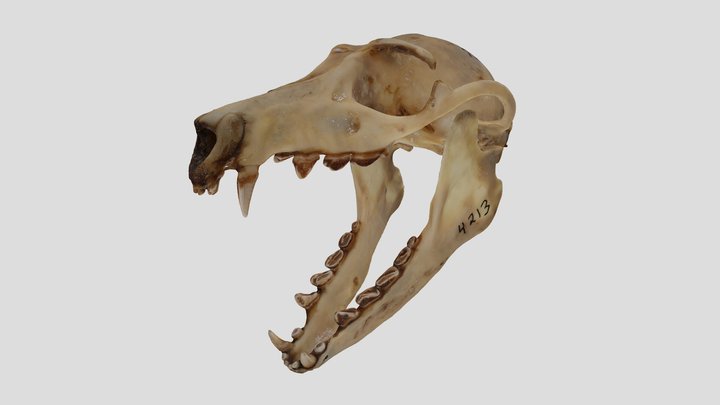
3D model
- Source
- Sketchfab
- Credit
- Yale Peabody Museum
- Licence
- CC Attribution
- Commercial use
- cannot be read from the licence given — check the record
Smithsonian Open Access and MorphoSource were not reached for this taxon, so this list is what the others held rather than everything there is.
The description on this site
- Source
- Wikipedia, “Bat”
- Licence
- CC BY-SA 4.0
This is what the site found, which is not the same as what exists.
Keep going
What may have been alongside itPlacentalia through timeFormations of the PleistoceneThe world it lived on
Occurrence data from the Paleobiology Database, CC BY 4.0. (Blumenbach 1779)