Lepus
Hares are mammals belonging to the genus Lepus. They are herbivores and live solitarily or in pairs. They nest in depressions in the ground called forms, and their young are able to fend for themselves shortly after birth. The genus includes the largest lagomorphs. Most are fast runners with long, powerful hind legs, and large ears that dissipate body heat. Hare species are native to Africa, Eurasia and North America. A hare less than one year old is called a leveret. A group of hares may be called either a husk or a down.

Bernard DUPONT from FRANCE · CC BY-SA 2.0 · via Wikipedia/Commons. May be a photograph of a specimen, or an artist’s reconstruction — an interpretation of a skeleton, since colour and soft tissue are almost never preserved.
On record
Recorded, not inferred- Also called
- harePBDB
- Sits inside
- LeporinaePBDB
- Diet
- grazer, browserPBDB, for Leporidae
- Life habit
- ground dwellingPBDB, for Leporidae
- Motility
- actively mobilePBDB, for Osteichthyes
- Environment
- terrestrialPBDB, for Eutheria
Time the record covers
At least 7.2 million years on record.
The record covers at least 7.246 Mya to 11.7 ka. No occurrence read is dated outside 23.04 Mya to 0 Mya.
378 occurrences of Lepus on record, most of them in the Pleistocene. The Paleobiology Database records this as a living group. Bar height is expected occurrences, not a count: each fossil is spread across the span it is dated to, so a tall narrow bar means tight dating and a low wide one means loose.
When
378 occurrences- Miocene2%
- Pliocene3%
- Pleistocene72%
- Holocene22%
These are dates about fossils, not the animal: the record can only begin after it arose and end before it died out, so either end may reach further. Shares are expected occurrences: a fossil dated to a span is counted partly in each period it straddles. More on what this infers.
Found in
42 formations
- "unnamed sandstone" Formation5
- Shungura Formation · Omo Group5
- Kingsdown Formation4
- Nubia Formation4
- Palm Spring Formation2
- San Timoteo Formation2
Loading coastlines…
The named rock units Lepus has been recovered from, largest first. Drawn where the rock is now, not where it formed. 18 further formations hold fewer occurrences each and are not listed. 309 occurrences have no formation on record, which is common for older literature.
Lepus and its relatives
PleistoceneWhere Lepus and its relatives were recorded in the Pleistocene.
Found in the same rock
1,882 taxa- Equus94 sites
- Microtus64 sites
- Myodes38 sites
- Bovidae36 sites
- Pliomys34 sites
- Sylvilagus34 sites
- Mimomys33 sites
- Apodemus sylvaticus32 sites
- Sorex31 sites
- Allocricetus30 sites
- Canis lupus29 sites
- Cricetus cricetus29 sites
- Neotoma29 sites
- Bison28 sites
- Canis latrans28 sites
- Cervus27 sites
- Crocidura27 sites
- Panthera pardus27 sites
- Spermophilus26 sites
- Thomomys26 sites
- Vulpes vulpes26 sites
- Canis25 sites
- Peromyscus25 sites
- Alcelaphus buselaphus23 sites
The Paleobiology Database records 354 sites for Lepus, and this reads 240 of them. The number is how many of those sites it was catalogued from too. The 24 sharing the most are listed.
This is not a list of everything alive at the time. It is only what has come out of the same ground as this animal and been written down.
Entered from
216 references- The Northernmost Ruins of the Globe18
- I giacimenti Quaternari di vertebrati fossili nell'Italia Nord-Orientale15
- Polar bear fossil and archaeological records from the Pleistocene and Holocene in relation to sea ice extent and open water polynyas11
- Biochronology of the Pleistocene deposits at Betfia (Bihor, Romania)10
- Mittelpleistozane Saugetierfaunen aus Mitteleuropa - der Versuch einer biostratigraphischen Zuordnung9
- Catalogue of Tertiary Fossil Sites of the Land Mammals in the U.S.S.R.9
- A review of the biostratigraphy of Pliocene and Pleistocene sediments in the Elsinore Fault Zone, Riverside County, California7
- Preliminary taphonomic analyses of the mammalian microfauna.6
- A catalogue of late Quaternary Vertebrates from California: Part Two, Mammals6
- The Latest Villfranchian faunas in Italy - the Pirro Nord local fauna (Apricena, Gargano)5
- Wendorf and Schild, 19765
- Geologic history, stratigraphy, and paleontology of SAM Cave, north-central New Mexico4
Each of the 378 occurrences read was entered from one of these publications, ordered by how many each accounts for. This is not a search for papers mentioning the name. 204 further references are not listed. Entries link to doi.org where the Paleobiology Database holds an identifier, and to its own record where it does not. Relayed as the Paleobiology Database holds them, not checked against what they resolve to.
Media and terms
Media content3
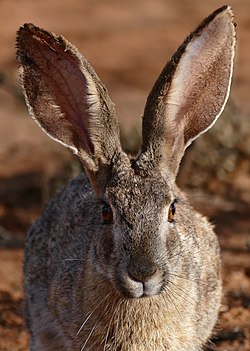
Picture of Lepus
- Source
- Wikipedia/Commons
- Credit
- Bernard DUPONT from FRANCE
- Licence
- CC BY-SA 2.0
- Commercial use
- the licence allows it
CT scan
- Source
- MorphoSource
- Credit
- No Organization
- Licence
- not stated by the source
- Commercial use
- cannot be read from the licence given — check the record
- Specimen
- Lepus timidus · none:none
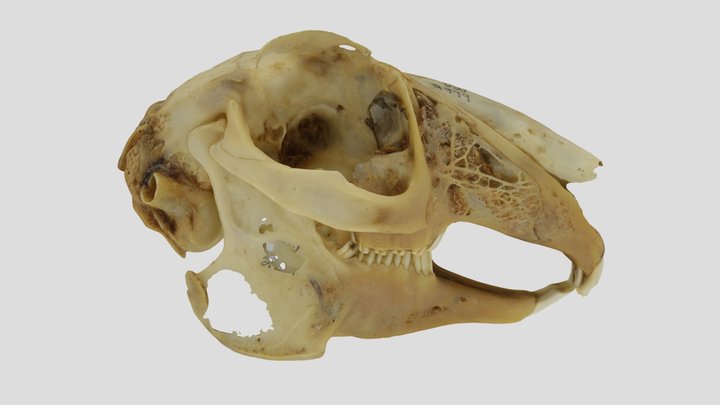
3D model
- Source
- Sketchfab
- Licence
- CC Attribution
- Commercial use
- cannot be read from the licence given — check the record
The description on this site
- Source
- Wikipedia, “Hare”
- Licence
- CC BY-SA 4.0
This is what the site found, which is not the same as what exists.
Keep going
What may have been alongside itLeporinae through timeFormations of the PleistoceneThe world it lived on
Occurrence data from the Paleobiology Database, CC BY 4.0. Linnaeus 1758