Canis latrans
The coyote is a species of canine also known as the American jackal, prairie wolf, and brush wolf. It is native to North America, and it is smaller than its close relative, the gray wolf, and slightly smaller than the closely related eastern wolf and red wolf. It fills much of the same ecological niche as the golden jackal does in Eurasia but the coyote is generally larger.

Yathin S Krishnappa · CC BY-SA 3.0 · via Wikipedia/Commons. May be a photograph of a specimen, or an artist’s reconstruction — an interpretation of a skeleton, since colour and soft tissue are almost never preserved.
On record
Recorded, not inferred- Also called
- coyotePBDB
- Sits inside
- CanisPBDB
- Diet
- carnivore, omnivorePBDB
- Life habit
- ground dwellingPBDB, for Canidae
- Motility
- actively mobilePBDB, for Osteichthyes
- Environment
- terrestrialPBDB, for Eutheria
- Mass
- 262.5 gWikidata
Time the record covers
At least 1.7 million years on record.
The record covers at least 1.8 Mya to 11.7 ka. No occurrence read is dated outside 4.7 Mya to 0 Mya.
103 occurrences of Canis latrans on record, most of them in the Pleistocene. The Paleobiology Database records this as a living group. Bar height is expected occurrences, not a count: each fossil is spread across the span it is dated to, so a tall narrow bar means tight dating and a low wide one means loose.
When
103 occurrences- Pliocene5%
- Pleistocene91%
- Holocene3%
These are dates about fossils, not the animal: the record can only begin after it arose and end before it died out, so either end may reach further. Shares are expected occurrences: a fossil dated to a span is counted partly in each period it straddles. More on what this infers.
Found in
21 formations
- Palm Spring Formation9
- "unnamed sandstone" Formation3
- Crooked Creek Formation2
- Kingsdown Formation2
- Chapala Formation2
- Wando Formation2
Loading coastlines…
The named rock units Canis latrans has been recovered from, largest first. Drawn where the rock is now, not where it formed. 68 occurrences have no formation on record, which is common for older literature.
Canis latrans and its relatives
PleistoceneWhere Canis latrans and its relatives were recorded in the Pleistocene.
Found in the same rock
1,211 taxa- Equus57 sites
- Aenocyon dirus32 sites
- Camelops28 sites
- Odocoileus28 sites
- Camelops hesternus27 sites
- Paramylodon harlani25 sites
- Sylvilagus25 sites
- Lynx rufus24 sites
- Mammuthus columbi24 sites
- Hemiauchenia23 sites
- Lepus22 sites
- Neotoma22 sites
- Platygonus22 sites
- Peromyscus20 sites
- Thomomys20 sites
- Odocoileus virginianus19 sites
- Taxidea taxus19 sites
- Equus mexicanus17 sites
- Ursus americanus17 sites
- Procyon lotor16 sites
- Puma concolor16 sites
- Smilodon fatalis16 sites
- Dipodomys15 sites
- Microtus15 sites
The Paleobiology Database records 102 sites for Canis latrans, and this reads all of them. The number is how many of those sites it was catalogued from too. The 24 sharing the most are listed.
This is not a list of everything alive at the time. It is only what has come out of the same ground as this animal and been written down.
Entered from
72 references- Biostratigraphy of Blancan and Irvingtonian mammals in the Fish Creek-Vallecito Creek section, southern California, and a review of the Blancan-Irvingtonian boundary9
- Phylogenetic Systematics of the North American Fossil Caninae (Carnivora: Canidae)6
- Synonymies and reidentifications of North American fossil mammals5
- A catalogue of late Quaternary Vertebrates from California: Part Two, Mammals4
- Cenozoic vertebrate biostratigraphy of South Carolina, U.S.A. and additions to the fauna3
- Middle Pleistocene arvicoline rodents and environmental change at 2900-meters elevation, Porcupine Cave, South Park, Colorado3
- North American Quaternary Canis3
- Late Cenozoic fossil mammals from the Chapala rift basin, Jalisco, Mexico2
- Blancan, Irvingtonian, and Rancholabrean(?) land mammal age faunas from western Riverside County, California2
- Pleistocene vertebrates of the Los Angeles basin and vicinity:(exclusive of Rancho La Brea)2
- The Levi Site: a Paleo-Indian campsite in central Texas2
- The fauna of Burnet Cave, Guadalupe Mountains, New Mexico2
Each of the 103 occurrences read was entered from one of these publications, ordered by how many each accounts for. This is not a search for papers mentioning the name. 60 further references are not listed. Entries link to doi.org where the Paleobiology Database holds an identifier, and to its own record where it does not. Relayed as the Paleobiology Database holds them, not checked against what they resolve to.
Media and terms
Media content3

Picture of Canis latrans
- Source
- Wikipedia/Commons
- Credit
- Yathin S Krishnappa
- Licence
- CC BY-SA 3.0
- Commercial use
- the licence allows it
Laser scan
- Source
- MorphoSource
- Licence
- In Copyright
- Commercial use
- cannot be read from the licence given — check the record
- Specimen
- Canis latrans · NMV:Mammalogy:C31314
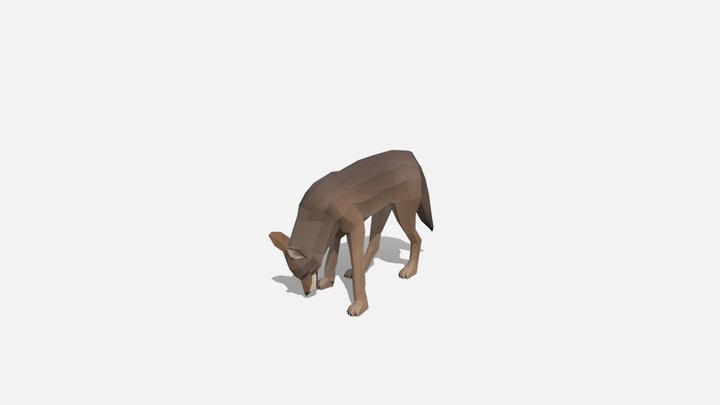
3D model
- Source
- Sketchfab
- Licence
- CC Attribution-NonCommercial-ShareAlike
- Commercial use
- the licence does not allow it
Smithsonian Open Access was not reached for this taxon, so this list is what the others held rather than everything there is.
The description on this site
- Source
- Wikipedia, “Coyote”
- Licence
- CC BY-SA 4.0
This is what the site found, which is not the same as what exists.
Keep going
What may have been alongside itCanis through timeFormations of the PleistoceneThe world it lived on
Occurrence data from the Paleobiology Database, CC BY 4.0. (Say 1823)