Camelops
Camelops is an extinct genus of camel that lived in North and Central America from the middle Pliocene to the end of the Pleistocene. It is more closely related to living camels than to lamines, making it a true camel of the Camelini tribe. Its name is derived from the Ancient Greek κάμηλος and ὄψ, i.e. "camel-face". Camelops lived across Western North America, ranging from the Pacific Coast to the Great Plains, southwards to Honduras and northwards to Alaska. Camelops became extinct as part of the end-Pleistocene extinction event, along with most large mammals across the Americas. The extinctions followed the arrival of humans to the Americas, and evidence has been found indicating that humans butchered Camelops, suggesting that hunting may have been a factor in its extinction.

Jonathan Chen · CC BY-SA 4.0 · via Wikipedia/Commons. May be a photograph of a specimen, or an artist’s reconstruction — an interpretation of a skeleton, since colour and soft tissue are almost never preserved.
On record
Recorded, not inferred- Sits inside
- CameliniPBDB
- Diet
- browser, browserPBDB, for Camelidae
- Life habit
- ground dwellingPBDB, for Camelidae
- Motility
- actively mobilePBDB, for Osteichthyes
- Environment
- terrestrialPBDB, for Artiodactyla
Time the record covers
At least 2.4 million years on record.
The record covers at least 2.58 Mya to 129 ka. No occurrence read is dated outside 4.7 Mya to 0 Mya.
232 occurrences of Camelops on record, most of them in the Pleistocene. Bar height is expected occurrences, not a count: each fossil is spread across the span it is dated to, so a tall narrow bar means tight dating and a low wide one means loose.
When
232 occurrences- Pliocene16%
- Pleistocene84%
- Holoceneunder 1%
These are dates about fossils, not the animal: the record can only begin after it arose and end before it died out, so either end may reach further. Shares are expected occurrences: a fossil dated to a span is counted partly in each period it straddles. More on what this infers.
Found in
41 formations
- Palm Spring Formation19
- St. David Formation7
- Palos Verdes Sand Formation7
- Kingsdown Formation5
- Pauba Formation5
- Gila Conglomerate Formation4
Loading coastlines…
The named rock units Camelops has been recovered from, largest first. Drawn where the rock is now, not where it formed. 17 further formations hold fewer occurrences each and are not listed. 132 occurrences have no formation on record, which is common for older literature.
Camelops and its relatives
PleistoceneWhere Camelops and its relatives were recorded in the Pleistocene.
Found in the same rock
1,211 taxa- Equus130 sites
- Hemiauchenia61 sites
- Odocoileus55 sites
- Canis latrans54 sites
- Mammuthus columbi50 sites
- Platygonus46 sites
- Paramylodon harlani38 sites
- Mammuthus36 sites
- Equus mexicanus35 sites
- Neotoma35 sites
- Sylvilagus35 sites
- Plesippus simplicidens33 sites
- Bison32 sites
- Megalonyx31 sites
- Capromeryx28 sites
- Equus conversidens28 sites
- Perognathinae27 sites
- Thomomys27 sites
- Aenocyon dirus26 sites
- Lepus25 sites
- Peromyscus25 sites
- Dipodomys23 sites
- Sigmodon minor23 sites
- Taxidea taxus23 sites
The Paleobiology Database records 223 sites for Camelops, and this reads all of them. The number is how many of those sites it was catalogued from too. The 24 sharing the most are listed.
This is not a list of everything alive at the time. It is only what has come out of the same ground as this animal and been written down.
Entered from
137 references- Biostratigraphy of Blancan and Irvingtonian mammals in the Fish Creek-Vallecito Creek section, southern California, and a review of the Blancan-Irvingtonian boundary19
- A catalogue of late Quaternary Vertebrates from California: Part Two, Mammals18
- Cenozoic Vertebrate Localities and Faunas in Arizona7
- Synonymies and reidentifications of North American fossil mammals6
- Hintlian, 19756
- Dalquest and Schultz, 19925
- Pleistocene vertebrates of Silicon Valley (Santa Clara County, California)4
- Faunal correlation of Pleistocene deposits in Western Canada4
- Magnetic Polarity Stratigraphy of Pliocene-Pleistocene Terrestrial Deposits and Vertebrate Faunas, San Pedro Valley, Arizona4
- A review of the biostratigraphy of Pliocene and Pleistocene sediments in the Elsinore Fault Zone, Riverside County, California3
- Small mammal fossils and correlation of continental deposits, Safford and Duncan basins, Arizona3
- Biostratigraphy and magnetostratigraphy, late Pliocene rocks, 111 Ranch, Arizona3
Each of the 232 occurrences read was entered from one of these publications, ordered by how many each accounts for. This is not a search for papers mentioning the name. 125 further references are not listed. Entries link to doi.org where the Paleobiology Database holds an identifier, and to its own record where it does not. Relayed as the Paleobiology Database holds them, not checked against what they resolve to.
Media and terms
Media content3

Picture of Camelops
- Source
- Wikipedia/Commons
- Credit
- Jonathan Chen
- Licence
- CC BY-SA 4.0
- Commercial use
- the licence allows it
Structured light scan
- Source
- MorphoSource
- Credit
- LACM Rancho La Brea
- Licence
- In Copyright
- Commercial use
- cannot be read from the licence given — check the record
- Specimen
- Camelops hesternus · LACM:rlb:Z 2683
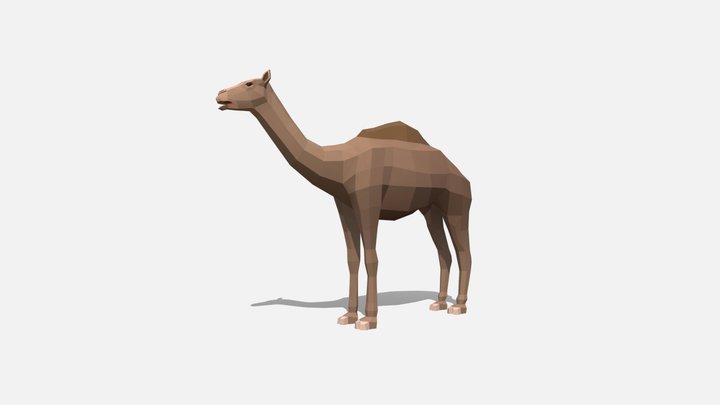
3D model
- Source
- Sketchfab
- Licence
- CC Attribution-NonCommercial-ShareAlike
- Commercial use
- the licence does not allow it
Smithsonian Open Access was not reached for this taxon, so this list is what the others held rather than everything there is.
The description on this site
- Source
- Wikipedia, “Camelops”
- Licence
- CC BY-SA 4.0
This is what the site found, which is not the same as what exists.
Keep going
What may have been alongside itCamelini through timeFormations of the PleistoceneThe world it lived on
Occurrence data from the Paleobiology Database, CC BY 4.0. Leidy 1854