Puma concolor
The cougar, also called puma, mountain lion, catamount, and panther, is a large feline native to the Americas. It inhabits North, Central and South America, making it the most widely distributed wild, terrestrial mammal in the Western Hemisphere, and one of the most widespread in the world. Its range spans Yukon, British Columbia and Alberta in Canada, the Rocky Mountains and areas in the western United States. Further south, its range extends through Mexico to the Amazon rainforest and the southern Andes Mountains in Patagonia. It is an adaptable generalist species, occurring in most American habitat types. It prefers habitats with dense underbrush and rocky areas for stalking but also lives in open areas.

National Park Service · Public Domain · via Wikipedia/Commons. May be a photograph of a specimen, or an artist’s reconstruction — an interpretation of a skeleton, since colour and soft tissue are almost never preserved.
On record
Recorded, not inferred- Also called
- pumaPBDB
- Sits inside
- PumaPBDB
- Diet
- carnivorePBDB, for Puma
- Life habit
- scansorialPBDB, for Felidae
- Motility
- actively mobilePBDB, for Osteichthyes
- Environment
- terrestrialPBDB, for Eutheria
Time the record covers
At least 1.3 million years on record.
The record covers at least 1.4 Mya to 11.7 ka. No occurrence read is dated outside 4.7 Mya to 0 Mya.
56 occurrences of Puma concolor on record, most of them in the Pleistocene. The Paleobiology Database records this as a living group. Bar height is expected occurrences, not a count: each fossil is spread across the span it is dated to, so a tall narrow bar means tight dating and a low wide one means loose.
When
56 occurrences- Pliocene8%
- Pleistocene75%
- Holocene17%
These are dates about fossils, not the animal: the record can only begin after it arose and end before it died out, so either end may reach further. Shares are expected occurrences: a fossil dated to a span is counted partly in each period it straddles. More on what this infers.
Found in
9 formations
- Glenns Ferry Formation3
- Palm Spring Formation3
- Sopas Formation3
- ? Tulare Formation1
- Kingsdown Formation1
- American Falls Lake Bed E Formation1
Loading coastlines…
The named rock units Puma concolor has been recovered from, largest first. Drawn where the rock is now, not where it formed. 41 occurrences have no formation on record, which is common for older literature.
Puma concolor and its relatives
PleistoceneWhere Puma concolor and its relatives were recorded in the Pleistocene.
Found in the same rock
1,009 taxa- Equus21 sites
- Canis latrans16 sites
- Aenocyon dirus15 sites
- Odocoileus virginianus14 sites
- Panthera onca14 sites
- Procyon lotor14 sites
- Lynx rufus13 sites
- Ursus americanus11 sites
- Camelops10 sites
- Odocoileus10 sites
- Hemiauchenia9 sites
- Meleagris gallopavo9 sites
- Urocyon cinereoargenteus9 sites
- Canis lupus8 sites
- Castor canadensis8 sites
- Lepus8 sites
- Mephitis mephitis8 sites
- Nothrotherium shastense8 sites
- Panthera leo atrox8 sites
- Sylvilagus8 sites
- Taxidea taxus8 sites
- Anas platyrhynchos7 sites
- Antilocapra americana7 sites
- Cervus canadensis7 sites
The Paleobiology Database records 54 sites for Puma concolor, and this reads all of them. The number is how many of those sites it was catalogued from too. The 24 sharing the most are listed.
This is not a list of everything alive at the time. It is only what has come out of the same ground as this animal and been written down.
Entered from
47 references- Synonymies and reidentifications of North American fossil mammals7
- The Early Pleistocene (Latest Blancan-Earliest Irvingtonian) Froman Ferry Fauna and History of the Glenns Ferry Formation, Southwestern Idaho3
- Animal remains from Ohio rock shelters2
- Additions to the Pleistocene Mammal Faunas of South Carolina, North Carolina, and Georgia1
- The American Falls local fauna: Late Pleistocene (Sangamonian) vertebrates from southeastern Idaho1
- Asociación cultural con fauna extinguida en el sitio arqueologico Cueva Tixi, provincia de Buenos Aires, Argentina1
- Fossil history of the panther (Puma concolor) and the cheetah-like cat (Miracinonyx inexpectatus) in Florida1
- A new extinct primate among the Pleistocene megafauna of Bahia, Brazil1
- The Eocene to Pleistocene vertebrates of Bolivia and their stratigraphic context: a review1
- Barro Colorado Island and Tropical Biology1
- Central Amazonian Forests and the Minimum Crtical Size of Ecosystems Project1
- An Overview of Research at Cocha Cashu Biological Station1
Each of the 56 occurrences read was entered from one of these publications, ordered by how many each accounts for. This is not a search for papers mentioning the name. 35 further references are not listed. Entries link to doi.org where the Paleobiology Database holds an identifier, and to its own record where it does not. Relayed as the Paleobiology Database holds them, not checked against what they resolve to.
Media and terms
Media content3
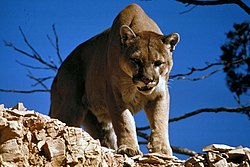
Picture of Puma concolor
- Source
- Wikipedia/Commons
- Credit
- National Park Service
- Licence
- Public Domain
- Commercial use
- the licence allows it
CT scan
- Source
- MorphoSource
- Credit
- Museu Câmara Cascudo
- Licence
- In Copyright
- Commercial use
- cannot be read from the licence given — check the record
- Specimen
- Puma concolor · MCC:MCC:991V
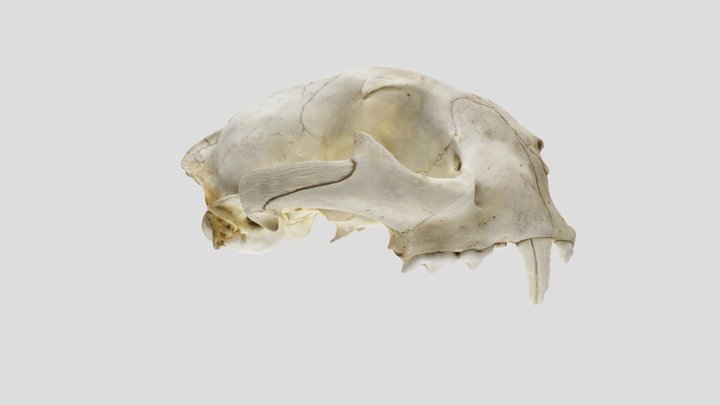
3D model
- Source
- Sketchfab
- Licence
- CC Attribution
- Commercial use
- cannot be read from the licence given — check the record
The description on this site
- Source
- Wikipedia, “Cougar”
- Licence
- CC BY-SA 4.0
This is what the site found, which is not the same as what exists.
Keep going
Everything alive alongside itPuma through timeFormations of the PleistoceneThe world it lived on
Occurrence data from the Paleobiology Database, CC BY 4.0. (Linnaeus 1771)