Cnidaria
Searched as Cnidaria indet.. The Paleobiology Database treats Cnidaria as the accepted name.
Cnidaria is a phylum of animals containing over 11,000 species of aquatic invertebrates found both in freshwater and marine environments, including jellyfish, hydroids, sea anemones, corals and some of the smallest marine parasites. Their distinguishing features are a decentralized nerve net distributed throughout a gelatinous body, and the presence of cnidocytes or cnidoblasts, specialized cells with ejectable organelles used mainly for envenomation and capturing prey. Their bodies consist of mesoglea, a non-living, jelly-like substance, sandwiched between two layers of epithelium that are mostly one cell thick. Many cnidarian species can reproduce both sexually and asexually.

Frédéric Ducarme · CC BY-SA 4.0 · via Wikipedia/Commons. May be a photograph of a specimen, or an artist’s reconstruction — an interpretation of a skeleton, since colour and soft tissue are almost never preserved.
On record
Recorded, not inferred- Sits inside
- AnimaliaPBDB
Time the record covers
At least 536 million years on record.
The record covers at least 538.8 Mya to 2.58 Mya. No occurrence read is dated outside 1000 Mya to 11.7 ka.
57 occurrences of Cnidaria on record, most of them in the Cambrian. The Paleobiology Database records this as a living group. Bar height is expected occurrences, not a count: each fossil is spread across the span it is dated to, so a tall narrow bar means tight dating and a low wide one means loose.
When
57 occurrences- Cambrian21%
- Ordovician5%
- Silurian9%
- Devonian19%
- Carboniferous12%
- Permian2%
- Late Triassic2%
- Early Jurassic2%
- Middle Jurassicunder 1%
- Late Jurassic9%
- Early Cretaceous2%
- Paleocene4%
- Eocene2%
- Oligocene2%
- Miocene2%
- Pleistocene2%
These are dates about fossils, not the animal: the record can only begin after it arose and end before it died out, so either end may reach further. Shares are expected occurrences: a fossil dated to a span is counted partly in each period it straddles. More on what this infers.
Found in
36 formations
- Balang Formation6
- Praha Formation4
- Upper Tului Formation3
- Lodo Formation2
- Road River Formation2
- Doushantuo Formation2
Loading coastlines…
The named rock units Cnidaria has been recovered from, largest first. Drawn where the rock is now, not where it formed. 12 further formations hold fewer occurrences each and are not listed. 7 occurrences have no formation on record, which is common for older literature.
Cnidaria and its relatives
CambrianWhere Cnidaria and its relatives were recorded in the Cambrian.
Found in the same rock
1,948 taxa- Crinoidea88 sites
- Leptaena52 sites
- Rugosa50 sites
- Atrypa48 sites
- Favosites39 sites
- Bryozoa38 sites
- Ostracoda38 sites
- Schuchertella36 sites
- Rhipidomella35 sites
- Lingula33 sites
- Spirifer33 sites
- Hallopora32 sites
- Archaeogastropoda31 sites
- Conularia30 sites
- Camarotoechia29 sites
- Pterinea29 sites
- Isotelus27 sites
- Orbiculoidea27 sites
- Platystrophia27 sites
- Punctospirifer27 sites
- Tentaculites27 sites
- Cornulites26 sites
- Rafinesquina26 sites
- Syringopora26 sites
The Paleobiology Database records at least 865 sites for Cnidaria, and this reads 240 of them. The number is how many of those sites it was catalogued from too. The 24 sharing the most are listed.
This is not a list of everything alive at the time. It is only what has come out of the same ground as this animal and been written down.
Entered from
34 references- A Cambrian soft-bodied biota after the first Phanerozoic mass extinction6
- New data on Carboniferous (Dinantian) trilobites from the Peak District, Derbyshire, England5
- Development of coral–sponge–microbialite reefs in a coated grain‑dominated carbonate ramp (Upper Jurassic, eastern Sardinia, Italy)4
- Nowakia Dacryconarids in the Pragian of the Praha Basin (lower Devonian, Czech Republic)3
- Reconnaissance of the Ordovician and Silurian rocks of Northern Yukon Territory3
- Devonian of the Mechra Ben Abbou region (Rehamna) – new data on the reef succession, microfacies, stratigraphy, and palaeogeography2
- The diverse radiodont fauna from the Marjum Formation of Utah, USA (Cambrian: Drumian)2
- Geología del Área Carrizalillo-El Tofo, Regiones de Atacama y Coquimbo2
- Neoproterozoic to early Cambrian small shelly fossil assemblages and a revised biostratigraphic correlation of the Yangtze Platform (China)2
- New Lutetium-Hafnium and Lead-Lead age constraints on the earliest animal fossils2
- Age, Correlation and Possible Tethyan Affinities of Mollusks from the Lodo Formation of Fresno County, California2
- Unterdevonische Gastropoden aus den Karnischen Alpen2
Each of the 57 occurrences read was entered from one of these publications, ordered by how many each accounts for. This is not a search for papers mentioning the name. 22 further references are not listed. Entries link to doi.org where the Paleobiology Database holds an identifier, and to its own record where it does not. Relayed as the Paleobiology Database holds them, not checked against what they resolve to.
Media and terms
Media content2
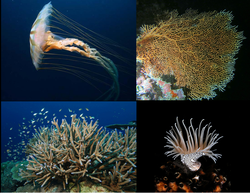
Picture of Cnidaria
- Source
- Wikipedia/Commons
- Credit
- Frédéric Ducarme
- Licence
- CC BY-SA 4.0
- Commercial use
- the licence allows it
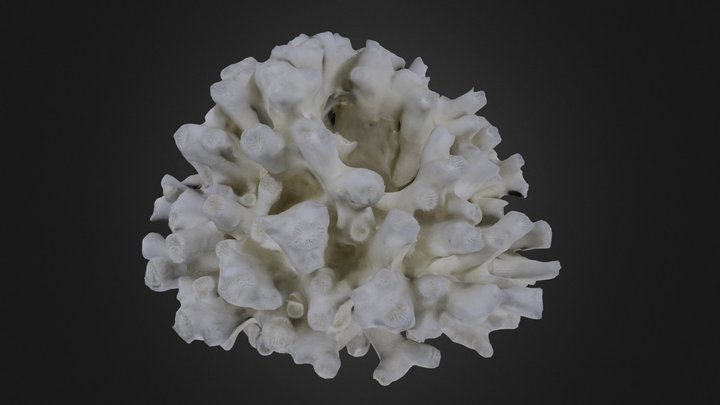
3D model
- Source
- Sketchfab
- Licence
- CC0 Public Domain
- Commercial use
- the licence allows it
Smithsonian Open Access was not reached for this taxon, so this list is what the others held rather than everything there is.
The description on this site
- Source
- Wikipedia, “Cnidaria”
- Licence
- CC BY-SA 4.0
This is what the site found, which is not the same as what exists.
Keep going
What may have been alongside itAnimalia through timeFormations of the CambrianThe world it lived on
Occurrence data from the Paleobiology Database, CC BY 4.0. (Hatschek 1888)