Crinoidea
Crinoids are marine invertebrates that make up the class Crinoidea. Crinoids that remain attached to the sea floor by a stalk in their adult form are commonly called sea lilies, while the unstalked forms, called feather stars or comatulids, are members of the largest crinoid order, Comatulida. Crinoids are echinoderms in the phylum Echinodermata, which also includes the starfish, brittle stars, sea urchins, and sea cucumbers. They live in both shallow water and at depths over 9,000 m (30,000 ft).

Alexander Vasenin · CC BY-SA 3.0 · via Wikipedia/Commons. May be a photograph of a specimen, or an artist’s reconstruction — an interpretation of a skeleton, since colour and soft tissue are almost never preserved.
On record
Recorded, not inferred- Also called
- Sea lilyPBDB
- Sits inside
- BlastozoaPBDB
- Diet
- suspension feederPBDB
- Life habit
- upper-level epifaunalPBDB
- Motility
- stationary, attachedPBDB
- Vision
- blindPBDB
- Environment
- marinePBDB, for Echinodermata
Time the record covers
At least 504 million years on record.
The record covers at least 504.5 Mya to 129 ka. No occurrence read is dated outside 538.8 Mya to 11.7 ka.
12,000+ occurrences of Crinoidea on record. The Paleobiology Database records this as a living group. Bar height is expected occurrences, not a count: each fossil is spread across the span it is dated to, so a tall narrow bar means tight dating and a low wide one means loose.
When
12,000 occurrences read- Cambrianunder 1%
- Ordovician18%
- Silurian13%
- Devonian16%
- Carboniferous29%
- Permian10%
- Early Triassicunder 1%
- Middle Triassic2%
- Late Triassic2%
- Early Jurassic1%
- Middle Jurassic2%
- Late Jurassic1%
- Early Cretaceous2%
- Late Cretaceous2%
- Paleoceneunder 1%
- Eoceneunder 1%
- Oligoceneunder 1%
- Mioceneunder 1%
- Pleistoceneunder 1%
These are dates about fossils, not the animal: the record can only begin after it arose and end before it died out, so either end may reach further. Shares are expected occurrences: a fossil dated to a span is counted partly in each period it straddles. The read hit its cap, so every figure above is a floor and the shares are of the occurrences read. More on what this infers.
Found in
at least 1200 formations
- Edwardsville Formation405
- Fort Payne Formation398
- Kope Formation · Cincinnati Group348
- Bangor Limestone Formation290
- Muldraugh Formation220
- Borden Formation204
Loading coastlines…
The named rock units Crinoidea has been recovered from, largest first. Drawn where the rock is now, not where it formed. The read hit its cap, so each count is a floor. 1,176 further formations hold fewer occurrences each and are not listed. 1,408 occurrences have no formation on record, which is common for older literature.
Found in the same rock
1,588 taxa- Crurithyris61 sites
- Rhombopora60 sites
- Brachiopoda57 sites
- Gastropoda45 sites
- Hallopora43 sites
- Punctospirifer40 sites
- Leptaena38 sites
- Isotelus37 sites
- Rhipidomella36 sites
- Composita34 sites
- Flexicalymene34 sites
- Rafinesquina34 sites
- Hustedia32 sites
- Bryozoa31 sites
- Lingula31 sites
- Platystrophia31 sites
- Ctenodonta30 sites
- Ostracoda29 sites
- Archaeogastropoda28 sites
- Strophomena28 sites
- Zygospira27 sites
- Atrypa26 sites
- Cornulites26 sites
- Ambonychia25 sites
The Paleobiology Database records at least 751 sites for Crinoidea, and this reads 240 of them. The number is how many of those sites it was catalogued from too. The 24 sharing the most are listed.
This is not a list of everything alive at the time. It is only what has come out of the same ground as this animal and been written down.
Entered from
at least 1,185 references- Caradocian-Gedinnian echinoderm associations of Central and Eastern North America846
- Crinoid assemblages from the Fort Payne Formation (late Osagean, early Viséan, Mississippian) from Kentucky, Tennessee, and Alabama490
- Gradient ecology of a biotic invasion: biofacies of the type Cincinnatian Series (Upper Ordovician), Cincinnati, Ohio region, USA407
- Upper Mississippi Valley Champlainian and Cincinnatian echinoderms361
- Community Organization, Paleontology, and Sedimentology of the Lower Mississippian Borden Delta Platform (Edwardsville Formation, Southern Indiana)326
- Filtration models, guilds, and biofacies: crinoid paleoecology of the Stanton Formation (Upper Pennsylvanian), Midcontinent, North America298
- The Paleontology and Paleoecology of the Lower Bangor Limestone (Chesterian, Mississippian)in northwestern Alabama289
- Analysis of sample-level properties along a paleoenvironmental gradient: the behavior of evenness as a function of sample size236
- Ecological restructuring after extinction: the Late Ordovician (Mohawkian) of the eastern United States232
- Paleontology and paleoecology of the Crawfordsville fossil site (Upper Osagian: Indiana)202
- Stratigraphy and Paleontology of the Uppermost Pennsylvanian and Lowermost Permian Rocks in Kansas176
- Lower Pennsylvanian (Morrowan) crinoids from Arkansas, Oklahoma, and Texas144
Each of the 12,000 occurrences read was entered from one of these publications, ordered by how many each accounts for. This is not a search for papers mentioning the name. That read hit its cap, so each count is a floor. 1,173 further references are not listed. Entries link to doi.org where the Paleobiology Database holds an identifier, and to its own record where it does not. Relayed as the Paleobiology Database holds them, not checked against what they resolve to.
Media and terms
Media content2

Picture of Crinoidea
- Source
- Wikipedia/Commons
- Credit
- Alexander Vasenin
- Licence
- CC BY-SA 3.0
- Commercial use
- the licence allows it
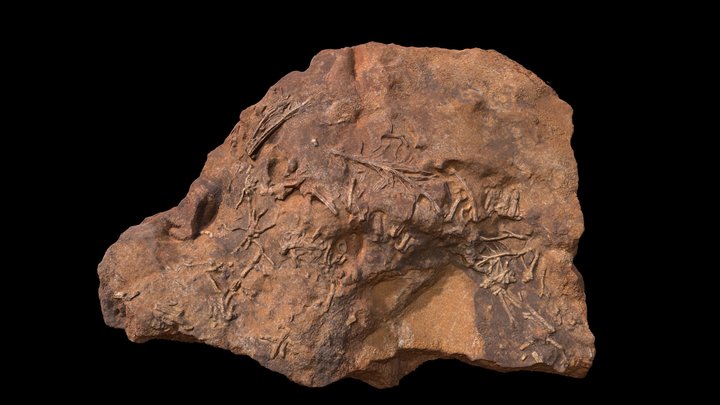
3D model
- Source
- Sketchfab
- Licence
- CC Attribution
- Commercial use
- cannot be read from the licence given — check the record
The description on this site
- Source
- Wikipedia, “Crinoid”
- Licence
- CC BY-SA 4.0
This is what the site found, which is not the same as what exists.
Keep going
What may have been alongside itBlastozoa through timeThe world it lived on
Occurrence data from the Paleobiology Database, CC BY 4.0. Miller 1821