Spiriferida
Spiriferida is an extinct order of brachiopods, known from the Ordovician to the Triassic.

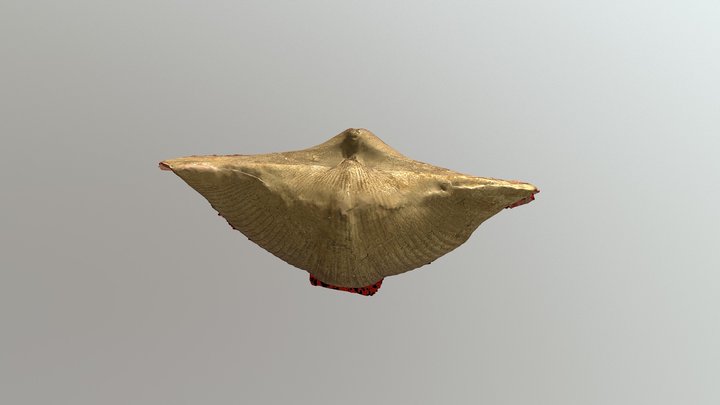
Wilson44691 · CC BY-SA 3.0 · via Wikipedia/Commons. May be a photograph of a specimen, or an artist’s reconstruction — an interpretation of a skeleton, since colour and soft tissue are almost never preserved.
On record
Recorded, not inferred- Sits inside
- RhynchonellataPBDB
- Diet
- suspension feederPBDB
- Life habit
- epifaunalPBDB
- Motility
- stationaryPBDB
- Vision
- blindPBDB, for Rhynchonellata
- Environment
- marinePBDB, for Lophophorata
Time the record covers
At least 274 million years on record.
The record covers at least 458.2 Mya to 184.2 Mya. No occurrence read is dated outside 468 Mya to 161.5 Mya.
12,000+ occurrences of Spiriferida on record. The Paleobiology Database records this as a living group, and the chart stops with its fossils rather than at the present. Bar height is expected occurrences, not a count: each fossil is spread across the span it is dated to, so a tall narrow bar means tight dating and a low wide one means loose.
When
12,000 occurrences read- Ordovicianunder 1%
- Silurian11%
- Devonian46%
- Carboniferous23%
- Permian19%
- Early Triassicunder 1%
- Early Jurassicunder 1%
- Middle Jurassicunder 1%
These are dates about fossils, not the animal: the record can only begin after it arose and end before it died out, so either end may reach further. Shares are expected occurrences: a fossil dated to a span is counted partly in each period it straddles. The read hit its cap, so every figure above is a floor and the shares are of the occurrences read. More on what this infers.
Found in
at least 1125 formations
- Moscow Formation · Hamilton Group446
- Ludlowville Formation · Hamilton Group364
- Skaneateles Formation · Hamilton Group206
- Banff Formation204
- Geneseo Formation · Genesee Group164
- Three Forks Shale Formation123
Loading coastlines…
The named rock units Spiriferida has been recovered from, largest first. Drawn where the rock is now, not where it formed. The read hit its cap, so each count is a floor. 1,101 further formations hold fewer occurrences each and are not listed. 1,370 occurrences have no formation on record, which is common for older literature.
Found in the same rock
1,331 taxa- Crinoidea110 sites
- Crurithyris79 sites
- Brachiopoda58 sites
- Rhombopora58 sites
- Atrypa43 sites
- Punctospirifer43 sites
- Schuchertella42 sites
- Leptaena41 sites
- Rhipidomella41 sites
- Composita37 sites
- Gastropoda36 sites
- Howellella36 sites
- Spirifer36 sites
- Hustedia35 sites
- Bryozoa34 sites
- Derbyia33 sites
- Orbiculoidea32 sites
- Bivalvia31 sites
- Camarotoechia31 sites
- Archaeogastropoda28 sites
- Chonetinella27 sites
- Lingula27 sites
- Crurithyris expansa26 sites
- Platyceras26 sites
The Paleobiology Database records at least 1,057 sites for Spiriferida, and this reads 240 of them. The number is how many of those sites it was catalogued from too. The 24 sharing the most are listed.
This is not a list of everything alive at the time. It is only what has come out of the same ground as this animal and been written down.
Entered from
at least 795 references- Permian Brachiopods of West Texas, VI424
- Using GIS to unlock the interactions between biogeography, environment, and evolution in middle and Late Devonian brachiopods and bivalves348
- Stratigraphy and Paleontology of the Uppermost Pennsylvanian and Lowermost Permian Rocks in Kansas245
- The Dynamics of Rapid, Asynchronous Biotic Turnover in the Middle Devonian Appalachian Basin of New York220
- Lower Carboniferous brachiopods from the Banff Formation of Western Alberta186
- Early Carboniferous brachiopod zones of eastern Australia167
- The classification and distribution of the Hamilton and Chemung series of central and eastern New York166
- Community paleoecology as a geologic tool: the Chinese Ashgillian-Eifelian (latest Ordovician through early Middle Devonian) as an example148
- Devonian sections in Guangxi from which pelecypods were collected147
- Permian Brachiopoda and Mollusca from north-west Nepal142
- Stratigraphy and Paleontology of the Mahantango Formation in south-central Pennsylvania125
- Quantitative community analysis: Recurrent group and cluster techniques applied to the fauna of the Upper Devonian Sonyea Group, New York124
Each of the 12,000 occurrences read was entered from one of these publications, ordered by how many each accounts for. This is not a search for papers mentioning the name. That read hit its cap, so each count is a floor. 783 further references are not listed. Entries link to doi.org where the Paleobiology Database holds an identifier, and to its own record where it does not. Relayed as the Paleobiology Database holds them, not checked against what they resolve to.
Media and terms
Media content2

Picture of Spiriferida
- Source
- Wikipedia/Commons
- Credit
- Wilson44691
- Licence
- CC BY-SA 3.0
- Commercial use
- the licence allows it
Smithsonian Open Access was not reached for this taxon, so this list is what the others held rather than everything there is.
The description on this site
- Source
- Wikipedia, “Spiriferida”
- Licence
- CC BY-SA 4.0
This is what the site found, which is not the same as what exists.
Keep going
What may have been alongside itRhynchonellata through timeThe world it lived on
Occurrence data from the Paleobiology Database, CC BY 4.0. Waagen 1883