Naja
Naja is a genus of venomous elapid snakes commonly known as cobras. Various species occur throughout Africa, Southwest Asia, South Asia, and Southeast Asia. Several other elapid species are often called "cobras", such as the king cobra and the rinkhals, but they are not "true cobras", in that they do not belong to the genus Naja.

Pavan Kumar N · CC BY-SA 3.0 · via Wikipedia/Commons. May be a photograph of a specimen, or an artist’s reconstruction — an interpretation of a skeleton, since colour and soft tissue are almost never preserved.
On record
Recorded, not inferred- Also called
- cobraPBDB
- Sits inside
- ElapidaePBDB
- Diet
- carnivorePBDB, for Elapidae
- Life habit
- ground dwellingPBDB, for Elapidae
- Motility
- actively mobilePBDB, for Osteichthyes
- Environment
- terrestrialPBDB, for Amniota
Time the record covers
At least 15 million years on record.
The record covers at least 15.98 Mya to 129 ka. No occurrence read is dated outside 23.04 Mya to 11.7 ka.
39 occurrences of Naja on record, most of them in the Miocene. The Paleobiology Database records this as a living group. Bar height is expected occurrences, not a count: each fossil is spread across the span it is dated to, so a tall narrow bar means tight dating and a low wide one means loose.
When
39 occurrences- Miocene79%
- Pliocene15%
- Pleistocene6%
These are dates about fossils, not the animal: the record can only begin after it arose and end before it died out, so either end may reach further. Shares are expected occurrences: a fossil dated to a span is counted partly in each period it straddles. More on what this infers.
Found in
9 formations
- Vogel River Series Formation2
- Córcoles Formation2
- Edelény Formation2
- Olduvai Formation1
- Grund Formation1
- Lefkon Formation1
Loading coastlines…
The named rock units Naja has been recovered from, largest first. Drawn where the rock is now, not where it formed. 27 occurrences have no formation on record, which is common for older literature.
Naja and its relatives
MioceneWhere Naja and its relatives were recorded in the Miocene.
Found in the same rock
849 taxa- Vipera13 sites
- Colubrinae10 sites
- Serpentes9 sites
- Varanus9 sites
- Colubridae8 sites
- Natrix8 sites
- Ophisaurus8 sites
- Scolecophidia8 sites
- Lacerta7 sites
- Natricinae7 sites
- Rana7 sites
- Coluber6 sites
- Elapidae6 sites
- Gekkonidae6 sites
- Hipparion6 sites
- Lacertidae6 sites
- Pelobates6 sites
- Scincidae6 sites
- Anguinae5 sites
- Bovidae5 sites
- Bufo5 sites
- Chelotriton5 sites
- Pelophylax5 sites
- Salamandridae5 sites
The Paleobiology Database records 33 sites for Naja, and this reads all of them. The number is how many of those sites it was catalogued from too. The 24 sharing the most are listed.
This is not a list of everything alive at the time. It is only what has come out of the same ground as this animal and been written down.
Entered from
31 references- Snake fossil remains from the middle Miocene stratigraphic series of Abocador de Can Mata (Els Hostalets de Pierola, Catalonia, Spain)3
- Fossil snake assemblages from the French Middle Miocene localities at La Grive (France)3
- Recent Advances on Multidisciplinary Research at Rudabánya, Late Miocene (MN9), Hungary: a compendium2
- Snakes of the lower/middle Miocene transition at Vieux Collonges (Rhône, France), with comments on the colonisation of western Europe by colubroids.2
- Neogene cobras of the genus Naja (Serpentes: Elapidae) of East Europe2
- Laetoli: a Pliocene Site in Northern Tanzania2
- Lizards and snakes from the late Miocene hominoid locality of Ravin de la Pluie (Axios Valley, Greece)1
- Ectothermic vertebrates from the late Middle Miocene of Gratkorn (Austria, Styria)1
- Amphibians and Squamate Reptiles from the Late Miocene (Vallesian) of Eastern Morocco (GuefaIT-1, Jerada Province)1
- Snake fauna (Reptilia: Serpentes) from the Early/Middle Miocene of Sandelzhausen and Rothenstein 13 (Germany)1
- Iberian snake fauna of the early/middle Miocene transition1
- Squamate reptiles from the early Miocene of Arrisdrift (Namibia)1
Each of the 39 occurrences read was entered from one of these publications, ordered by how many each accounts for. This is not a search for papers mentioning the name. 19 further references are not listed. Entries link to doi.org where the Paleobiology Database holds an identifier, and to its own record where it does not. Relayed as the Paleobiology Database holds them, not checked against what they resolve to.
Media and terms
Media content2
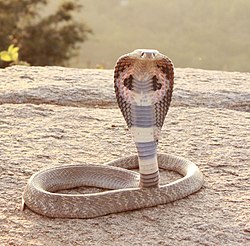
Picture of Naja
- Source
- Wikipedia/Commons
- Credit
- Pavan Kumar N
- Licence
- CC BY-SA 3.0
- Commercial use
- the licence allows it
CT scan
- Source
- MorphoSource
- Licence
- not stated by the source
- Commercial use
- cannot be read from the licence given — check the record
- Specimen
- NAJA NAJA · UMMZ:herps:61298
Smithsonian Open Access was not reached for this taxon, so this list is what the others held rather than everything there is.
The description on this site
- Source
- Wikipedia, “Naja”
- Licence
- CC BY-SA 4.0
This is what the site found, which is not the same as what exists.
Keep going
What may have been alongside itElapidae through timeFormations of the MioceneThe world it lived on
Occurrence data from the Paleobiology Database, CC BY 4.0. Laurenti 1768