Chelotriton
Chelotriton is an extinct genus of prehistoric salamanders that lived in Europe and Central Asia during the Neogene. It closely resembles the extant genera Tylototriton and Echinotriton.

Ghedoghedo · CC BY-SA 3.0 · via Wikipedia/Commons. May be a photograph of a specimen, or an artist’s reconstruction — an interpretation of a skeleton, since colour and soft tissue are almost never preserved.
On record
Recorded, not inferred- Sits inside
- SalamandridaePBDB
- Diet
- carnivorePBDB, for Temnospondyli
- Life habit
- amphibiousPBDB, for Temnospondyli
- Motility
- actively mobilePBDB, for Temnospondyli
- Environment
- brackish,freshwater,terrestrialPBDB, for Tetrapoda
Time the record covers
At least 19 million years on record.
The record covers at least 23.04 Mya to 3.6 Mya. No occurrence read is dated outside 27.3 Mya to 2.58 Mya.
35 occurrences of Chelotriton on record, most of them in the Miocene. Bar height is expected occurrences, not a count: each fossil is spread across the span it is dated to, so a tall narrow bar means tight dating and a low wide one means loose.
When
35 occurrencesThese are dates about fossils, not the animal: the record can only begin after it arose and end before it died out, so either end may reach further. Shares are expected occurrences: a fossil dated to a span is counted partly in each period it straddles. More on what this infers.
Found in
8 formations
- Upper Freshwater Molasse Formation · Molasse Group4
- Laa Formation3
- Edelény Formation2
- Gaverdovsky Formation2
- Ville Formation1
- Brackwater Molasse Formation · Molasse Group1
Loading coastlines…
The named rock units Chelotriton has been recovered from, largest first. Drawn where the rock is now, not where it formed. 20 occurrences have no formation on record, which is common for older literature.
Chelotriton and its relatives
MioceneWhere Chelotriton and its relatives were recorded in the Miocene.
Found in the same rock
780 taxa- Lacerta16 sites
- Ophisaurus15 sites
- Pelobates15 sites
- Colubrinae11 sites
- Pelophylax11 sites
- Rana11 sites
- Natrix10 sites
- Vipera10 sites
- Coluber8 sites
- Latonia gigantea8 sites
- Mioproteus caucasicus8 sites
- Natricinae8 sites
- Triturus marmoratus8 sites
- Blackia miocaenica7 sites
- Lacertidae7 sites
- Palaeobatrachus7 sites
- Testudo7 sites
- Trionyx7 sites
- Triturus7 sites
- Andrias scheuchzeri6 sites
- Bufo viridis6 sites
- Eopelobates6 sites
- Gekkonidae6 sites
- Latonia6 sites
The Paleobiology Database records 28 sites for Chelotriton, and this reads all of them. The number is how many of those sites it was catalogued from too. The 24 sharing the most are listed.
This is not a list of everything alive at the time. It is only what has come out of the same ground as this animal and been written down.
Entered from
26 references- Amphibians and squamate reptiles from the late Miocene of Fălciu (Eastern Romania)4
- Terrestrial and marine faunas from the Miocene deposits of the Mokra Plateau (Drahany Upland, Czech Republic) - impact on palaeogeography4
- Lower Vertebrates (Teleostei, Amphibia, Sauria) from the Karpatian of the Korneuburg Basin - Paleoecological, environmental and paleoclimatical implications3
- Recent Advances on Multidisciplinary Research at Rudabánya, Late Miocene (MN9), Hungary: a compendium2
- A new Miocene ape and locomotion in the ancestor of great apes and humans1
- Late Messinian mollusks and vertebrates from Moncucco Torinese, north-western Italy. Paleoecological and paleoclimatological implications1
- Neogene amphibians and reptiles (Caudata, Anura, Gekkota, Lacertilia, and Testudines) from the south of Western Siberia, Russia, and Northeastern Kazakhstan1
- Late Oligocene ambient temperatures reconstructed by stable isotope analysis of terrestrial and aquatic vertebrate fossils of Enspel, Germany1
- Ectothermic vertebrates from the late Middle Miocene of Gratkorn (Austria, Styria)1
- A new early late Oligocene (MP 26) continental vertebrate fauna from Saint-Privat-des-Vieux (Alès Basin, Gard, Southern France)1
- Snakes from Griesbeckerzell (Langhian, Early Badenian), North Alpine Foreland Basin (Germany), with comments on the evolution of snake faunas in Central Europe during the Miocene Climatic Optimum1
- Ectothermic vertebrates (Actinopterygii, Allocaudata, Urodela, Anura, Crocodylia, Squamata) from the Miocene of Sandelzhausen (Germany, Bavaria) and their implications for environment reconstruction and palaeoclimate1
Each of the 35 occurrences read was entered from one of these publications, ordered by how many each accounts for. This is not a search for papers mentioning the name. 14 further references are not listed. Entries link to doi.org where the Paleobiology Database holds an identifier, and to its own record where it does not. Relayed as the Paleobiology Database holds them, not checked against what they resolve to.
Media and terms
Media content1
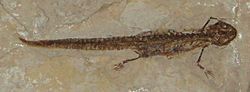
Picture of Chelotriton
- Source
- Wikipedia/Commons
- Credit
- Ghedoghedo
- Licence
- CC BY-SA 3.0
- Commercial use
- the licence allows it
No 3D scan was found. Smithsonian Open Access, MorphoSource and Sketchfab were all searched.
The description on this site
- Source
- Wikipedia, “Chelotriton”
- Licence
- CC BY-SA 4.0
This is what the site found, which is not the same as what exists.
Keep going
What may have been alongside itSalamandridae through timeFormations of the MioceneThe world it lived on
Occurrence data from the Paleobiology Database, CC BY 4.0. Pomel 1853