Echinoidea
Sea urchins or urchins are the class Echinoidea within the echinoderms. Approximately 950 species live on the seabed, inhabiting all oceans and depths from the intertidal zone to the deep sea. They typically have a globular body covered by spiny protective tests, typically from 3 to 10 cm across. Sea urchins move slowly, crawling with their tube feet, and sometimes pushing themselves with their spines. They feed primarily on algae but also eat slow-moving or sessile animals such as crinoids and sponges. Their predators include sharks, sea otters, starfish, wolf eels, triggerfish, and humans. When unchecked by predators, urchins can create urchin barrens, damaged environments devoid of large algae and the animals associated with them.

Nhobgood ( talk ) Nick Hobgood · CC BY-SA 3.0 · via Wikipedia/Commons. May be a photograph of a specimen, or an artist’s reconstruction — an interpretation of a skeleton, since colour and soft tissue are almost never preserved.
On record
Recorded, not inferred- Also called
- sea urchinPBDB
- Sits inside
- EchinozoaPBDB
- Diet
- grazer, deposit feederPBDB
- Life habit
- epifaunalPBDB
- Motility
- actively mobilePBDB
- Vision
- limitedPBDB
- Environment
- marinePBDB, for Echinodermata
Time the record covers
At least 458 million years on record.
The record covers at least 458.2 Mya to 11.7 ka. No occurrence read is dated outside 471.3 Mya to 0 Mya.
11,653 occurrences of Echinoidea on record, most of them in the Late Cretaceous. The Paleobiology Database records this as a living group. Bar height is expected occurrences, not a count: each fossil is spread across the span it is dated to, so a tall narrow bar means tight dating and a low wide one means loose.
When
11,653 occurrences- Ordovicianunder 1%
- Silurianunder 1%
- Devonian1%
- Carboniferous3%
- Permian2%
- Early Triassicunder 1%
- Middle Triassic1%
- Late Triassic3%
- Early Jurassic1%
- Middle Jurassic5%
- Late Jurassic6%
- Early Cretaceous15%
- Late Cretaceous26%
- Paleocene3%
- Eocene9%
- Oligocene3%
- Miocene11%
- Pliocene4%
- Pleistocene4%
- Holoceneunder 1%
These are dates about fossils, not the animal: the record can only begin after it arose and end before it died out, so either end may reach further. Shares are expected occurrences: a fossil dated to a span is counted partly in each period it straddles. More on what this infers.
Found in
1251 formations
- Calcaires à Spatangues Formation399
- Dhruma Formation · Shaqra Group231
- Cotinguiba Formation211
- Castle Hayne Formation · Jackson Group169
- Maastricht Formation148
- Cassian Formation · Wegen Group140
Loading coastlines…
The named rock units Echinoidea has been recovered from, largest first. Drawn where the rock is now, not where it formed. 1,227 further formations hold fewer occurrences each and are not listed. 3,480 occurrences have no formation on record, which is common for older literature.
Echinoidea and its relatives
Late CretaceousWhere Echinoidea and its relatives were recorded in the Late Cretaceous.
Found in the same rock
2,074 taxa- Bryozoa48 sites
- Ostrea44 sites
- Porifera38 sites
- Lima35 sites
- Panopea35 sites
- Toxaster31 sites
- Chlamys30 sites
- Pleurotomaria28 sites
- Holaster27 sites
- Cardium26 sites
- Diplopodia (Pseudodiadema)25 sites
- Ammonoidea24 sites
- Natica24 sites
- Pecten24 sites
- Terebratula24 sites
- Cidaris23 sites
- Arca22 sites
- Crinoidea22 sites
- Rhynchonella22 sites
- Anthozoa21 sites
- Mytilus21 sites
- Periarchus lyelli21 sites
- Serpula21 sites
- Venus20 sites
The Paleobiology Database records at least 945 sites for Echinoidea, and this reads 240 of them. The number is how many of those sites it was catalogued from too. The 24 sharing the most are listed.
This is not a list of everything alive at the time. It is only what has come out of the same ground as this animal and been written down.
Entered from
1,377 references- La variation chez les échinides irréguliers. Dimensions ontogénétiques, écologiques, évolutives399
- Jura Vaudois et Neuchatelois285
- Late Cretaceous-Early Paleocene echinoderms and the K/T boundary in the southeast Netherlands and the northeast Belgium. - part 4: Echinoids264
- Le Jurassique D`Arabie Centrale263
- Paléoécologie et paléobiogéographie des faunes d'échinides du Cénomanien nord-aquitain (Charente-Maritime, France)251
- American Upper Cretaceous Echinoidea240
- Recherches géologiques sur le Crétacé inférieur de l'Estremadura (Portugal)235
- British Jurassic regular echinoids. Part 1, Introduction, Cidaroida, Echinothurioida, Aspidodiadematoida and Pedinoida168
- Les grès verts helvétiques (Aptien moyen-Albien supérieur) de Haute-Savoie, Valais et Vaud (Alpes occidentales franco-suisses)162
- The Echinoids of the Middle Eocene Warley Hill Formation, Santee Limestone, and Castle Hayne Limestone of North and South Carolina157
- Cretaceous echinoids from north-eastern Brazil138
- Stratigraphic Distribution of Paleocene and Eocene Fossils in the Eastern Gulf Coast Region134
Each of the 11,653 occurrences read was entered from one of these publications, ordered by how many each accounts for. This is not a search for papers mentioning the name. 1,365 further references are not listed. Entries link to doi.org where the Paleobiology Database holds an identifier, and to its own record where it does not. Relayed as the Paleobiology Database holds them, not checked against what they resolve to.
Media and terms
Media content2

Picture of Echinoidea
- Source
- Wikipedia/Commons
- Credit
- Nhobgood ( talk ) Nick Hobgood
- Licence
- CC BY-SA 3.0
- Commercial use
- the licence allows it
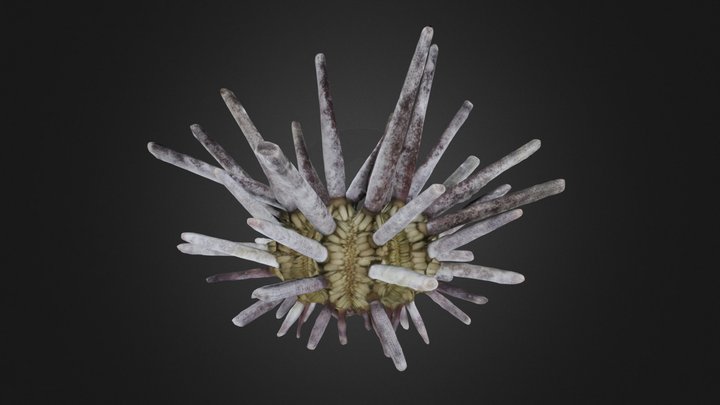
3D model
- Source
- Sketchfab
- Licence
- CC0 Public Domain
- Commercial use
- the licence allows it
Smithsonian Open Access was not reached for this taxon, so this list is what the others held rather than everything there is.
The description on this site
- Source
- Wikipedia, “Sea urchin”
- Licence
- CC BY-SA 4.0
This is what the site found, which is not the same as what exists.
Keep going
Everything alive alongside itEchinozoa through timeFormations of the Late CretaceousThe world it lived on
Occurrence data from the Paleobiology Database, CC BY 4.0. (Leske 1778)