Ammonoidea
Ammonoids are extinct, typically coiled-shelled cephalopods composing the subclass Ammonoidea. They are more closely related to living octopuses, squid, and cuttlefish than they are to nautiluses, which they resemble. The earliest ammonoids appeared during the Emsian stage of the Early Devonian, around 410-408 million years ago, with the last species vanishing during or soon after the Cretaceous–Paleogene extinction event approximately 66 million years ago. They are often called ammonites, which is most frequently used for members of the order Ammonitida, the only remaining group of ammonoids from the Jurassic up until their extinction.

Llez (H. Zell) . · CC BY-SA 3.0 · via Wikipedia/Commons. May be a photograph of a specimen, or an artist’s reconstruction — an interpretation of a skeleton, since colour and soft tissue are almost never preserved.
On record
Recorded, not inferred- Also called
- ammonitePBDB
- Sits inside
- CephalopodaPBDB
- Diet
- carnivorePBDB
- Life habit
- nektonicPBDB
- Motility
- fast-movingPBDB
- Vision
- well-developedPBDB, for Cephalopoda
- Environment
- marinePBDB, for Cephalopoda
Time the record covers
At least 333 million years on record.
The record covers at least 399.5 Mya to 66 Mya. No occurrence read is dated outside 419.62 Mya to 61.66 Mya.
12,000+ occurrences of Ammonoidea on record. The Paleobiology Database records this as a living group, and the chart stops with its fossils rather than at the present. Bar height is expected occurrences, not a count: each fossil is spread across the span it is dated to, so a tall narrow bar means tight dating and a low wide one means loose.
When
12,000 occurrences read- Devonian9%
- Carboniferous7%
- Permianunder 1%
- Early Triassic9%
- Middle Triassic6%
- Late Triassic4%
- Early Jurassic10%
- Middle Jurassic2%
- Late Jurassic12%
- Early Cretaceous22%
- Late Cretaceous17%
- Paleoceneunder 1%
These are dates about fossils, not the animal: the record can only begin after it arose and end before it died out, so either end may reach further. Shares are expected occurrences: a fossil dated to a span is counted partly in each period it straddles. The read hit its cap, so every figure above is a floor and the shares are of the occurrences read. More on what this infers.
Found in
at least 502 formations
- Fannin Formation · Maude Group375
- Nishinakayama Formation · Toyora Group283
- Prairie Bluff Formation217
- Folkestone Formation · Lower Greensand Group211
- Zhitkov Formation205
- Virgin Hills Formation197
Loading coastlines…
The named rock units Ammonoidea has been recovered from, largest first. Drawn where the rock is now, not where it formed. The read hit its cap, so each count is a floor. 478 further formations hold fewer occurrences each and are not listed. 4,227 occurrences have no formation on record, which is common for older literature.
Found in the same rock
521 taxa- Entolium orbiculare68 sites
- Bryozoa62 sites
- Camptonectes58 sites
- Belemnitida55 sites
- Buchia mosquensis54 sites
- Isognomon51 sites
- Astarte47 sites
- Pleuromya46 sites
- Taimyrothyris45 sites
- Grammatodon42 sites
- Inoceramus39 sites
- Pleuromya uniformis37 sites
- Protocardia striatula36 sites
- Hartwellia35 sites
- Hoploscaphites35 sites
- Isocyprina34 sites
- Serpula intestinalis34 sites
- Pinna31 sites
- Liostrea28 sites
- Orbiculoidea28 sites
- Oxytoma inequivalvis28 sites
- Cataceramus subcompressus26 sites
- Thracia depressa26 sites
- Dentalium24 sites
The Paleobiology Database records at least 536 sites for Ammonoidea, and this reads 240 of them. The number is how many of those sites it was catalogued from too. The 24 sharing the most are listed.
This is not a list of everything alive at the time. It is only what has come out of the same ground as this animal and been written down.
Entered from
at least 463 references- Lower Barremian ammonite biostratigraphy in the Subbetic Domain (Betic Cordillera, southern Spain)762
- The stratigraphical palaeontology of the Lower Greensand528
- Pliensbachian (Lower Jurassic) ammonites of the Queen Charlotte Islands, British Columbia514
- L'Oxfordien dans la moitié sud du Jura francais - etude stratigraphique412
- Triassic Ammonoid succession in South Primorye: 1. Lower Olenekian Hedenstroemia bosphorensis and Anasibirites nevolini Zones289
- Early Jurrasic Macrofauna of the Oxygen-Depleted Epicontinental Marin Basin in the Toyora Area, West Japan283
- Quantitative stratigraphy and taxonomy of late Emsian and Eifelian ammonoids of the eastern Anti-Atlas (Morocco)267
- Untersuchungen zur Paläontologie der Cephalopoden des Unter-Tithon der Südlichen Frankenalb265
- Upper Cretaceous (Maestrichtian) Mollusca from the Haustator bilira Assemblage Zone in the East Gulf Coastal Plain254
- Lower Triassic Ammonoids from Western Kwangsi, China223
- The Jurassic-Cretaceous Boundary and the Berriasian Stage in the Boreal Realm207
- Valanginian (Early Cretaceous ) ammonite faunas from the western High Atlas, Morocco, and the recognition of western Mediterranean 'standard' zones202
Each of the 12,000 occurrences read was entered from one of these publications, ordered by how many each accounts for. This is not a search for papers mentioning the name. That read hit its cap, so each count is a floor. 451 further references are not listed. Entries link to doi.org where the Paleobiology Database holds an identifier, and to its own record where it does not. Relayed as the Paleobiology Database holds them, not checked against what they resolve to.
Media and terms
Media content2
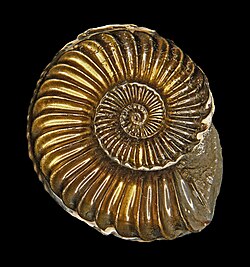
Picture of Ammonoidea
- Source
- Wikipedia/Commons
- Credit
- Llez (H. Zell) .
- Licence
- CC BY-SA 3.0
- Commercial use
- the licence allows it
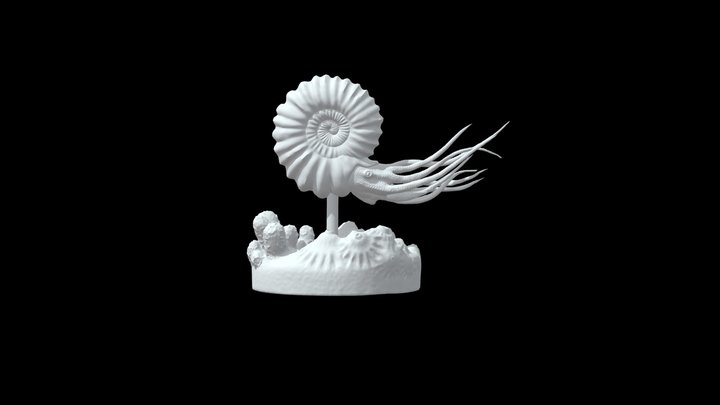
3D model
- Source
- Sketchfab
- Credit
- abbyschlich
- Licence
- CC Attribution
- Commercial use
- cannot be read from the licence given — check the record
The description on this site
- Source
- Wikipedia, “Ammonoidea”
- Licence
- CC BY-SA 4.0
This is what the site found, which is not the same as what exists.
Keep going
What may have been alongside itCephalopoda through timeThe world it lived on
Occurrence data from the Paleobiology Database, CC BY 4.0. (Zittel 1884)