Anthozoa
Anthozoa is one of the three subphyla of Cnidaria, along with Medusozoa and Endocnidozoa. It includes sessile marine invertebrates and invertebrates of brackish water, such as sea anemones, stony corals, soft corals and sea pens. Almost all adult anthozoans are attached to the seabed, while their larvae exist as zooplankton. The basic unit of the adult is the polyp, an individual animal consisting of a cylindrical column topped by a disc with a central mouth surrounded by tentacles. Sea anemones are mostly solitary, but the majority of corals are colonial, being formed by the budding of new polyps from an original, founding individual. Colonies of stony corals are strengthened by mainly aragonite and other materials, and can take various massive, plate-like, bushy or leafy forms.

Toby Hudson · CC BY-SA 3.0 · via Wikipedia/Commons. May be a photograph of a specimen, or an artist’s reconstruction — an interpretation of a skeleton, since colour and soft tissue are almost never preserved.
On record
Recorded, not inferred- Sits inside
- CnidariaPBDB
- Diet
- microcarnivorePBDB
- Life habit
- intermediate-level epifaunalPBDB
- Motility
- stationary, attachedPBDB
- Vision
- blindPBDB
Time the record covers
At least 511 million years on record.
The record covers at least 512.1 Mya to 129 ka. No occurrence read is dated outside 516 Mya to 11.7 ka.
12,000+ occurrences of Anthozoa on record. The Paleobiology Database records this as a living group. Bar height is expected occurrences, not a count: each fossil is spread across the span it is dated to, so a tall narrow bar means tight dating and a low wide one means loose.
When
12,000 occurrences read- Cambrianunder 1%
- Ordovician10%
- Silurian28%
- Devonian23%
- Carboniferous13%
- Permian1%
- Middle Triassicunder 1%
- Late Triassic1%
- Early Jurassic1%
- Middle Jurassicunder 1%
- Late Jurassic6%
- Early Cretaceous2%
- Late Cretaceous4%
- Paleocene1%
- Eocene3%
- Oligocene2%
- Miocene3%
- Plioceneunder 1%
- Pleistoceneunder 1%
These are dates about fossils, not the animal: the record can only begin after it arose and end before it died out, so either end may reach further. Shares are expected occurrences: a fossil dated to a span is counted partly in each period it straddles. The read hit its cap, so every figure above is a floor and the shares are of the occurrences read. More on what this infers.
Found in
at least 783 formations
- Ludlowville Formation · Hamilton Group277
- Onondaga Formation265
- High Tor Limestone Formation180
- Korallenoolith Formation180
- Coopers Creek Limestone Formation159
- Brassfield Formation156
Loading coastlines…
The named rock units Anthozoa has been recovered from, largest first. Drawn where the rock is now, not where it formed. The read hit its cap, so each count is a floor. 759 further formations hold fewer occurrences each and are not listed. 2,313 occurrences have no formation on record, which is common for older literature.
Found in the same rock
1,750 taxa- Crinoidea86 sites
- Rugosa50 sites
- Leptaena48 sites
- Atrypa47 sites
- Favosites39 sites
- Schuchertella35 sites
- Bryozoa34 sites
- Rhipidomella34 sites
- Spirifer33 sites
- Archaeogastropoda30 sites
- Heliolites28 sites
- Ostracoda28 sites
- Lingula27 sites
- Syringopora27 sites
- Camarotoechia26 sites
- Fenestella26 sites
- Punctospirifer26 sites
- Tabulata25 sites
- Tentaculites25 sites
- Trepostomata25 sites
- Halysites24 sites
- Isorthis24 sites
- Crurithyris23 sites
- Howellella23 sites
The Paleobiology Database records at least 845 sites for Anthozoa, and this reads 240 of them. The number is how many of those sites it was catalogued from too. The 24 sharing the most are listed.
This is not a list of everything alive at the time. It is only what has come out of the same ground as this animal and been written down.
Entered from
at least 581 references- Correlation of the Silurian rocks of China457
- Silurian Reefs of Gotland309
- Silurian and Devonian Corals of the Falls of the Ohio267
- The palaeontology and stratigraphy of the Siluro-Devonian sediments of the Tyers Area, Gippsland, Victoria213
- Stratigraphy and palaeontology of the Interlake Group and Stonewall Formation of Southern Manitoba195
- Fossil associations in the High Tor Limestone (Lower Carboniferous) of South Wales180
- Stratigraphy of the Onondaga Limestone in Central New York166
- Caradocian-Gedinnian echinoderm associations of Central and Eastern North America154
- Carbonate deposition in accretionary prism settings: Early Miocene coral limestones and corals of the Makran Mountain Range in southern Iran151
- Silurian and Early Devonian benthic communities of the Ural-Tien Shan region146
- The corals of the Brassfield Formation (mid-Llandovery, Lower Silurian) in the Cincinnati Arch Region141
- Ordovician paleontology of the Northern Hudson Bay lowland140
Each of the 12,000 occurrences read was entered from one of these publications, ordered by how many each accounts for. This is not a search for papers mentioning the name. That read hit its cap, so each count is a floor. 569 further references are not listed. Entries link to doi.org where the Paleobiology Database holds an identifier, and to its own record where it does not. Relayed as the Paleobiology Database holds them, not checked against what they resolve to.
Media and terms
Media content2

Picture of Anthozoa
- Source
- Wikipedia/Commons
- Credit
- Toby Hudson
- Licence
- CC BY-SA 3.0
- Commercial use
- the licence allows it
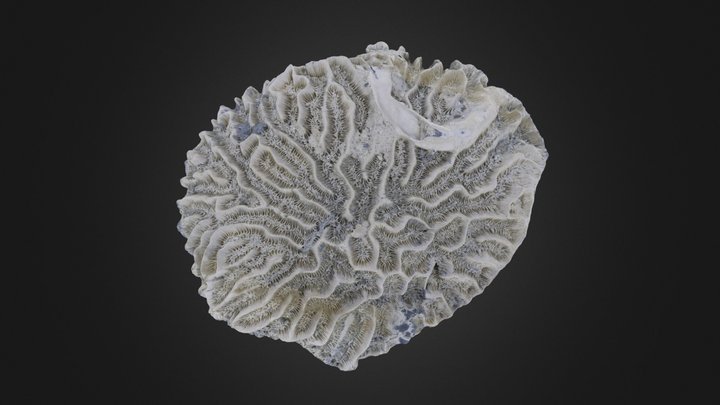
3D model
- Source
- Sketchfab
- Licence
- CC0 Public Domain
- Commercial use
- the licence allows it
The description on this site
- Source
- Wikipedia, “Anthozoa”
- Licence
- CC BY-SA 4.0
This is what the site found, which is not the same as what exists.
Keep going
What may have been alongside itCnidaria through timeThe world it lived on
Occurrence data from the Paleobiology Database, CC BY 4.0. Ehrenberg 1834