Rhynchonella
Rhynchonella is an extinct genus of brachiopods known from the Late Jurassic (Oxfordian) to the Early Cretaceous. Formerly this genus was understood much more widely and less critical sources still list species of Rhynchonella from the Ordovician to the Eocene. Like most brachiopods, Rhynchonella was a stationary epifaunal suspension feeder.

Hectonichus · CC BY-SA 3.0 · via Wikipedia/Commons. May be a photograph of a specimen, or an artist’s reconstruction — an interpretation of a skeleton, since colour and soft tissue are almost never preserved.
On record
Recorded, not inferred- Sits inside
- RhynchonellinaePBDB
- Diet
- suspension feederPBDB, for Rhynchonellida
- Life habit
- epifaunalPBDB, for Rhynchonellida
- Motility
- stationaryPBDB, for Rhynchonellida
- Vision
- blindPBDB, for Rhynchonellata
- Environment
- marinePBDB, for Lophophorata
Time the record covers
At least 372 million years on record.
The record covers at least 438.6 Mya to 66 Mya. No occurrence read is dated outside 443.1 Mya to 56 Mya.
607 occurrences of Rhynchonella on record, most of them in the Middle Jurassic. Bar height is expected occurrences, not a count: each fossil is spread across the span it is dated to, so a tall narrow bar means tight dating and a low wide one means loose.
When
607 occurrences- Silurian3%
- Devonian2%
- Carboniferousunder 1%
- Permian4%
- Early Triassicunder 1%
- Middle Triassic9%
- Late Triassic13%
- Early Jurassic13%
- Middle Jurassic20%
- Late Jurassic14%
- Early Cretaceous11%
- Late Cretaceous5%
- Paleocene3%
These are dates about fossils, not the animal: the record can only begin after it arose and end before it died out, so either end may reach further. Shares are expected occurrences: a fossil dated to a span is counted partly in each period it straddles. More on what this infers.
Found in
115 formations
- Cassian Formation · Wegen Group18
- Tataouine Formation17
- Kap Leslie Formation14
- Lautaro Formation14
- Chari Formation11
- Bulog Formation6
Loading coastlines…
The named rock units Rhynchonella has been recovered from, largest first. Drawn where the rock is now, not where it formed. 91 further formations hold fewer occurrences each and are not listed. 360 occurrences have no formation on record, which is common for older literature.
Rhynchonella and its relatives
Middle JurassicWhere Rhynchonella and its relatives were recorded in the Middle Jurassic.
Found in the same rock
2,465 taxa- Terebratula40 sites
- Cidaris25 sites
- Ostrea24 sites
- Astarte22 sites
- Belemnitida22 sites
- Terebratulina chrysalis22 sites
- Lima21 sites
- Plagiostoma20 sites
- Pecten19 sites
- Argyrotheca stevensis18 sites
- Bryozoa18 sites
- Camptonectes18 sites
- Gastropoda18 sites
- Porifera17 sites
- Argyrotheca16 sites
- Crinoidea16 sites
- Isocrania costata16 sites
- Pleurotomaria16 sites
- Rugia16 sites
- Argyrotheca bronnii15 sites
- Bivalvia15 sites
- Entolium orbiculare15 sites
- Liostrea15 sites
- Nerinea15 sites
The Paleobiology Database records 468 sites for Rhynchonella, and this reads 240 of them. The number is how many of those sites it was catalogued from too. The 24 sharing the most are listed.
This is not a list of everything alive at the time. It is only what has come out of the same ground as this animal and been written down.
Entered from
171 references- Les terebratulidae du Dogger dans le Mâconnais, le mont d'Or lyonnais et le Jura méridional: Étude systématique et biostratigraphique. Rapports avec la paléoécologie43
- End-Cretaceous brachiopod extinctions in the chalk of Denmark25
- Brachiopoden und Lamellibranchiaten aus der Trias von Bosnien, Dalmatien, und Venetien [Brachiopods and bivalves of the Triassic of Bosnia, Dalmatia and Veneto]22
- Dynamische Palaookologie und taxonomische Bearbeitung des Unterjura (Hettangium bis unteres Sinemurium) auf der Schwabischen Alb20
- Makridin, 196420
- The stratigraphical palaeontology of the Lower Greensand15
- Geologie der Umgebung von Sarajevo13
- La Fauna dei Calcari Con Fusulina della Valle del Fiume Sosio nella Provincia di Palermo, Brachiopoda13
- Unpublished data from Kachchh12
- Geologie de Madagascar I. Les Terrains Sedimentaires12
- Jura Vaudois et Neuchatelois12
- Genesis and environmental significance of Upper Cretaceous shell concentrations from the Cauvery Basin, southern India11
Each of the 607 occurrences read was entered from one of these publications, ordered by how many each accounts for. This is not a search for papers mentioning the name. 159 further references are not listed. Entries link to doi.org where the Paleobiology Database holds an identifier, and to its own record where it does not. Relayed as the Paleobiology Database holds them, not checked against what they resolve to.
Media and terms
Media content2

Picture of Rhynchonella
- Source
- Wikipedia/Commons
- Credit
- Hectonichus
- Licence
- CC BY-SA 3.0
- Commercial use
- the licence allows it
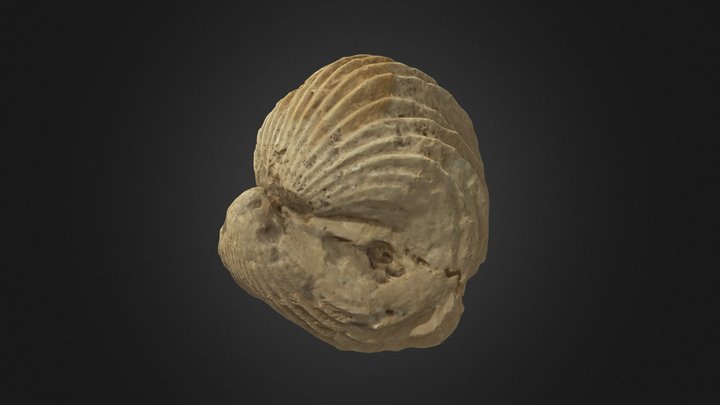
3D model
- Source
- Sketchfab
- Credit
- Simeon Schmauß
- Licence
- CC Attribution
- Commercial use
- cannot be read from the licence given — check the record
Smithsonian Open Access and MorphoSource were not reached for this taxon, so this list is what the others held rather than everything there is.
The description on this site
- Licence
- CC BY-SA 4.0
This is what the site found, which is not the same as what exists.
Keep going
What may have been alongside itRhynchonellinae through timeFormations of the Middle JurassicThe world it lived on
Occurrence data from the Paleobiology Database, CC BY 4.0. Fischer 1809