Ursus arctos
The brown bear is a large bear native to Eurasia and North America. Of the land carnivorans, it is rivaled in size only by its closest relative, the polar bear, which is much less variable in size and slightly bigger on average. The brown bear is a sexually dimorphic species, as adult males are larger and more compactly built than females. The fur ranges in color from cream to reddish to dark brown. It has evolved large hump muscles, unique among bears, and paws up to 21 cm (8.3 in) wide and 36 cm (14 in) long, to effectively dig through dirt. Its teeth are similar to those of other bears and reflect its dietary plasticity.

Yathin S Krishnappa · CC BY-SA 3.0 · via Wikipedia/Commons. May be a photograph of a specimen, or an artist’s reconstruction — an interpretation of a skeleton, since colour and soft tissue are almost never preserved.
On record
Recorded, not inferred- Also called
- brown bearPBDB
- Sits inside
- UrsusPBDB
- Diet
- herbivore, carnivorePBDB
- Life habit
- ground dwellingPBDB, for Ursidae
- Motility
- actively mobilePBDB, for Osteichthyes
- Environment
- terrestrialPBDB, for Eutheria
- Mass
- 500 kgWikidata
Time the record covers
At least 762 thousand years on record.
The record covers at least 774 ka to 11.7 ka. No occurrence read is dated outside 2.58 Mya to 0 Mya.
58 occurrences of Ursus arctos on record, most of them in the Pleistocene. The Paleobiology Database records this as a living group. Bar height is expected occurrences, not a count: each fossil is spread across the span it is dated to, so a tall narrow bar means tight dating and a low wide one means loose.
When
58 occurrences- Pleistocene84%
- Holocene16%
These are dates about fossils, not the animal: the record can only begin after it arose and end before it died out, so either end may reach further. Shares are expected occurrences: a fossil dated to a span is counted partly in each period it straddles. More on what this infers.
Found in
3 formations
Loading coastlines…
The named rock units Ursus arctos has been recovered from, largest first. Drawn where the rock is now, not where it formed. 54 occurrences have no formation on record, which is common for older literature.
Ursus arctos and its relatives
PleistoceneWhere Ursus arctos and its relatives were recorded in the Pleistocene.
Found in the same rock
686 taxa- Canis lupus24 sites
- Vulpes vulpes19 sites
- Cervus elaphus18 sites
- Microtus18 sites
- Sus scrofa18 sites
- Equus13 sites
- Arvicola12 sites
- Lepus12 sites
- Bos primigenius11 sites
- Cervus11 sites
- Myodes11 sites
- Capreolus capreolus10 sites
- Meles meles9 sites
- Palaeoloxodon antiquus9 sites
- Panthera pardus9 sites
- Apodemus8 sites
- Aves8 sites
- Bison priscus8 sites
- Cricetus cricetus8 sites
- Crocuta crocuta8 sites
- Equus caballus8 sites
- Glis glis8 sites
- Microtus arvalis8 sites
- Panthera leo8 sites
The Paleobiology Database records 58 sites for Ursus arctos, and this reads all of them. The number is how many of those sites it was catalogued from too. The 24 sharing the most are listed.
This is not a list of everything alive at the time. It is only what has come out of the same ground as this animal and been written down.
Entered from
43 references- I giacimenti Quaternari di vertebrati fossili nell'Italia Nord-Orientale7
- Quaternary vertebrates from Shiriya area, Shimokita Pininsula, northeastern Japan4
- Avian remains from new Upper Pleistocene and Holocene sites in the Spanish Pyrenees3
- From tortoises to elephants: the impact of elephants in the broad spectrum diet at Bolomor Cave (MIS 9–5 Spain)2
- Sea mammal hunters of Chukotka, Bering Strait: recent archaeological results and problems2
- Grizzly bears from eastern North America2
- Die jungpleistozänen Säugetierfaunen aus dem Travertingebiet von Taubach-Weimar-Ehringsdorf (The Early Plestocene mammalian fauna from the travetin-area of Taubach-Weimar-Ehringsdorf)2
- Neanderthal exploitation of marine mammals in Gibraltar1
- The Eurogeul—first report of the palaeontological, palynological and archaeological investigations of this part of the North Sea1
- The Island Rule in Large Mammals: Paleontology Meets Ecology1
- Mittelpleistozane Saugetierfaunen aus Mitteleuropa - der Versuch einer biostratigraphischen Zuordnung1
- The first fossil record of a short-finned pilot whale (Globicephala macrorhynchus) from the Penghu Channel1
Each of the 58 occurrences read was entered from one of these publications, ordered by how many each accounts for. This is not a search for papers mentioning the name. 31 further references are not listed. Entries link to doi.org where the Paleobiology Database holds an identifier, and to its own record where it does not. Relayed as the Paleobiology Database holds them, not checked against what they resolve to.
Media and terms
Media content2

Picture of Ursus arctos
- Source
- Wikipedia/Commons
- Credit
- Yathin S Krishnappa
- Licence
- CC BY-SA 3.0
- Commercial use
- the licence allows it
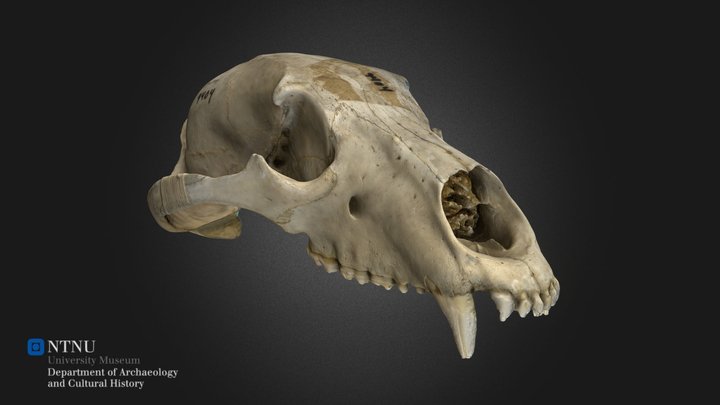
3D model
- Source
- Sketchfab
- Credit
- NTNU University museum
- Licence
- CC Attribution
- Commercial use
- cannot be read from the licence given — check the record
Smithsonian Open Access and MorphoSource were not reached for this taxon, so this list is what the others held rather than everything there is.
The description on this site
- Source
- Wikipedia, “Brown bear”
- Licence
- CC BY-SA 4.0
This is what the site found, which is not the same as what exists.
Keep going
What may have been alongside itUrsus through timeFormations of the PleistoceneThe world it lived on
Occurrence data from the Paleobiology Database, CC BY 4.0. Linnaeus 1758