Equus caballus

Srdjan Živulovič · Attribution · via Wikidata/Commons. May be a photograph of a specimen, or an artist’s reconstruction — an interpretation of a skeleton, since colour and soft tissue are almost never preserved.
On record
Recorded, not inferred- Also called
- horsePBDB
- Sits inside
- EquusPBDB
- Diet
- grazerPBDB, for Equus
- Life habit
- ground dwellingPBDB, for Equus
- Motility
- actively mobilePBDB, for Osteichthyes
- Environment
- terrestrialPBDB, for Eutheria
Time the record covers
At least 2.5 million years on record.
The record covers at least 2.58 Mya to 11.7 ka. No occurrence read is dated outside 5.333 Mya to 0 Mya.
96 occurrences of Equus caballus on record, most of them in the Pleistocene. The Paleobiology Database records this as a living group. Bar height is expected occurrences, not a count: each fossil is spread across the span it is dated to, so a tall narrow bar means tight dating and a low wide one means loose.
When
96 occurrences- Pliocene1%
- Pleistocene92%
- Holocene6%
These are dates about fossils, not the animal: the record can only begin after it arose and end before it died out, so either end may reach further. Shares are expected occurrences: a fossil dated to a span is counted partly in each period it straddles. More on what this infers.
Found in
11 formations
- Lujan Formation3
- Cromer Forest Bed Formation3
- Salto Ander Egg Formation2
- Sopas Formation2
- 'Ubeidiya Formation1
- Nuapua Formation1
Loading coastlines…
The named rock units Equus caballus has been recovered from, largest first. Drawn where the rock is now, not where it formed. 79 occurrences have no formation on record, which is common for older literature.
Equus caballus and its relatives
PleistoceneWhere Equus caballus and its relatives were recorded in the Pleistocene.
Found in the same rock
713 taxa- Cervus elaphus27 sites
- Canis lupus26 sites
- Cervus26 sites
- Sus scrofa19 sites
- Microtus18 sites
- Bos primigenius17 sites
- Capreolus capreolus15 sites
- Microtus arvalis15 sites
- Palaeoloxodon antiquus14 sites
- Dama dama13 sites
- Macrauchenia patagonica12 sites
- Rangifer tarandus12 sites
- Crocuta crocuta11 sites
- Glyptodon reticulatus11 sites
- Lepus11 sites
- Panthera leo11 sites
- Ursus spelaeus11 sites
- Vulpes vulpes11 sites
- Bison priscus10 sites
- Notiomastodon platensis10 sites
- Oryctolagus cuniculus10 sites
- Smilodon populator10 sites
- Arvicola9 sites
- Cervidae9 sites
The Paleobiology Database records 92 sites for Equus caballus, and this reads all of them. The number is how many of those sites it was catalogued from too. The 24 sharing the most are listed.
This is not a list of everything alive at the time. It is only what has come out of the same ground as this animal and been written down.
Entered from
61 references- Le gisement Pleistocene moyen et superieur d'Artenac (Saint-Mary, Charent): premier bilan interdisciplinaire7
- I giacimenti Quaternari di vertebrati fossili nell'Italia Nord-Orientale6
- Mammal fauna with Elephas (Palaeoloxodon) antiquus from the lower levels of Ambrona (Soria, Spain)5
- The Vertebrata of the Forest Bed Series of Norfolk and Suffolk4
- Nearctic Pleistocene ungulates from the Pampean region (Argentina) in the historical collections of Santiago Roth in Switzerland: an overview3
- Paleontología de macromamíferos del yacimiento mesopleistoceno de Villacastín (Segovia, España)3
- La faune de vertébrés du Pléistocéne supérieur de l’aire archéologique de São Raimundo Nonato (Piauí, Brésil)3
- Säugetierfunde und Pleistozänstratigraphie in der Kolyma-Niederung (Pleistocene stratigraphy from the Kolyma fluvial plain and it's mammal fossils)3
- Vertebrate continental assemblage from the Last Interglacial in southern South America (Entre Ríos, Argentina). Biostratigraphy and paleoenvironment2
- Pleistocene mammals from Uruguay: Biostratigraphic, biogeographic and environmental connotations2
- Large mammal fossil occurrences and associated archaeological evidence in Pleistocene contexts of peninsular India and Sri Lanka2
- Mamíferos extintos del Cuaternario de la Provincia del Chaco (Argentina) y su relación con aquéllos del este de la región pampeana y de Chile2
Each of the 96 occurrences read was entered from one of these publications, ordered by how many each accounts for. This is not a search for papers mentioning the name. 49 further references are not listed. Entries link to doi.org where the Paleobiology Database holds an identifier, and to its own record where it does not. Relayed as the Paleobiology Database holds them, not checked against what they resolve to.
Media and terms
Media content3
Picture of Equus caballus
- Source
- Wikidata/Commons
- Credit
- Srdjan Živulovič
- Licence
- Attribution
- Commercial use
- cannot be read from the licence given — check the record
CT scan
- Source
- MorphoSource
- Licence
- not stated by the source
- Commercial use
- cannot be read from the licence given — check the record
- Specimen
- Equus caballus · L-NS:MAMM:NS293
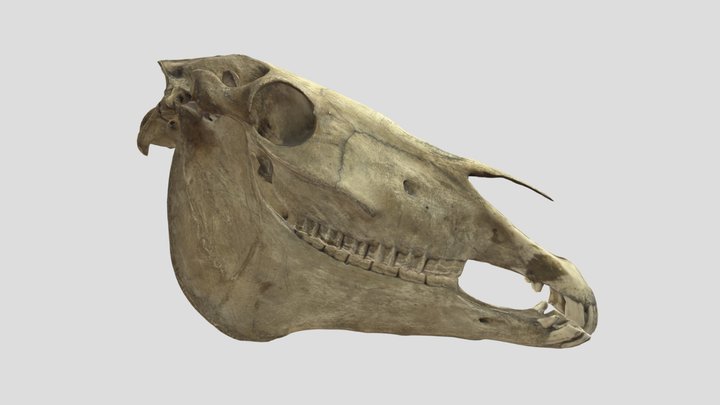
3D model
- Source
- Sketchfab
- Credit
- JChanteloupUPS
- Licence
- CC Attribution
- Commercial use
- cannot be read from the licence given — check the record
Smithsonian Open Access was not reached for this taxon, so this list is what the others held rather than everything there is.
This is what the site found, which is not the same as what exists.
Keep going
What may have been alongside itEquus through timeFormations of the PleistoceneThe world it lived on
Occurrence data from the Paleobiology Database, CC BY 4.0. Linnaeus 1758