Stromboidea
The Stromboidea, originally named the Strombacea by Rafinesque in 1815, is a superfamily of medium-sized to very large sea snails in the order Littorinimorpha.

No machine-readable author provided. Haplochromis assumed (based on copyright claims). · Public Domain · via Wikipedia/Commons. May be a photograph of a specimen, or an artist’s reconstruction — an interpretation of a skeleton, since colour and soft tissue are almost never preserved.
On record
Recorded, not inferred- Sits inside
- LatrogastropodaPBDB
- Diet
- grazerPBDB
- Life habit
- epifaunalPBDB
- Motility
- actively mobilePBDB
- Vision
- limitedPBDB, for Gastropoda
Time the record covers
At least 201 million years on record.
The record covers at least 201.4 Mya to 11.7 ka. No occurrence read is dated outside 205.7 Mya to 0 Mya.
5,008 occurrences of Stromboidea on record, most of them in the Late Cretaceous. The Paleobiology Database records this as a living group. Bar height is expected occurrences, not a count: each fossil is spread across the span it is dated to, so a tall narrow bar means tight dating and a low wide one means loose.
When
5,008 occurrences- Late Triassicunder 1%
- Early Jurassicunder 1%
- Middle Jurassic4%
- Late Jurassic2%
- Early Cretaceous6%
- Late Cretaceous28%
- Paleocene6%
- Eocene21%
- Oligocene3%
- Miocene14%
- Pliocene7%
- Pleistocene7%
- Holoceneunder 1%
These are dates about fossils, not the animal: the record can only begin after it arose and end before it died out, so either end may reach further. Shares are expected occurrences: a fossil dated to a span is counted partly in each period it straddles. More on what this infers.
Found in
663 formations
- Gurabo Formation154
- Prairie Bluff Formation · Selma Group101
- La Meseta Formation95
- Ripley Formation · Selma Group93
- Ladd Formation73
- Redding Formation · Pacheco Group73
Loading coastlines…
The named rock units Stromboidea has been recovered from, largest first. Drawn where the rock is now, not where it formed. 639 further formations hold fewer occurrences each and are not listed. 947 occurrences have no formation on record, which is common for older literature.
Stromboidea and its relatives
Late CretaceousWhere Stromboidea and its relatives were recorded in the Late Cretaceous.
Found in the same rock
1,889 taxa- Drepanocheilus56 sites
- Turritella54 sites
- Lucina40 sites
- Gastropoda38 sites
- Bivalvia35 sites
- Corbula35 sites
- Dentalium34 sites
- Natica33 sites
- Euspira31 sites
- Pycnodonte31 sites
- Cadulus28 sites
- Ostrea28 sites
- Inoceramidae27 sites
- Nuculana27 sites
- Eburneopecten scintillatus26 sites
- Hipponix26 sites
- Aporrhais25 sites
- Bryozoa25 sites
- Ostreidae25 sites
- Ammonoidea24 sites
- Astarte24 sites
- Calyptraea (Trochita) aperta24 sites
- Pholadomya24 sites
- Calyptraphorus23 sites
The Paleobiology Database records at least 1,331 sites for Stromboidea, and this reads 240 of them. The number is how many of those sites it was catalogued from too. The 24 sharing the most are listed.
This is not a list of everything alive at the time. It is only what has come out of the same ground as this animal and been written down.
Entered from
737 references- Neogene Paleontology of the Northern Dominican Republic. 23. Strombid Gastropods (Genera Strombus and Lobatus; Mollusca: Gastropoda: Strombidae) of the Cibao Valley191
- Upper Cretaceous (Maestrichtian) Mollusca from the Haustator bilira Assemblage Zone in the East Gulf Coastal Plain180
- Molluscan Systematics and Biostratigraphy138
- Resilience of marine invertebrate communities during the early Cenozoic hyperthermals103
- Skwarko, 199487
- Catalogue of the Paleocene and Eocene mollusca of the southern and eastern United States. Part 1. Pelecypoda, Amphineura, Pteropoda, Scaphopoda and Cephalopoda86
- Molluscs at the K/Pg boundary in Argentina: Extinction and recovery patterns. unpublished Ph.D. thesis81
- Archeogastropoda, Mesogastropoda and stratigraphy of the Ripley, Owl Creek, and Prairie Bluff Formations71
- Upper Cretaceous (Maestrichtian) larger invertebrate Fossils from the Haustator bilira Assemblage Zone in the west gulf Coastal Plain65
- Jura Vaudois et Neuchatelois58
- A contribution to the study of the Eocene in Western Pakistan and Western India: C. The description of the Scaphopoda and Gastropoda from standard sections in the Rakhi Nala and Zindar Pir areas of the Western Punjab and in the Kohat District57
- Maastrichtian non-cephalopod mollusks: Scaphopoda, Gastropoda and Bivalvia of the Middle Vistula Valley, central Poland56
Each of the 5,008 occurrences read was entered from one of these publications, ordered by how many each accounts for. This is not a search for papers mentioning the name. 725 further references are not listed. Entries link to doi.org where the Paleobiology Database holds an identifier, and to its own record where it does not. Relayed as the Paleobiology Database holds them, not checked against what they resolve to.
Media and terms
Media content1
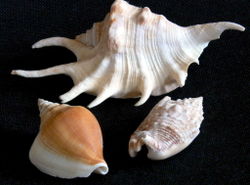
Picture of Stromboidea
- Source
- Wikipedia/Commons
- Credit
- No machine-readable author provided. Haplochromis assumed (based on copyright claims).
- Licence
- Public Domain
- Commercial use
- the licence allows it
No 3D scan of Stromboidea was found in MorphoSource and Sketchfab.
Smithsonian Open Access was not reached for this taxon, so this list is what the others held rather than everything there is.
The description on this site
- Source
- Wikipedia, “Stromboidea”
- Licence
- CC BY-SA 4.0
This is what the site found, which is not the same as what exists.
Keep going
What may have been alongside itLatrogastropoda through timeFormations of the Late CretaceousThe world it lived on
Occurrence data from the Paleobiology Database, CC BY 4.0. Rafinesque 1815