Cadulus
Cadulus is a large genus of small tusk shells in the family Gadilidae. It contains over fifty-one described species.

Uncredited · CC0 · via Wikipedia/Commons. May be a photograph of a specimen, or an artist’s reconstruction — an interpretation of a skeleton, since colour and soft tissue are almost never preserved.
On record
Recorded, not inferred- Sits inside
- GadilinaePBDB
- Diet
- deposit feederPBDB, for Gadilida
- Life habit
- shallow infaunalPBDB, for Gadilida
- Motility
- slow-movingPBDB, for Gadilida
- Vision
- blindPBDB, for Scaphopoda
Time the record covers
At least 132 million years on record.
The record covers at least 132.6 Mya to 129 ka. No occurrence read is dated outside 137.05 Mya to 11.7 ka.
504 occurrences of Cadulus on record, most of them in the Eocene. The Paleobiology Database records this as a living group. Bar height is expected occurrences, not a count: each fossil is spread across the span it is dated to, so a tall narrow bar means tight dating and a low wide one means loose.
When
504 occurrences- Early Cretaceous2%
- Late Cretaceous15%
- Paleocene9%
- Eocene38%
- Oligocene6%
- Miocene16%
- Pliocene9%
- Pleistocene4%
These are dates about fossils, not the animal: the record can only begin after it arose and end before it died out, so either end may reach further. Shares are expected occurrences: a fossil dated to a span is counted partly in each period it straddles. More on what this infers.
Found in
104 formations
- Cook Mountain Formation · Claiborne Group52
- Gatun Formation48
- Providence Formation32
- Lisbon Formation · Claiborne Group23
- Hatchetigbee Bluff Formation · Wilcox Group18
- Moodys Branch Formation · Jackson Group14
Loading coastlines…
The named rock units Cadulus has been recovered from, largest first. Drawn where the rock is now, not where it formed. 80 further formations hold fewer occurrences each and are not listed. 20 occurrences have no formation on record, which is common for older literature.
Cadulus and its relatives
EoceneWhere Cadulus and its relatives were recorded in the Eocene.
Found in the same rock
3,080 taxa- Turritella74 sites
- Nuculana67 sites
- Dentalium51 sites
- Corbula50 sites
- Gastropoda48 sites
- Naticidae45 sites
- Striarca40 sites
- Tellina40 sites
- Acteon38 sites
- Cyprimeria37 sites
- Anomia argentaria36 sites
- Cymbophora36 sites
- Euspira rectilabrum36 sites
- Athleta petrosa34 sites
- Syncyclonema34 sites
- Anthozoa33 sites
- Retusa galba32 sites
- Vertebrata32 sites
- Cyclorisma31 sites
- Aenona eufaulensis30 sites
- Turritella bilira30 sites
- Calyptraea (Trochita) aperta29 sites
- Cubitostrea tecticosta29 sites
- Cylichna29 sites
The Paleobiology Database records 357 sites for Cadulus, and this reads 240 of them. Of that, one read hit the database's own return limit, so every count below is a floor rather than a total. The number is how many of those sites it was catalogued from too. The 24 sharing the most are listed.
This is not a list of everything alive at the time. It is only what has come out of the same ground as this animal and been written down.
Entered from
99 references- Resilience of marine invertebrate communities during the early Cenozoic hyperthermals54
- Catalogue of the Paleocene and Eocene mollusca of the southern and eastern United States. Part 1. Pelecypoda, Amphineura, Pteropoda, Scaphopoda and Cephalopoda44
- A paleobiotic survey of Caribbean faunas from the Neogene of the Isthmus of Panama39
- Geology and paleontology of canal zone and adjoing parts of Panama: Description of Tertiary mollusks (additions to gastropods, scaphopods, pelecypods: Nuculidae to Malleidae)35
- Faunal stability and environmental change in the middle Eocene Gulf Coastal Plain (PhD Thesis, Harvard University)25
- Upper Cretaceous (Maestrichtian) larger invertebrates from the Haustator bilira Assemblage Zone in the Atlantic Coastal Plain with further data for the East Gulf22
- Ecological control of evolutionary rates in Paleocene - Eocene marine molluscs21
- Upper Cretaceous (Maestrichtian) Mollusca from the Haustator bilira Assemblage Zone in the East Gulf Coastal Plain20
- Environmental and biological controls on the diversity and ecology of Late Cretaceous through early Paleogene marine ecosystems in the US Gulf Coastal Plain12
- Fossil assemblages of a marine transgressive sand, Moody''s Branch Formation (Upper Eocene), Louisiana and Mississippi12
- Paleoecological patterns in molluscan extinctions and recoveries: comparison of the Cretaceous-Paleogene and Eocene-Oligocene extinctions in North America11
- Impact of lithification on the diversity, size distribution, and recovery dynamics of marine invertebrate assemblages10
Each of the 504 occurrences read was entered from one of these publications, ordered by how many each accounts for. This is not a search for papers mentioning the name. 87 further references are not listed. Entries link to doi.org where the Paleobiology Database holds an identifier, and to its own record where it does not. Relayed as the Paleobiology Database holds them, not checked against what they resolve to.
Media and terms
Media content1
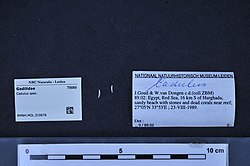
Picture of Cadulus
- Source
- Wikipedia/Commons
- Credit
- nobody named on the record
- Licence
- CC0
- Commercial use
- the licence allows it
No 3D scan was found. Smithsonian Open Access, MorphoSource and Sketchfab were all searched.
The description on this site
- Source
- Wikipedia, “Cadulus”
- Licence
- CC BY-SA 4.0
This is what the site found, which is not the same as what exists.
Keep going
What may have been alongside itGadilinae through timeFormations of the EoceneThe world it lived on
Occurrence data from the Paleobiology Database, CC BY 4.0. Philippi 1844