Phocoenoides dalli
Dall's porpoise is a species of porpoise endemic to the North Pacific. It is the largest of porpoises and the only member of the genus Phocoenoides. The species is named after American naturalist W. H. Dall.

Susan E Adams ( https://www.flickr.com/photos/susanad813/ ) · CC BY-SA 2.0 · via Wikipedia/Commons. May be a photograph of a specimen, or an artist’s reconstruction — an interpretation of a skeleton, since colour and soft tissue are almost never preserved.
On record
Recorded, not inferred- Also called
- Dall's porpoisePBDB
- Sits inside
- PhocoenoidesPBDB
- Diet
- piscivorePBDB, for Phocoenidae
- Life habit
- aquatic, depth=surfacePBDB, for Cetacea
- Motility
- actively mobilePBDB, for Cetacea
- Environment
- marine,freshwaterPBDB, for Odontoceti
- Mass
- 200 kgWikidata
Time the record covers
At most 12 thousand years on record.
Every occurrence read is dated to somewhere between 11.7 ka and 0 Mya, and nothing in the dating separates them, so that window is what the record shows rather than a span.
9 occurrences of Phocoenoides dalli on record, most of them in the Holocene. The Paleobiology Database records this as a living group. Bar height is expected occurrences, not a count: each fossil is spread across the span it is dated to, so a tall narrow bar means tight dating and a low wide one means loose.
When
9 occurrences- Holocene100%
These are dates about fossils, not the animal: the record can only begin after it arose and end before it died out, so either end may reach further. Shares are expected occurrences: a fossil dated to a span is counted partly in each period it straddles. More on what this infers.
Phocoenoides dalli and its relatives
HoloceneWhere Phocoenoides dalli and its relatives were recorded in the Holocene.
Found in the same rock
24 taxa- Phocoena phocoena5 sites
- Sagmatias obliquidens3 sites
- Callorhinus ursinus2 sites
- Cetacea2 sites
- Delphinapterus leucas2 sites
- Enhydra lutris2 sites
- Orcinus orca2 sites
- Ursus maritimus2 sites
- Balaenoptera acutorostrata1 site
- Balaenoptera musculus1 site
- Balaenoptera physalus1 site
- Berardius bairdii1 site
- Erignathus barbatus1 site
- Eubalaena glacialis1 site
- Eumatopias jubata1 site
- Eumetopias jubatus1 site
- Megaptera novaeangliae1 site
- Mesoplodon stejnegeri1 site
- Odobenus rosmarus1 site
- Phoca1 site
- Phoca vitulina1 site
- Physeter macrocephalus1 site
- Pinnipedia indet.1 site
- Pusa hispida1 site
The Paleobiology Database records 9 sites for Phocoenoides dalli, and this reads all of them. The number is how many of those sites it was catalogued from too.
This is not a list of everything alive at the time. It is only what has come out of the same ground as this animal and been written down.
Entered from
6 references- Hidden population turnover of small odontocetes in the northwestern North Pacific during the Holocene3
- Alaska marine mammal stock assessments2
- Sea ice expansion in the Bering Sea during the Neoglacial: evidence from archaeozoology1
- Whales, dorphines [dolphins] and porpoises off Shiretoko1
- Sea mammal hunting and the Neoglacial: An archaeofaunal study of environmental change and subsistence technology at Margaret Bay, Unalaska1
- Catalog of Living Whales1
Each of the 9 occurrences read was entered from one of these publications, ordered by how many each accounts for. This is not a search for papers mentioning the name. Entries link to doi.org where the Paleobiology Database holds an identifier, and to its own record where it does not. Relayed as the Paleobiology Database holds them, not checked against what they resolve to.
Media and terms
Media content1
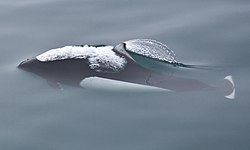
Picture of Phocoenoides dalli
- Source
- Wikipedia/Commons
- Credit
- Susan E Adams ( https://www.flickr.com/photos/susanad813/ )
- Licence
- CC BY-SA 2.0
- Commercial use
- the licence allows it
No 3D scan of Phocoenoides dalli was found in Sketchfab.
Smithsonian Open Access and MorphoSource were not reached for this taxon, so this list is what the others held rather than everything there is.
The description on this site
- Licence
- CC BY-SA 4.0
This is what the site found, which is not the same as what exists.
Keep going
What may have been alongside itPhocoenoides through timeFormations of the HoloceneThe world it lived on
Occurrence data from the Paleobiology Database, CC BY 4.0. (True 1885)