Eumetopias jubatus
The Steller sea lion, also known as Steller's sea lion or the northern sea lion, is a large, near-threatened species of sea lion, predominantly found in the coastal marine habitats of the northeast Pacific Ocean and the Pacific Northwest regions of North America, from north-central California to Oregon, Washington and British Columbia to Alaska. Its range continues across the Northern Pacific and the Aleutian Islands, all the way to Kamchatka, Magadan Oblast, and the Sea of Okhotsk, south to Honshu's northern coastline. It is the sole member of the genus Eumetopias, and the largest of the so-called eared seals (Otariidae). Among pinnipeds, only the walrus and the two species of elephant seal are bigger. The species is named for the naturalist and explorer Georg Wilhelm Steller, who first described them in 1741. Steller sea lions have attracted considerable attention in recent decades, both from scientists and the general public, due to significant declines in their numbers over an extensive portion of their northern range, notably in Alaska.

Алексей Алтухов · CC BY-SA 3.0 · via Wikipedia/Commons. May be a photograph of a specimen, or an artist’s reconstruction — an interpretation of a skeleton, since colour and soft tissue are almost never preserved.
On record
Recorded, not inferred- Also called
- Steller sea lionPBDB
- Sits inside
- EumetopiasPBDB
- Diet
- piscivorePBDB, for Otariidae
- Life habit
- amphibiousPBDB, for Pinnipedia
- Motility
- actively mobilePBDB, for Osteichthyes
- Environment
- marinePBDB, for Pinnipedia
- Mass
- 19.5 kgWikidata
Time the record covers
At least 3.5 million years on record.
The record covers at least 3.6 Mya to 11.7 ka. No occurrence read is dated outside 23.04 Mya to 0 Mya.
25 occurrences of Eumetopias jubatus on record, most of them in the Pleistocene. The Paleobiology Database records this as a living group. Bar height is expected occurrences, not a count: each fossil is spread across the span it is dated to, so a tall narrow bar means tight dating and a low wide one means loose.
When
25 occurrences- Miocene3%
- Pliocene5%
- Pleistocene56%
- Holocene36%
These are dates about fossils, not the animal: the record can only begin after it arose and end before it died out, so either end may reach further. Shares are expected occurrences: a fossil dated to a span is counted partly in each period it straddles. More on what this infers.
Found in
5 formations
- South Bight II Formation1
- Yushima Formation1
- Palos Verdes Sand Formation1
- Omma Formation1
- Ranquil Formation1
Loading coastlines…
The named rock units Eumetopias jubatus has been recovered from, largest first. Drawn where the rock is now, not where it formed. 20 occurrences have no formation on record, which is common for older literature.
Eumetopias jubatus and its relatives
PleistoceneWhere Eumetopias jubatus and its relatives were recorded in the Pleistocene.
Found in the same rock
274 taxa- Callorhinus ursinus9 sites
- Enhydra lutris7 sites
- Phoca vitulina7 sites
- Cetacea5 sites
- Bison4 sites
- Phocoena4 sites
- Zalophus californianus4 sites
- Aethia cristatella3 sites
- Apodemus3 sites
- Canis lupus3 sites
- Cepphus columba3 sites
- Crocidura3 sites
- Microtus3 sites
- Mogera wogura3 sites
- Mustela3 sites
- Myodes3 sites
- Phoca largha3 sites
- Sinomegaceros3 sites
- Sorex3 sites
- Synthliboramphus antiquus3 sites
- Uria aalge3 sites
- Urotrichus talpoides3 sites
- Ursus arctos3 sites
- Aethia pusilla2 sites
The Paleobiology Database records 25 sites for Eumetopias jubatus, and this reads all of them. The number is how many of those sites it was catalogued from too. The 24 sharing the most are listed.
This is not a list of everything alive at the time. It is only what has come out of the same ground as this animal and been written down.
Entered from
17 references- Archaeological and Historical Evidence for an 18th-Century "Blip" in the Distribution of the Northern Fur Seal at Kodiak Island, Alaska4
- Kurten and Anderson, 19804
- Quaternary vertebrates from Shiriya area, Shimokita Pininsula, northeastern Japan3
- The oldest record of the Steller sea lion Eumetopias jubatus (Schreber, 1776) from the early Pleistocene of the North Pacific1
- Reconstruction of Northeastern Pacific Ocean Holocene Production Using Marine Mammal Archaeofauna1
- Pupping-site fidelity among individual Steller sea lions (Eumetopias jubatus) at Chiswell Island, Alaska1
- A late Pleistocene Stellar sea lion (Eumetopias jubatus) from Courtenay, British Columbia: its death, associated biota, and paleoenvironment1
- Annotated Bibliography of Quaternary Vertebrates of Northern North America1
- Sea mammal hunting and the Neoglacial: An archaeofaunal study of environmental change and subsistence technology at Margaret Bay, Unalaska1
- A zooarchaeological study at Buldir Island, Western Aleutians, Alaska1
- Summary of the fossil record of pinnipeds of Japan, and comparisons with that from the eastern North Pacific1
- Preliminary List of the Marine Fishes and Other Vertebrate Remains from the Late Pleistocene Palos Verdes Sand Formation at Costa Mesa, Orange County, California1
Each of the 25 occurrences read was entered from one of these publications, ordered by how many each accounts for. This is not a search for papers mentioning the name. 5 further references are not listed. Entries link to doi.org where the Paleobiology Database holds an identifier, and to its own record where it does not. Relayed as the Paleobiology Database holds them, not checked against what they resolve to.
Media and terms
Media content1
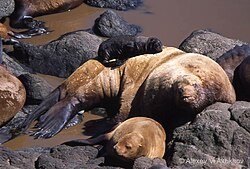
Picture of Eumetopias jubatus
- Source
- Wikipedia/Commons
- Credit
- Алексей Алтухов
- Licence
- CC BY-SA 3.0
- Commercial use
- the licence allows it
No 3D scan of Eumetopias jubatus was found in Sketchfab.
Smithsonian Open Access and MorphoSource were not reached for this taxon, so this list is what the others held rather than everything there is.
The description on this site
- Licence
- CC BY-SA 4.0
This is what the site found, which is not the same as what exists.
Keep going
What may have been alongside itEumetopias through timeFormations of the PleistoceneThe world it lived on
Occurrence data from the Paleobiology Database, CC BY 4.0. (Schreber 1776)