Paracrocodylomorpha
Paracrocodylomorpha is a clade of pseudosuchian archosaurs. The clade includes the diverse and unusual group Poposauroidea as well as the generally carnivorous and quadrupedal members of Loricata, including modern crocodylians. Paracrocodylomorpha was named by paleontologist J. Michael Parrish in 1993, although the group is now considered to encompass more reptiles than his original definition intended. The most recent definition of Paracrocodylomorpha, as defined by Sterling Nesbitt in 2011, is "the least inclusive clade containing Poposaurus and Crocodylus niloticus. Most groups of paracrocodylomorphs became extinct at the end of the Triassic period, with the exception of the crocodylomorphs, from which crocodylians such as crocodiles and alligators evolved in the latter part of the Mesozoic.

Photo by Derek Ramsey ( Ram-Man ) · CC BY-SA 2.5 · via Wikipedia/Commons. May be a photograph of a specimen, or an artist’s reconstruction — an interpretation of a skeleton, since colour and soft tissue are almost never preserved.
On record
Recorded, not inferred- Sits inside
- SuchiaPBDB
- Diet
- carnivorePBDB, for Pseudosuchia
- Motility
- actively mobilePBDB, for Osteichthyes
- Environment
- terrestrialPBDB, for Diapsida
Time the record covers
At least 248 million years on record.
The record covers at least 248.6 Mya to 11.7 ka. No occurrence read is dated outside 251.902 Mya to 0 Mya.
5,719 occurrences of Paracrocodylomorpha on record, most of them in the Late Cretaceous. The Paleobiology Database records this as a living group. Bar height is expected occurrences, not a count: each fossil is spread across the span it is dated to, so a tall narrow bar means tight dating and a low wide one means loose.
When
5,719 occurrences- Early Triassicunder 1%
- Middle Triassicunder 1%
- Late Triassic3%
- Early Jurassic2%
- Middle Jurassic4%
- Late Jurassic8%
- Early Cretaceous11%
- Late Cretaceous26%
- Paleocene6%
- Eocene12%
- Oligocene3%
- Miocene15%
- Pliocene3%
- Pleistocene7%
- Holocene1%
These are dates about fossils, not the animal: the record can only begin after it arose and end before it died out, so either end may reach further. Shares are expected occurrences: a fossil dated to a span is counted partly in each period it straddles. More on what this infers.
Found in
969 formations
- Hell Creek Formation · Montana Group199
- Willwood Formation169
- Solimões Formation100
- Morrison Formation99
- Koobi Fora Formation · Omo Group79
- Urumaco Formation70
Loading coastlines…
The named rock units Paracrocodylomorpha has been recovered from, largest first. Drawn where the rock is now, not where it formed. 945 further formations hold fewer occurrences each and are not listed. 1,031 occurrences have no formation on record, which is common for older literature.
Paracrocodylomorpha and its relatives
Late CretaceousWhere Paracrocodylomorpha and its relatives were recorded in the Late Cretaceous.
Found in the same rock
2,825 taxa- Crocodylus66 sites
- Crocodylia49 sites
- Equus38 sites
- Trionychidae36 sites
- Clarias35 sites
- Bovidae34 sites
- Alcelaphini33 sites
- Geochelone33 sites
- Trionyx33 sites
- Lepisosteus31 sites
- Crocodylus niloticus30 sites
- Osteichthyes29 sites
- Hipparion28 sites
- Euthecodon brumpti26 sites
- Palaeoloxodon recki24 sites
- Reptilia24 sites
- Aves23 sites
- Gazella22 sites
- Kobus22 sites
- Mammalia22 sites
- Suidae22 sites
- Theropithecus oswaldi22 sites
- Giraffidae21 sites
- Lates21 sites
The Paleobiology Database records at least 1,460 sites for Paracrocodylomorpha, and this reads 240 of them. The number is how many of those sites it was catalogued from too. The 24 sharing the most are listed.
This is not a list of everything alive at the time. It is only what has come out of the same ground as this animal and been written down.
Entered from
2,222 references- Stratigraphy and mammalian paleontology of the McCullough Peaks, northern Bighorn Basin, Wyoming: Implications for biochronology, basin development, and community reorganization across the Paleocene-Eocene boundary148
- Review of the Late Cretaceous-early Paleogene crocodylomorphs of Europe: Extinction patterns across the K-PG boundary91
- Georeferencing fossiliferous localities from Solimões and Acre Basins (Brazil) -what we know so far about Solimões Formation and future perspectives87
- Fossil Vertebrate Collections72
- Vertebrate biostratigraphy of the Hell Creek Formation in southwestern North Dakota and northwestern South Dakota68
- Synonymies and reidentifications of North American fossil vertebrates and so forth58
- Fossil crocodilians from Colombia and the Cenozoic history of the Crocodilia in South America52
- Exceptional continental record of biotic recovery after the Cretaceous–Paleogene mass extinction47
- Vertebrate faunal changes through Lancian and Puercan time in southern Wyoming41
- A 60-million-year Cenozoic history of western Amazonian ecosystems in Contamana, eastern Peru39
- Evolutionary relationships and systematics of Atoposauridae (Crocodylomorpha: Neosuchia): implications for the rise of Eusuchia33
- Italian Cenozoic crocodilians: taxa, timing and palaeobiogeographic implications31
Each of the 5,719 occurrences read was entered from one of these publications, ordered by how many each accounts for. This is not a search for papers mentioning the name. 2,210 further references are not listed. Entries link to doi.org where the Paleobiology Database holds an identifier, and to its own record where it does not. Relayed as the Paleobiology Database holds them, not checked against what they resolve to.
Media and terms
Media content2
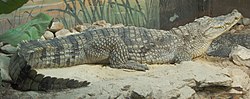
Picture of Paracrocodylomorpha
- Source
- Wikipedia/Commons
- Credit
- Photo by Derek Ramsey ( Ram-Man )
- Licence
- CC BY-SA 2.5
- Commercial use
- the licence allows it
Laser scan
- Source
- MorphoSource
- Licence
- No Copyright (US)
- Commercial use
- cannot be read from the licence given — check the record
- Specimen
- Paracrocodylomorpha indet. · pefo:31183
Smithsonian Open Access was not reached for this taxon, so this list is what the others held rather than everything there is.
The description on this site
- Licence
- CC BY-SA 4.0
This is what the site found, which is not the same as what exists.
Keep going
What may have been alongside itSuchia through timeFormations of the Late CretaceousThe world it lived on
Occurrence data from the Paleobiology Database, CC BY 4.0. Parrish 1993