Kobus
Kobus is a genus containing six species of African antelopes, all of which are associated with marshes, floodplains, or other grassy areas near water. They are sexually dimorphic, with females being smaller and lacking the horns of the males.

Taken and submitted by Paul Maritz (paulmaz) · CC BY-SA 3.0 · via Wikipedia/Commons. May be a photograph of a specimen, or an artist’s reconstruction — an interpretation of a skeleton, since colour and soft tissue are almost never preserved.
On record
Recorded, not inferred- Sits inside
- RedunciniPBDB
- Diet
- grazer, browserPBDB, for Bovidae
- Life habit
- ground dwellingPBDB, for Bovidae
- Motility
- actively mobilePBDB, for Osteichthyes
- Environment
- terrestrialPBDB, for Artiodactyla
Time the record covers
At least 5.3 million years on record.
The record covers at least 5.333 Mya to 11.7 ka. No occurrence read is dated outside 23.04 Mya to 0 Mya.
292 occurrences of Kobus on record, most of them in the Pleistocene. The Paleobiology Database records this as a living group. Bar height is expected occurrences, not a count: each fossil is spread across the span it is dated to, so a tall narrow bar means tight dating and a low wide one means loose.
When
292 occurrences- Miocene4%
- Pliocene22%
- Pleistocene68%
- Holocene5%
These are dates about fossils, not the animal: the record can only begin after it arose and end before it died out, so either end may reach further. Shares are expected occurrences: a fossil dated to a span is counted partly in each period it straddles. More on what this infers.
Found in
28 formations
- Koobi Fora Formation · Omo Group88
- Shungura Formation · Omo Group41
- Nachukui Formation · Omo Group37
- Olduvai Formation · Vogel River Series Group8
- Wembere-Manonga Formation6
- Varswater Formation5
Loading coastlines…
The named rock units Kobus has been recovered from, largest first. Drawn where the rock is now, not where it formed. 4 further formations hold fewer occurrences each and are not listed. 64 occurrences have no formation on record, which is common for older literature.
Kobus and its relatives
PleistoceneWhere Kobus and its relatives were recorded in the Pleistocene.
Found in the same rock
1,005 taxa- Palaeoloxodon recki97 sites
- Alcelaphini92 sites
- Hipparion81 sites
- Equus73 sites
- Reduncini70 sites
- Kolpochoerus limnetes69 sites
- Giraffa59 sites
- Tragelaphus strepsiceros53 sites
- Gazella52 sites
- Ceratotherium simum50 sites
- Metridiochoerus andrewsi49 sites
- Adenota recki47 sites
- Tragelaphus nakuae44 sites
- Hominidae43 sites
- Bovidae41 sites
- Aepyceros melampus40 sites
- Gerontochoerus scotti39 sites
- Tragelaphini39 sites
- Libytherium maurusium38 sites
- Deinotherium bozasi37 sites
- Hippopotamus32 sites
- Hippopotamus karumensis32 sites
- Cercopithecidae31 sites
- Crocodylus31 sites
The Paleobiology Database records 219 sites for Kobus, and this reads all of them. The number is how many of those sites it was catalogued from too. The 24 sharing the most are listed.
This is not a list of everything alive at the time. It is only what has come out of the same ground as this animal and been written down.
Entered from
90 references- Family Bovidae80
- Stratigraphy and Paleontology of pliocene and Pleistocene Localities West of Lake Turkana, Kenya35
- The Omo Group: Archives of the International Omo Research Expedition14
- Plio-Pleistocene terrestrial mammal assemblage from Konso, Southern Ethiopia10
- Extinct large Colobines from the Plio-Pleistocene of Africa9
- Diversity and frequency distributions of Omo Group Cercopithecidae7
- Lothagam: the dawn of humanity in eastern Africa6
- Fossils from Mille-Logya, Afar, Ethiopia, elucidate the link between Pliocene environmental changes and Homo origins5
- Late Pleistocene hunter-gatherers at Ishango (eastern Zaire): the faunal evidence5
- The bone assemblages from the excavated sites4
- Intoduction: Paleontological and Geological Research in the Manonga Valley, Tanzania4
- The first australopithecine 2500 kilometres west of the Rift Valley (Chad)4
Each of the 292 occurrences read was entered from one of these publications, ordered by how many each accounts for. This is not a search for papers mentioning the name. 78 further references are not listed. Entries link to doi.org where the Paleobiology Database holds an identifier, and to its own record where it does not. Relayed as the Paleobiology Database holds them, not checked against what they resolve to.
Media and terms
Media content2
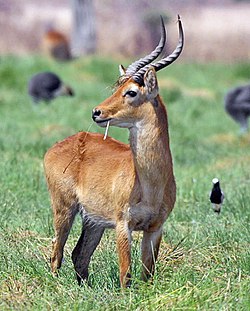
Picture of Kobus
- Source
- Wikipedia/Commons
- Credit
- Taken and submitted by Paul Maritz (paulmaz)
- Licence
- CC BY-SA 3.0
- Commercial use
- the licence allows it
Structured light scan
- Source
- MorphoSource
- Licence
- not stated by the source
- Commercial use
- cannot be read from the licence given — check the record
- Specimen
- Kobus sp. · MNHN:ZM:MO-1974-112
Smithsonian Open Access was not reached for this taxon, so this list is what the others held rather than everything there is.
The description on this site
- Licence
- CC BY-SA 4.0
This is what the site found, which is not the same as what exists.
Keep going
What may have been alongside itReduncini through timeFormations of the PleistoceneThe world it lived on
Occurrence data from the Paleobiology Database, CC BY 4.0. Smith 1840