Millepora alcicornis
Millepora alcicornis, or sea ginger, is a species of fire coral with a calcareous skeleton. It is found on shallow water coral reefs in the tropical west Atlantic Ocean. It shows a variety of different morphologies depending on its location. It feeds on plankton and derives part of its energy requirements from microalgae found within its tissues. It is an important member of the reef building community and subject to the same threats as other corals. It can cause painful stings to unwary divers.

Nhobgood Nick Hobgood · CC BY-SA 3.0 · via Wikipedia/Commons. May be a photograph of a specimen, or an artist’s reconstruction — an interpretation of a skeleton, since colour and soft tissue are almost never preserved.
On record
Recorded, not inferred- Sits inside
- MilleporaPBDB
- Diet
- carnivore, suspension feederPBDB, for Hydrozoa
- Life habit
- epifaunalPBDB, for Hydrozoa
- Motility
- stationary, attachedPBDB, for Hydrozoa
- Vision
- blindPBDB, for Hydrozoa
Time the record covers
At least 33 million years on record.
The record covers at least 33.9 Mya to 129 ka. No occurrence read is dated outside 37.71 Mya to 11.7 ka.
10 occurrences of Millepora alcicornis on record, most of them in the Pleistocene. Bar height is expected occurrences, not a count: each fossil is spread across the span it is dated to, so a tall narrow bar means tight dating and a low wide one means loose.
When
10 occurrences- Eocene10%
- Miocene10%
- Pliocene10%
- Pleistocene70%
These are dates about fossils, not the animal: the record can only begin after it arose and end before it died out, so either end may reach further. Shares are expected occurrences: a fossil dated to a span is counted partly in each period it straddles. More on what this infers.
Found in
5 formations
- Assomada Formation2
- Gatuncillo Formation1
- Key Largo Limestone/Miami Oolite Formation1
- Buckingham Formation1
- Siamaná Formation1
Loading coastlines…
The named rock units Millepora alcicornis has been recovered from, largest first. Drawn where the rock is now, not where it formed. 4 occurrences have no formation on record, which is common for older literature.
Millepora alcicornis and its relatives
PleistoceneWhere Millepora alcicornis and its relatives were recorded in the Pleistocene.
Found in the same rock
53 taxa- Agaricia agaricites1 site
- Amaurellina1 site
- Anthozoa1 site
- Astreopora1 site
- Bivalvia1 site
- Campanile1 site
- Cittarium pica1 site
- Codakia orbicularis1 site
- Columbella mercatoria1 site
- Cubanaster acunai1 site
- Cubitostrea1 site
- Cypraea1 site
- Cypraedia subelegans1 site
- Diploastrea crassolamellata1 site
- Ectinochilus gaudichaudi1 site
- Euspatangus clevei1 site
- Fabianaia cubensis1 site
- Favia weisbordi1 site
- Fimbria jamaicensis1 site
- Glycymeris caracoli1 site
- Goniopora reussiana1 site
- Heliopora1 site
- Lamarcka imbricata1 site
- Lepidocyclina1 site
The Paleobiology Database records 3 sites for Millepora alcicornis, and this reads all of them. The number is how many of those sites it was catalogued from too. The 24 sharing the most are listed.
This is not a list of everything alive at the time. It is only what has come out of the same ground as this animal and been written down.
Entered from
8 references- What Darwin did not see: Pleistocene fossil assemblages on a high energy coast at Ponta das Bicudas, Santiago, Cape Verde Islands2
- A geological reconnaissance of the Dominican Republic2
- Early Miocene coral reef-associated bryozoans from Colombia. Part II: “Ascophora” Cheilostomatida1
- Fossil and recent shallow water corals from the Atlantic islands off western Africa1
- The Pliocene Reefs of Miami: Their Geomorphological Significance in the Evolution of the Atlantic Coastal Ridge, Southeastern Florida, U.S.A.1
- Late Cenozoic corals of south Florida1
- Geology and Paleontology of Canal Zone and adjoining parts of Panama.1
- Geology of the Republic of Haiti1
Each of the 10 occurrences read was entered from one of these publications, ordered by how many each accounts for. This is not a search for papers mentioning the name. Entries link to doi.org where the Paleobiology Database holds an identifier, and to its own record where it does not. Relayed as the Paleobiology Database holds them, not checked against what they resolve to.
Media and terms
Media content2

Picture of Millepora alcicornis
- Source
- Wikipedia/Commons
- Credit
- Nhobgood Nick Hobgood
- Licence
- CC BY-SA 3.0
- Commercial use
- the licence allows it
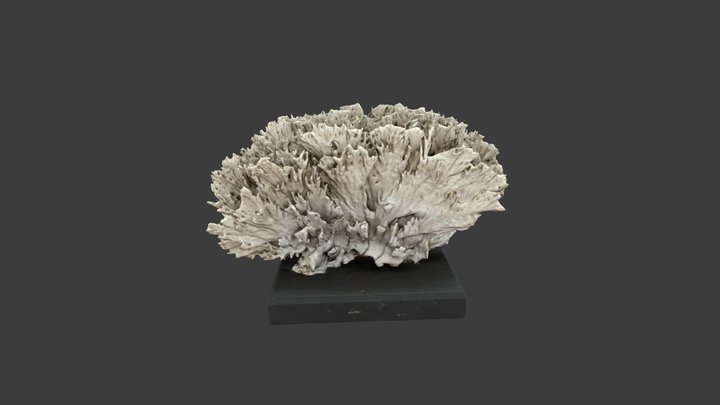
3D model
- Source
- Sketchfab
- Licence
- CC0 Public Domain
- Commercial use
- the licence allows it
Smithsonian Open Access and MorphoSource were not reached for this taxon, so this list is what the others held rather than everything there is.
The description on this site
- Licence
- CC BY-SA 4.0
This is what the site found, which is not the same as what exists.
Keep going
What may have been alongside itMillepora through timeFormations of the PleistoceneThe world it lived on
Occurrence data from the Paleobiology Database, CC BY 4.0. Linnaeus 1758