Campanile
Campanile is a genus of large sea snails, marine gastropod molluscs in the family Campanilidae.

Claire H. from New York City, USA · CC BY-SA 2.0 · via Wikipedia/Commons. May be a photograph of a specimen, or an artist’s reconstruction — an interpretation of a skeleton, since colour and soft tissue are almost never preserved.
On record
Recorded, not inferred- Sits inside
- CampanilidaePBDB
- Diet
- grazerPBDB, for Campanilidae
- Life habit
- epifaunalPBDB, for Campanilidae
- Motility
- actively mobilePBDB, for Campanilidae
- Vision
- limitedPBDB, for Gastropoda
Time the record covers
At least 91 million years on record.
The record covers at least 93.9 Mya to 2.58 Mya. No occurrence read is dated outside 100.5 Mya to 774 ka.
120 occurrences of Campanile on record, most of them in the Eocene. The Paleobiology Database records this as a living group, and the chart stops with its fossils rather than at the present. Bar height is expected occurrences, not a count: each fossil is spread across the span it is dated to, so a tall narrow bar means tight dating and a low wide one means loose.
When
120 occurrences- Late Cretaceous18%
- Paleocene19%
- Eocene48%
- Oligocene4%
- Miocene8%
- Pliocene2%
- Pleistoceneunder 1%
These are dates about fossils, not the animal: the record can only begin after it arose and end before it died out, so either end may reach further. Shares are expected occurrences: a fossil dated to a span is counted partly in each period it straddles. More on what this infers.
Found in
52 formations
- Shekhan Formation8
- Poivre Formation6
- Simsima Formation6
- Marnes de Smail Formation6
- Clayton Formation · Midway Group5
- Selsey Formation · Bracklesham Group5
Loading coastlines…
The named rock units Campanile has been recovered from, largest first. Drawn where the rock is now, not where it formed. 28 further formations hold fewer occurrences each and are not listed. 17 occurrences have no formation on record, which is common for older literature.
Campanile and its relatives
EoceneWhere Campanile and its relatives were recorded in the Eocene.
Found in the same rock
1,837 taxa- Velates perversus12 sites
- Ampullina11 sites
- Crassatella10 sites
- Venericardia10 sites
- Chama9 sites
- Conus9 sites
- Turritella9 sites
- Natica8 sites
- Bittium7 sites
- Cerithiella7 sites
- Cerithiopsis7 sites
- Cerithium7 sites
- Glycymeris7 sites
- Ostrea7 sites
- Sassia7 sites
- Spondylus7 sites
- Tellina7 sites
- Amaurellina6 sites
- Cepatia cepacea6 sites
- Cypraea6 sites
- Euspira6 sites
- Ficus6 sites
- Hipponix6 sites
- Pseudoliva6 sites
The Paleobiology Database records 80 sites for Campanile, and this reads all of them. The number is how many of those sites it was catalogued from too. The 24 sharing the most are listed.
This is not a list of everything alive at the time. It is only what has come out of the same ground as this animal and been written down.
Entered from
62 references- A contribution to the study of the Eocene in Western Pakistan and Western India: C. The description of the Scaphopoda and Gastropoda from standard sections in the Rakhi Nala and Zindar Pir areas of the Western Punjab and in the Kohat District8
- New reports of the large gastropod Campanile from the Paleocene and Eocene of the Pacific Coast of North America7
- Cenomanian gastropods of Bellezma-Aures mountains (Batna, NE Algeria): Taxonomy, palaeoecology and palaeobiogeography6
- Late Cretaceous (Maastrichtian) echinoid-mollusc-coral assemblages and palaeoenvironments from a Tethyan carbonate platform succession, northern Oman Mountains6
- Cenozoic Molluscs and Echinoids of Barrow Island, Western Australia6
- A catalogue of Danian gastropods from the Baunekule facies, Faxe Formation, Denmark4
- Distribution of Mollusca in Units S1 to S9 of the Selsey Formation (middle Lutetian), Selsey Peninsula, West Sussex4
- L'Oligocene e il Miocene della Somalia. Stratigrafia, Tettonica, Paleontologia (Macroforaminferi, Coralli, Molluschi)4
- Taxonomy and palaeoecology of the Cenomanian-Turonian macroinvertebrates from eastern Sinai, Egypt (part A)3
- Stratigraphic Distribution of Paleocene and Eocene Fossils in the Eastern Gulf Coast Region3
- Eocene Mollusks from Curacao, West Indies3
- The age of the so-called Danian fauna from Tibet3
Each of the 120 occurrences read was entered from one of these publications, ordered by how many each accounts for. This is not a search for papers mentioning the name. 50 further references are not listed. Entries link to doi.org where the Paleobiology Database holds an identifier, and to its own record where it does not. Relayed as the Paleobiology Database holds them, not checked against what they resolve to.
Media and terms
Media content2

Picture of Campanile
- Source
- Wikipedia/Commons
- Credit
- Claire H. from New York City, USA
- Licence
- CC BY-SA 2.0
- Commercial use
- the licence allows it
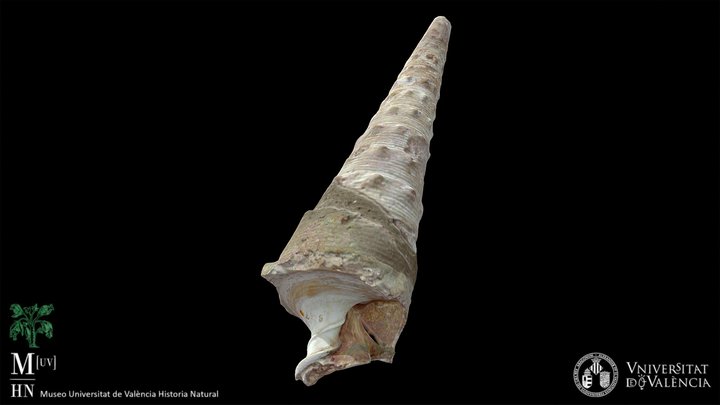
3D model
- Source
- Sketchfab
- Licence
- CC Attribution
- Commercial use
- cannot be read from the licence given — check the record
The description on this site
- Licence
- CC BY-SA 4.0
This is what the site found, which is not the same as what exists.
Keep going
What may have been alongside itCampanilidae through timeFormations of the EoceneThe world it lived on
Occurrence data from the Paleobiology Database, CC BY 4.0. Fischer 1884