Ampullina
Ampullina is an extinct taxonomic genus of deep-water sea snails, marine gastropod molluscs in the clade Caenogastropoda. These sea snails were epifaunal grazers. They lived from the Middle Triassic period to the Lower Pliocene age.

Hectonichus · CC BY-SA 3.0 · via Wikipedia/Commons. May be a photograph of a specimen, or an artist’s reconstruction — an interpretation of a skeleton, since colour and soft tissue are almost never preserved.
On record
Recorded, not inferred- Sits inside
- AmpullinidaePBDB
- Diet
- grazerPBDB, for Ampullinoidea
- Life habit
- epifaunalPBDB, for Ampullinoidea
- Motility
- actively mobilePBDB, for Ampullinoidea
- Vision
- limitedPBDB, for Gastropoda
Time the record covers
At least 236 million years on record.
The record covers at least 241.464 Mya to 5.333 Mya. No occurrence read is dated outside 247 Mya to 3.6 Mya.
533 occurrences of Ampullina on record, most of them in the Late Cretaceous. The Paleobiology Database records this as a living group, and the chart stops with its fossils rather than at the present. Bar height is expected occurrences, not a count: each fossil is spread across the span it is dated to, so a tall narrow bar means tight dating and a low wide one means loose.
When
533 occurrences- Middle Triassicunder 1%
- Late Triassic6%
- Middle Jurassic2%
- Late Jurassic18%
- Early Cretaceous5%
- Late Cretaceous30%
- Paleocene7%
- Eocene26%
- Oligocene4%
- Miocene2%
- Plioceneunder 1%
These are dates about fossils, not the animal: the record can only begin after it arose and end before it died out, so either end may reach further. Shares are expected occurrences: a fossil dated to a span is counted partly in each period it straddles. More on what this infers.
Found in
122 formations
- Cassian Formation29
- Alcobaca Formation26
- Ladd Formation26
- Jalama Formation18
- Redding Formation15
- Shekhan Formation13
Loading coastlines…
The named rock units Ampullina has been recovered from, largest first. Drawn where the rock is now, not where it formed. 98 further formations hold fewer occurrences each and are not listed. 108 occurrences have no formation on record, which is common for older literature.
Ampullina and its relatives
Late CretaceousWhere Ampullina and its relatives were recorded in the Late Cretaceous.
Found in the same rock
3,612 taxa- Turritella42 sites
- Nanogyra (Nanogyra) nana39 sites
- Cardium31 sites
- Nuculana29 sites
- Arcomytilus28 sites
- Dentalium26 sites
- Protocardia26 sites
- Serpula26 sites
- Nicaniella25 sites
- Ostrea24 sites
- Gastropoda23 sites
- Glycymeris23 sites
- Liostrea23 sites
- Pteria22 sites
- Corbula21 sites
- Isocyprina21 sites
- Cucullaea20 sites
- Modiolus20 sites
- Nerita20 sites
- Cerithium19 sites
- Corbulomima19 sites
- Crassatella19 sites
- Euspira19 sites
- Camptonectes18 sites
The Paleobiology Database records 406 sites for Ampullina, and this reads 240 of them. Of that, one read hit the database's own return limit, so every count below is a floor rather than a total. The number is how many of those sites it was catalogued from too. The 24 sharing the most are listed.
This is not a list of everything alive at the time. It is only what has come out of the same ground as this animal and been written down.
Entered from
160 references- Unpublished data54
- Primary collection data of Cassian Formation used for publication of Fürsich and Wendt (1977) (ref. 9188)27
- Palökologische und biofazielle Analyse des Kimmeridge (Oberjura) von Consolacao, Mittelportugal [Paleoecological and biofacies analysis of the Kimmeridgian (Upper Jurassic) of Consolacao, central Portugal]20
- Upper Cretaceous formations and faunas of southern California20
- Mollusca from the upper Cretaceous Jalama Formation, Santa Barbara County, California18
- Mid-Cretaceous (Albian to Turonian) biostratigraphy of northern California15
- Mollusca of the Tertiary formations of Northeastern Mexico14
- A contribution to the study of the Eocene in Western Pakistan and Western India: C. The description of the Scaphopoda and Gastropoda from standard sections in the Rakhi Nala and Zindar Pir areas of the Western Punjab and in the Kohat District13
- Stratigraphy of the outcropping post-Magothy Upper Cretaceous formations in Southern New Jersey an Northern Delmarva peninsula, Delaware and Maryland11
- Fauna de moluste a depozitelor Paleogene din nord-vestul Transilvaniei [Molluscan fauna from Paleogene deposits from NW Transilvania]10
- Mollusca of the Cretaceous Bald Hills Formation of California9
- A contribution to the invertebrate fauna of the Oligocene beds of Flint, River9
Each of the 533 occurrences read was entered from one of these publications, ordered by how many each accounts for. This is not a search for papers mentioning the name. 148 further references are not listed. Entries link to doi.org where the Paleobiology Database holds an identifier, and to its own record where it does not. Relayed as the Paleobiology Database holds them, not checked against what they resolve to.
Media and terms
Media content2

Picture of Ampullina
- Source
- Wikipedia/Commons
- Credit
- Hectonichus
- Licence
- CC BY-SA 3.0
- Commercial use
- the licence allows it
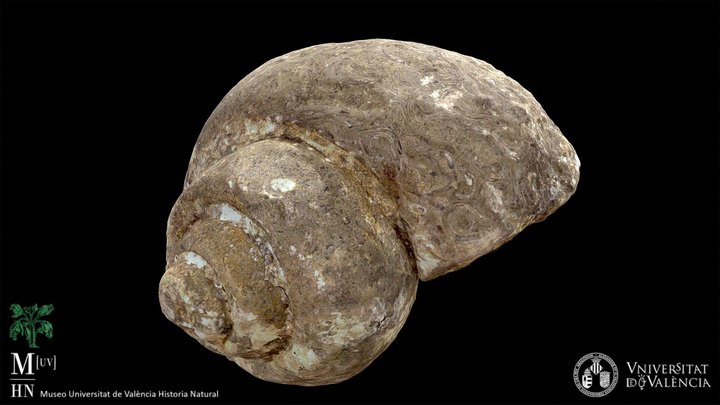
3D model
- Source
- Sketchfab
- Licence
- CC Attribution
- Commercial use
- cannot be read from the licence given — check the record
The description on this site
- Source
- Wikipedia, “Ampullina”
- Licence
- CC BY-SA 4.0
This is what the site found, which is not the same as what exists.
Keep going
What may have been alongside itAmpullinidae through timeFormations of the Late CretaceousThe world it lived on
Occurrence data from the Paleobiology Database, CC BY 4.0. (Férussac 1822)