Meriones
Meriones is a rodent genus that includes the gerbil most commonly kept as a pet, Meriones unguiculatus. The genus contains most animals referred to as jirds, but members of the genera Sekeetamys, Brachiones, and sometimes Pachyuromys are also known as jirds. The distribution of Meriones ranges from northern Africa to Mongolia. Meriones jirds tend to inhabit arid regions including clay desert, sandy desert, and steppe, but are also in slightly wetter regions, and are an agricultural pest.

Users Pengo , Ericje on en.wikipedia · CC BY-SA 3.0 · via Wikipedia/Commons. May be a photograph of a specimen, or an artist’s reconstruction — an interpretation of a skeleton, since colour and soft tissue are almost never preserved.
On record
Recorded, not inferred- Also called
- jirdPBDB
- Sits inside
- GerbillinaePBDB
- Diet
- herbivore, insectivorePBDB, for Muridae
- Life habit
- ground dwellingPBDB, for Muridae
- Motility
- actively mobilePBDB, for Osteichthyes
- Environment
- terrestrialPBDB, for Eutheria
Time the record covers
At least 2.4 million years on record.
The record covers at least 2.58 Mya to 129 ka. No occurrence read is dated outside 5.333 Mya to 0 Mya.
27 occurrences of Meriones on record, most of them in the Pleistocene. The Paleobiology Database records this as a living group. Bar height is expected occurrences, not a count: each fossil is spread across the span it is dated to, so a tall narrow bar means tight dating and a low wide one means loose.
When
27 occurrences- Pliocene4%
- Pleistocene96%
These are dates about fossils, not the animal: the record can only begin after it arose and end before it died out, so either end may reach further. Shares are expected occurrences: a fossil dated to a span is counted partly in each period it straddles. More on what this infers.
Found in
1 formation
Loading coastlines…
The named rock units Meriones has been recovered from, largest first. Drawn where the rock is now, not where it formed. 26 occurrences have no formation on record, which is common for older literature.
Meriones and its relatives
PleistoceneWhere Meriones and its relatives were recorded in the Pleistocene.
Found in the same rock
216 taxa- Gerbillus14 sites
- Paraethomys12 sites
- Ellobius10 sites
- Equus10 sites
- Praomys9 sites
- Crocidura7 sites
- Mus7 sites
- Arvicanthis6 sites
- Apodemus5 sites
- Bos primigenius5 sites
- Gazella atlantica5 sites
- Hystrix cristata5 sites
- Mus musculus5 sites
- Spalax5 sites
- Vulpes vulpes5 sites
- Chiroptera4 sites
- Cricetulus4 sites
- Crocuta crocuta4 sites
- Eliomys4 sites
- Lepus capensis4 sites
- Mascaromys medius4 sites
- Microtus4 sites
- Microtus guentheri4 sites
- Panthera leo4 sites
The Paleobiology Database records 24 sites for Meriones, and this reads all of them. The number is how many of those sites it was catalogued from too. The 24 sharing the most are listed.
This is not a list of everything alive at the time. It is only what has come out of the same ground as this animal and been written down.
Entered from
14 references- Decouverte en Afrique du Nord de restes humains du Paleolithique inferieur8
- Plio-Pleistocene mammalian biostratigraphy of Atlantic Morocco6
- The microvertebrates of Qesem Cave: A comparison of the two concentrations2
- Canis othmanii sp. nov. (Carnivora, Canidae) from the early Middle Pleistocene site of Wadi Sarrat (Tunisia)1
- The Villafranchian mammalian faunas and biochronology of Greece1
- Fossil equids (Mammalia, Equidae) from the Neogene and Pleistocene of Tadzhikistan1
- Upper Cenozoic bio-magnetic stratigraphy of Central Asian mammalian localities1
- The Mousterian site of Jebel Irhoud, Morocco: new data on the fauna and biochronology, and description of a new human fossil1
- Micromammiferes du Pleistocene moyen de Latamne (Syrie)1
- Le site paleontologique et archeologique de DoukkalaII:premier jalon en Afrique du Nord dun comportement humain assimilable a un charongnage controle et actif1
- Pleistocene Mammals from Lakhuti, Southern Tadjikistan, U.S.S.R.1
- The faunal remains of Iraq e Zigan, a Late Pleistocene site on Mt. Carmel1
Each of the 27 occurrences read was entered from one of these publications, ordered by how many each accounts for. This is not a search for papers mentioning the name. 2 further references are not listed. Entries link to doi.org where the Paleobiology Database holds an identifier, and to its own record where it does not. Relayed as the Paleobiology Database holds them, not checked against what they resolve to.
Media and terms
Media content2
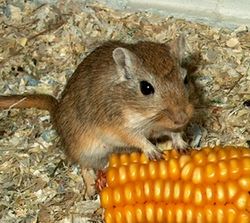
Picture of Meriones
- Source
- Wikipedia/Commons
- Credit
- Users Pengo , Ericje on en.wikipedia
- Licence
- CC BY-SA 3.0
- Commercial use
- the licence allows it
CT scan
- Source
- MorphoSource
- Licence
- not stated by the source
- Commercial use
- cannot be read from the licence given — check the record
- Specimen
- Meriones sp. · iphes:201
Smithsonian Open Access was not reached for this taxon, so this list is what the others held rather than everything there is.
The description on this site
- Licence
- CC BY-SA 4.0
This is what the site found, which is not the same as what exists.
Keep going
What may have been alongside itGerbillinae through timeFormations of the PleistoceneThe world it lived on
Occurrence data from the Paleobiology Database, CC BY 4.0. Illiger 1811