Melobesioideae
The Melobesioideae are a subfamily of Corallinacean Coralline algae with multiporate conceptacles.

Smith609 · CC BY-SA 3.0 · via Wikipedia/Commons. May be a photograph of a specimen, or an artist’s reconstruction — an interpretation of a skeleton, since colour and soft tissue are almost never preserved.
On record
Recorded, not inferred- Sits inside
- HapalidiaceaePBDB
- Diet
- "photoautotroph"PBDB, for Rhodophyta
Time the record covers
At least 100 million years on record.
The record covers at least 100.5 Mya to 11.7 ka. No occurrence read is dated outside 113.2 Mya to 0 Mya.
230 occurrences of Melobesioideae on record, most of them in the Miocene. The Paleobiology Database records this as a living group. Bar height is expected occurrences, not a count: each fossil is spread across the span it is dated to, so a tall narrow bar means tight dating and a low wide one means loose.
When
230 occurrences- Early Cretaceousunder 1%
- Paleocene13%
- Eocene29%
- Oligocene16%
- Miocene34%
- Pliocene3%
- Pleistocene2%
- Holocene2%
These are dates about fossils, not the animal: the record can only begin after it arose and end before it died out, so either end may reach further. Shares are expected occurrences: a fossil dated to a span is counted partly in each period it straddles. More on what this infers.
Found in
30 formations
- Sylhet Formation Formation29
- Barra Honda Formation14
- Prang Formation · Sylhet Limestone Group11
- Tortonian Limestone Formation9
- Guitar Formation Formation8
- Lakadong Formation · Shlhet Limestone Group7
Loading coastlines…
The named rock units Melobesioideae has been recovered from, largest first. Drawn where the rock is now, not where it formed. 6 further formations hold fewer occurrences each and are not listed. 100 occurrences have no formation on record, which is common for older literature.
Melobesioideae and its relatives
MioceneWhere Melobesioideae and its relatives were recorded in the Miocene.
Found in the same rock
445 taxa- Bryozoa82 sites
- Sporolithon60 sites
- Echinodermata56 sites
- Spongites54 sites
- Discocyclina50 sites
- Mesophyllum50 sites
- Operculina49 sites
- Amphistegina48 sites
- Heterostegina43 sites
- Mastophoroideae42 sites
- Nummulites42 sites
- Lithothamnion40 sites
- Mollusca40 sites
- Textulariida38 sites
- Ranikothalia37 sites
- Lithophyllum32 sites
- Lepidocyclina (Nephrolepidina)31 sites
- Aethesolithon30 sites
- Glomalveolina30 sites
- Halimeda30 sites
- Dasycladales29 sites
- Lockhartia29 sites
- Sporolithon lugeonii29 sites
- Distichoplax28 sites
The Paleobiology Database records 198 sites for Melobesioideae, and this reads all of them. The number is how many of those sites it was catalogued from too. The 24 sharing the most are listed.
This is not a list of everything alive at the time. It is only what has come out of the same ground as this animal and been written down.
Entered from
48 references- The Enigmatic Paleocene-Eocene coralline Distichoplax: Approaching the structural complexities, ecological affinities and extinction hypotheses29
- Late Chattian platform carbonates with benthic foraminifera and coralline algae from the SE Iberian plate26
- On the calcareous algae (Melobesioideae) of Gebel Gharra (Cario-Suez road) with a local zonation and some possible correlations21
- Paleocene-earliest Eocene larger benthic foraminifera and Ranikothalia-bearing carbonate paleo-environments of Costa Rica (South Central America)13
- Coralline red algal limestones of the late Eocene alpine Foreland Basin in Upper Austria: Component analysis, facies and palecology11
- Paleogene shallow-water larger foraminifers from holes 714A and 715A, Leg 115, Indian Ocean10
- Coralline algae from the Prang Formation (middle-late Eocene) of the Lumshnong area, Jaintia Hills, Meghalaya9
- Palaeoenvironmental reconstruction based on non-geniculate coralline red algal assemblages in Miocene limestone of central Crete9
- Fossil and recent calcareous algae from Guam9
- Facies analysis and paleoenvironmental interpretation of Piacenzian carbonate deposits from the Guitar Formation of Car Nicobar Island, India8
- Additional Coralline Algae from the Lower Miocene to Late Holocene Sediments of the Porbandar Group, Gujarat7
- Coralline algae (Corallinales, Rhodophyta) in western and central Mediterranean Messinian reefs6
Each of the 230 occurrences read was entered from one of these publications, ordered by how many each accounts for. This is not a search for papers mentioning the name. 36 further references are not listed. Entries link to doi.org where the Paleobiology Database holds an identifier, and to its own record where it does not. Relayed as the Paleobiology Database holds them, not checked against what they resolve to.
Media and terms
Media content1
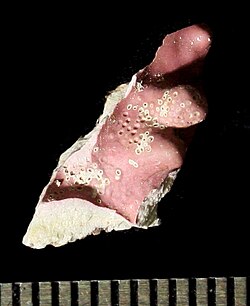
Picture of Melobesioideae
- Source
- Wikipedia/Commons
- Credit
- Smith609
- Licence
- CC BY-SA 3.0
- Commercial use
- the licence allows it
No 3D scan of Melobesioideae was found in MorphoSource and Sketchfab.
Smithsonian Open Access was not reached for this taxon, so this list is what the others held rather than everything there is.
The description on this site
- Licence
- CC BY-SA 4.0
This is what the site found, which is not the same as what exists.
Keep going
What may have been alongside itHapalidiaceae through timeFormations of the MioceneThe world it lived on
Occurrence data from the Paleobiology Database, CC BY 4.0. Bizzozero 1885