Mollusca
Mollusca is a phylum of protostomic invertebrate animals, whose members are known as molluscs or mollusks. 86,600 extant species of molluscs are recognized, making it the second-largest animal phylum after Arthropoda. The number of additional fossil species is estimated between 60,000 and 100,000, and the proportion of undescribed extant species is very high. Many taxa remain poorly studied.

PaleoNeolitic · CC BY 4.0 · via Wikipedia/Commons. May be a photograph of a specimen, or an artist’s reconstruction — an interpretation of a skeleton, since colour and soft tissue are almost never preserved.
On record
Recorded, not inferred- Also called
- molluskPBDB
- Sits inside
- LophotrochozoaPBDB
Time the record covers
At least 468 million years on record.
The record covers at least 509.7 Mya to 41.03 Mya. No occurrence read is dated outside 538.8 Mya to 33.9 Mya.
12,000+ occurrences of Mollusca on record. The Paleobiology Database records this as a living group, and the chart stops with its fossils rather than at the present. Bar height is expected occurrences, not a count: each fossil is spread across the span it is dated to, so a tall narrow bar means tight dating and a low wide one means loose.
When
12,000 occurrences read- Cambrianunder 1%
- Ordovician8%
- Silurian4%
- Devonian2%
- Carboniferous7%
- Permianunder 1%
- Late Jurassic13%
- Early Cretaceousunder 1%
- Late Cretaceous48%
- Eocene15%
These are dates about fossils, not the animal: the record can only begin after it arose and end before it died out, so either end may reach further. Shares are expected occurrences: a fossil dated to a span is counted partly in each period it straddles. The read hit its cap, so every figure above is a floor and the shares are of the occurrences read. More on what this infers.
Found in
at least 238 formations
- Kap Leslie Formation1,504
- Moodys Branch Formation · Jackson Group991
- Pierre Shale Formation · Montana Group450
- Jalama Formation421
- Lisbon Formation341
- Cook Mountain Formation249
Loading coastlines…
The named rock units Mollusca has been recovered from, largest first. Drawn where the rock is now, not where it formed. The read hit its cap, so each count is a floor. 214 further formations hold fewer occurrences each and are not listed. 5,124 occurrences have no formation on record, which is common for older literature.
Found in the same rock
1,669 taxa- Crinoidea99 sites
- Brachiopoda51 sites
- Crurithyris50 sites
- Gastropoda50 sites
- Rhombopora43 sites
- Isotelus37 sites
- Bivalvia33 sites
- Flexicalymene33 sites
- Rafinesquina33 sites
- Ambonychia30 sites
- Hallopora30 sites
- Modiolopsis30 sites
- Hustedia29 sites
- Nuculites29 sites
- Leptaena28 sites
- Zygospira28 sites
- Lingula27 sites
- Ctenodonta26 sites
- Bryozoa25 sites
- Pterinea25 sites
- Strophomena24 sites
- Chonetinella23 sites
- Platystrophia23 sites
- Punctospirifer23 sites
The Paleobiology Database records at least 353 sites for Mollusca, and this reads 240 of them. The number is how many of those sites it was catalogued from too. The 24 sharing the most are listed.
This is not a list of everything alive at the time. It is only what has come out of the same ground as this animal and been written down.
Entered from
at least 194 references- Unpublished data on Cretaceous-Paleocene molluscan assemblages4,846
- Genesis and environmental significance of Upper Cretaceous shell concentrations from the Cauvery Basin, southern India1,070
- Fossil assemblages of a marine transgressive sand, Moody''s Branch Formation (Upper Eocene), Louisiana and Mississippi1,066
- Ecological control of evolutionary rates in Paleocene - Eocene marine molluscs742
- The Red Bird Section of the Upper Cretaceous Pierre Shale in Wyoming475
- Unpublished data447
- Mollusca from the upper Cretaceous Jalama Formation, Santa Barbara County, California396
- Paleoecology and taphonomy of faunal assemblages in gray "core" (offshore) shales in Midcontinent Pennsylvanian cyclothems336
- The fossil fauna of the Ordovician in the Cincinnati Region331
- T.D. Olszewski''s Ph.D. - Penn State University136
- Stratigraphic and Paleontologic Studies of the Pennsylvanian and Permian Rocks in North-Central Texas114
- Pennsylvanian Invertebrate Faunas of Southeastern Kansas94
Each of the 12,000 occurrences read was entered from one of these publications, ordered by how many each accounts for. This is not a search for papers mentioning the name. That read hit its cap, so each count is a floor. 182 further references are not listed. Entries link to doi.org where the Paleobiology Database holds an identifier, and to its own record where it does not. Relayed as the Paleobiology Database holds them, not checked against what they resolve to.
Media and terms
Media content3

Picture of Mollusca
- Source
- Wikipedia/Commons
- Credit
- PaleoNeolitic
- Licence
- CC BY 4.0
- Commercial use
- the licence allows it
Photogrammetry
- Source
- MorphoSource
- Licence
- not stated by the source
- Commercial use
- cannot be read from the licence given — check the record
- Specimen
- mollusca indet. · MST:PALEO:MST-SP-2476
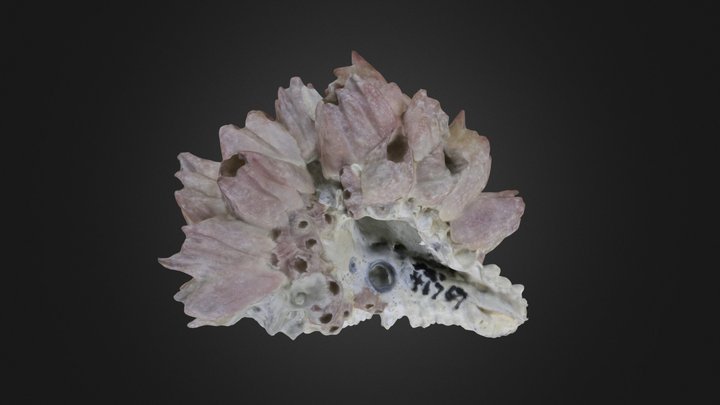
3D model
- Source
- Sketchfab
- Licence
- CC0 Public Domain
- Commercial use
- the licence allows it
The description on this site
- Source
- Wikipedia, “Mollusca”
- Licence
- CC BY-SA 4.0
This is what the site found, which is not the same as what exists.
Keep going
What may have been alongside itLophotrochozoa through timeThe world it lived on
Occurrence data from the Paleobiology Database, CC BY 4.0. (Linnaeus 1758)