Amphistegina
Amphistegina is a genus of foraminiferal protists included in the Rotaliida with a stratigraphic range extending from the Eocene to recent and a cosmopolitan distribution. The test is an asymmetrically biconvex trochospiral that may be bi-involute or partially evolute on the spiral side. Chambers are numerous, broad. and low, strongly curved back at the periphery to form chamber prolongations. The umbilical side is stellate, like that of Asterigerina, and has a distinct umbilical plug. The wall is calcareous, optically radial; the surface finely perforate and smooth overall. The periphery angular to carinate (keeled); the aperture an interiomarginal slit on the umbilical side, bordered by a lip.

Carlos Natário · CC BY-SA 4.0 · via Wikipedia/Commons. May be a photograph of a specimen, or an artist’s reconstruction — an interpretation of a skeleton, since colour and soft tissue are almost never preserved.
On record
Recorded, not inferred- Sits inside
- AmphisteginidaePBDB
- Diet
- carnivorePBDB
- Life habit
- semi-infaunalPBDB, for Foraminifera
- Motility
- stationaryPBDB, for Rotaliina
- Environment
- outer shelf,marinePBDB, for Rotaliina
Time the record covers
At least 48 million years on record.
The record covers at least 48.07 Mya to 11.7 ka. No occurrence read is dated outside 56 Mya to 0 Mya.
683 occurrences of Amphistegina on record, most of them in the Pleistocene. The Paleobiology Database records this as a living group. Bar height is expected occurrences, not a count: each fossil is spread across the span it is dated to, so a tall narrow bar means tight dating and a low wide one means loose.
When
683 occurrencesThese are dates about fossils, not the animal: the record can only begin after it arose and end before it died out, so either end may reach further. Shares are expected occurrences: a fossil dated to a span is counted partly in each period it straddles. More on what this infers.
Found in
50 formations
- Qom Formation Formation77
- Tortonian Limestone Formation33
- Lithothamnion limestone Formation18
- Lower Coralline Limestone Formation8
- Guitar Formation Formation8
- Nummulitic Limestone Formation8
Loading coastlines…
The named rock units Amphistegina has been recovered from, largest first. Drawn where the rock is now, not where it formed. 26 further formations hold fewer occurrences each and are not listed. 446 occurrences have no formation on record, which is common for older literature.
Amphistegina and its relatives
PleistoceneWhere Amphistegina and its relatives were recorded in the Pleistocene.
Found in the same rock
943 taxa- Elphidium105 sites
- Cibicidoides93 sites
- Foraminifera84 sites
- Cibicides83 sites
- Quinqueloculina70 sites
- Bolivina61 sites
- Textularia59 sites
- Operculina53 sites
- Discorbinella48 sites
- Lenticulina44 sites
- Heterostegina37 sites
- Heterolepa34 sites
- Uvigerina31 sites
- Lagena29 sites
- Ammonia27 sites
- Reussella25 sites
- Triloculina25 sites
- Globocassidulina23 sites
- Mesophyllum23 sites
- Cancris22 sites
- Elphidium advenum22 sites
- Melonis22 sites
- Nonionoides22 sites
- Rotalinoides22 sites
The Paleobiology Database records 514 sites for Amphistegina, and this reads 240 of them. The number is how many of those sites it was catalogued from too. The 24 sharing the most are listed.
This is not a list of everything alive at the time. It is only what has come out of the same ground as this animal and been written down.
Entered from
108 references- Sedimentary facies and depositional environments of the Oligocene–early Miocene marine Qom Formation, Central Iran Back-Arc Basin, Iran (northeastern margin of the Tethyan Seaway)77
- Site U146277
- Site U146442
- Site U146134
- Palaeoenvironmental reconstruction based on non-geniculate coralline red algal assemblages in Miocene limestone of central Crete33
- Late Chattian platform carbonates with benthic foraminifera and coralline algae from the SE Iberian plate29
- Site U139726
- Site U146523
- Site U146623
- Site U139819
- Middle Miocene warm-temperate carbonates of Central Paratethys (Mt. Zrinska Gora, Croatia): paleoenvironmental reconstruction based on bryozoans, coralline red algae, foraminifera, and calcareous nannoplankton18
- Coralline Algae and Benthic Foraminifera from the Long Formation (middle Miocene) of the Little Andaman Island, India: Biofacies Analysis, Systematics and Palaeoenvironmental Implications13
Each of the 683 occurrences read was entered from one of these publications, ordered by how many each accounts for. This is not a search for papers mentioning the name. 96 further references are not listed. Each entry links to doi.org. Relayed as the Paleobiology Database holds them, not checked against what they resolve to.
Media and terms
Media content2

Picture of Amphistegina
- Source
- Wikipedia/Commons
- Credit
- Carlos Natário
- Licence
- CC BY-SA 4.0
- Commercial use
- the licence allows it
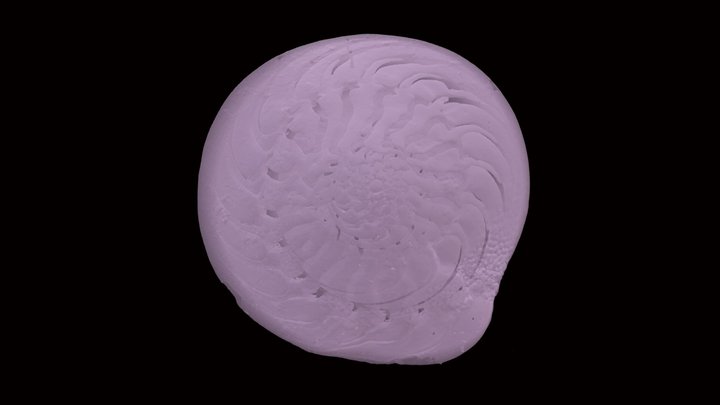
3D model
- Source
- Sketchfab
- Credit
- BelangerForamLab
- Licence
- CC Attribution-NonCommercial
- Commercial use
- the licence does not allow it
Smithsonian Open Access and MorphoSource were not reached for this taxon, so this list is what the others held rather than everything there is.
The description on this site
- Licence
- CC BY-SA 4.0
This is what the site found, which is not the same as what exists.
Keep going
What may have been alongside itAmphisteginidae through timeFormations of the PleistoceneThe world it lived on
Occurrence data from the Paleobiology Database, CC BY 4.0. d'Orbigny 1826