Foraminifera
Foraminifera are single-celled organisms, members of a phylum or class of Rhizarian protists characterized by streaming granular ectoplasm for catching food and other uses; and commonly an external shell called a test of diverse forms and materials. Tests of chitin are believed to be the most primitive type. Most foraminifera are marine, the majority of which live on or within the seafloor sediment, while a smaller number float in the water column at various depths, which belong to the suborder Globigerinina. Fewer are known from freshwater or brackish conditions, and some very few (nonaquatic) soil species have been identified through molecular analysis of small subunit ribosomal DNA.

Scott Fay · CC BY 2.5 · via Wikipedia/Commons. May be a photograph of a specimen, or an artist’s reconstruction — an interpretation of a skeleton, since colour and soft tissue are almost never preserved.
On record
Recorded, not inferred- Also called
- foramPBDB
- Sits inside
- RhizariaPBDB
- Diet
- omnivorePBDB
- Life habit
- semi-infaunalPBDB
- Motility
- stationaryPBDB
Time the record covers
At least 528 million years on record.
The record covers at least 529 Mya to 11.7 ka. No occurrence read is dated outside 538.8 Mya to 0 Mya.
12,000+ occurrences of Foraminifera on record. The Paleobiology Database records this as a living group. Bar height is expected occurrences, not a count: each fossil is spread across the span it is dated to, so a tall narrow bar means tight dating and a low wide one means loose.
When
12,000 occurrences read- Cambrianunder 1%
- Ordovicianunder 1%
- Silurianunder 1%
- Devonian2%
- Carboniferous11%
- Permian7%
- Early Triassicunder 1%
- Middle Triassic2%
- Late Triassic5%
- Early Jurassic2%
- Middle Jurassic6%
- Late Jurassic4%
- Early Cretaceous4%
- Late Cretaceous36%
- Paleocene10%
- Eocene5%
- Oligocene2%
- Miocene2%
- Plioceneunder 1%
- Pleistoceneunder 1%
- Holoceneunder 1%
These are dates about fossils, not the animal: the record can only begin after it arose and end before it died out, so either end may reach further. Shares are expected occurrences: a fossil dated to a span is counted partly in each period it straddles. The read hit its cap, so every figure above is a floor and the shares are of the occurrences read. More on what this infers.
Found in
at least 383 formations
- El Haria Formation4,043
- Dakhla Formation1,217
- Dhruma Formation · Shaqra Group373
- Amsden Formation281
- Tuwaiq Mt.Lst. Formation · Shaqra Group258
- San Cassiano Formation235
Loading coastlines…
The named rock units Foraminifera has been recovered from, largest first. Drawn where the rock is now, not where it formed. The read hit its cap, so each count is a floor. 359 further formations hold fewer occurrences each and are not listed. 1,363 occurrences have no formation on record, which is common for older literature.
Found in the same rock
2,087 taxa- Nubeculinella45 sites
- Nanogyra (Nanogyra) nana41 sites
- Serpula38 sites
- Bryozoa37 sites
- Endothyra33 sites
- Actinostreon gregarea31 sites
- Crinoidea28 sites
- Calcisphaera25 sites
- Gryphaea24 sites
- Lenticulina22 sites
- Isognomon21 sites
- Earlandia20 sites
- Radulopecten fibrosus20 sites
- Asteroarchaediscus19 sites
- Pholadomya19 sites
- Echinoidea18 sites
- Fenestella18 sites
- Cleiothyridina16 sites
- Cristellaria (Marginulina)16 sites
- Eostaffella16 sites
- Gastropoda16 sites
- Haplophragmoides16 sites
- Deltoideum (Deltoideum) delta15 sites
- Nucula15 sites
The Paleobiology Database records at least 667 sites for Foraminifera, and this reads 240 of them. The number is how many of those sites it was catalogued from too. The 24 sharing the most are listed.
This is not a list of everything alive at the time. It is only what has come out of the same ground as this animal and been written down.
Entered from
at least 401 references- The Late Campian and Maastrichtian in northwestern Tunisia: palaeoenvironmental inferences from lithology, macrofauna and benthic formainifera2,190
- Guembelitria-dominated late Maastrichtian planktic foraminiferal assemblages mimic early Danian in central Egypt1,216
- Paleoecology of the Cretaceous-Tertiary mass extinction in planktonic foraminifera1,025
- Le Jurassique D`Arabie Centrale913
- The Cretaceous/Tertiary boundary stratotype section at El Kef, Tunisia: how catastrophic was the mass extinction?828
- Stratigraphy and Paleontology of the Uppermost Pennsylvanian and Lowermost Permian Rocks in Kansas356
- Stratigraphy and geologic history of the Amsden Formation (Mississippian and Pennsylvanian) of Wyoming281
- The Prati di Stuores/Stuores Wiesen Section (Dolomites, Italy): a candidate Global Stratotype Section and Point for the base of the Carnian stage.243
- The Jurassic-Cretaceous Boundary and the Berriasian Stage in the Boreal Realm234
- Permskaya sistema Pribaltiki (fauna i stratigrafiya). Permian deposits of the Baltic region (stratigraphy and fauna)224
- The paleoecology of a Lower Carboniferous marine transgression183
- Marine Communities of a Portion of the Wewoka Formation (Pennsylvanian) in Hughes County, Oklahoma145
Each of the 12,000 occurrences read was entered from one of these publications, ordered by how many each accounts for. This is not a search for papers mentioning the name. That read hit its cap, so each count is a floor. 389 further references are not listed. Entries link to doi.org where the Paleobiology Database holds an identifier, and to its own record where it does not. Relayed as the Paleobiology Database holds them, not checked against what they resolve to.
Media and terms
Media content2

Picture of Foraminifera
- Source
- Wikipedia/Commons
- Credit
- Scott Fay
- Licence
- CC BY 2.5
- Commercial use
- the licence allows it
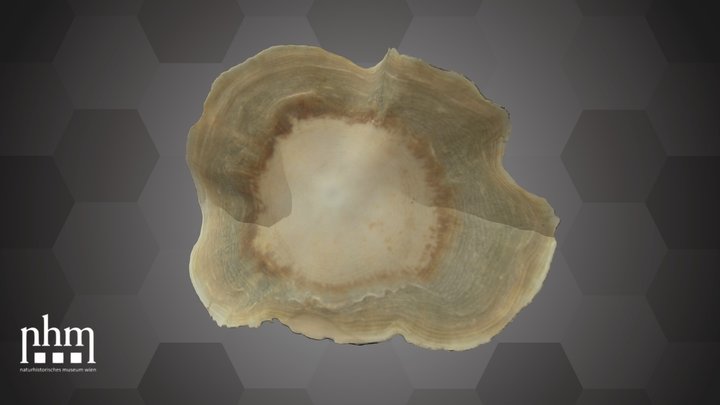
3D model
- Source
- Sketchfab
- Licence
- CC Attribution-NonCommercial
- Commercial use
- the licence does not allow it
The description on this site
- Licence
- CC BY-SA 4.0
This is what the site found, which is not the same as what exists.
Keep going
What may have been alongside itRhizaria through timeThe world it lived on
Occurrence data from the Paleobiology Database, CC BY 4.0. (Eichwald 1830)