Echinodermata
An echinoderm is any animal of the phylum Echinodermata, which includes starfish, brittle stars, sea urchins, sand dollars and sea cucumbers, as well as the sessile sea lilies or "stone lilies". While bilaterally symmetrical as larvae, as adults echinoderms are recognisable by their usually five-pointed radial symmetry, and are found on the sea bed at every ocean depth from the intertidal zone to the abyssal zone. The phylum contains about 7,600 living species, making it the second-largest group of deuterostomes after the chordates, as well as the largest marine-only phylum. The first definitive echinoderms appeared near the start of the Cambrian.

François Michonneau Hectonichus Philippe Bourjon Hectonichus Philippe Bourjon Bruce Martin · CC BY-SA 4.0 · via Wikipedia/Commons. May be a photograph of a specimen, or an artist’s reconstruction — an interpretation of a skeleton, since colour and soft tissue are almost never preserved.
On record
Recorded, not inferred- Sits inside
- AmbulacrariaPBDB
- Environment
- marinePBDB
Time the record covers
At least 511 million years on record.
The record covers at least 512.1 Mya to 129 ka. No occurrence read is dated outside 538.8 Mya to 0 Mya.
12,000+ occurrences of Echinodermata on record. The Paleobiology Database records this as a living group. Bar height is expected occurrences, not a count: each fossil is spread across the span it is dated to, so a tall narrow bar means tight dating and a low wide one means loose.
When
12,000 occurrences read- Cambrianunder 1%
- Ordovician14%
- Silurian15%
- Devonian12%
- Carboniferous21%
- Permian4%
- Early Triassicunder 1%
- Middle Triassic2%
- Late Triassicunder 1%
- Early Jurassic2%
- Middle Jurassic3%
- Late Jurassic3%
- Early Cretaceous4%
- Late Cretaceous9%
- Paleocene1%
- Eocene5%
- Oligoceneunder 1%
- Miocene1%
- Plioceneunder 1%
- Pleistoceneunder 1%
- Holoceneunder 1%
These are dates about fossils, not the animal: the record can only begin after it arose and end before it died out, so either end may reach further. Shares are expected occurrences: a fossil dated to a span is counted partly in each period it straddles. The read hit its cap, so every figure above is a floor and the shares are of the occurrences read. More on what this infers.
Found in
at least 1084 formations
- Edwardsville Formation446
- Bangor Limestone Formation437
- Maastricht Formation231
- Muldraugh Formation206
- Gulpen Formation199
- Bromide Formation185
Loading coastlines…
The named rock units Echinodermata has been recovered from, largest first. Drawn where the rock is now, not where it formed. The read hit its cap, so each count is a floor. 1,060 further formations hold fewer occurrences each and are not listed. 1,899 occurrences have no formation on record, which is common for older literature.
Found in the same rock
1,751 taxa- Crinoidea144 sites
- Rhombopora60 sites
- Crurithyris59 sites
- Brachiopoda55 sites
- Gastropoda44 sites
- Punctospirifer40 sites
- Isotelus35 sites
- Composita33 sites
- Hallopora31 sites
- Hustedia31 sites
- Rafinesquina31 sites
- Rhipidomella31 sites
- Flexicalymene29 sites
- Leptaena28 sites
- Bryozoa27 sites
- Orbiculoidea27 sites
- Lingula26 sites
- Zygospira26 sites
- Strophomena25 sites
- Chonetinella24 sites
- Ctenodonta24 sites
- Bivalvia23 sites
- Modiolopsis23 sites
- Ostracoda23 sites
The Paleobiology Database records at least 641 sites for Echinodermata, and this reads 240 of them. The number is how many of those sites it was catalogued from too. The 24 sharing the most are listed.
This is not a list of everything alive at the time. It is only what has come out of the same ground as this animal and been written down.
Entered from
at least 898 references- Caradocian-Gedinnian echinoderm associations of Central and Eastern North America1,126
- Upper Mississippi Valley Champlainian and Cincinnatian echinoderms541
- The Paleontology and Paleoecology of the Lower Bangor Limestone (Chesterian, Mississippian)in northwestern Alabama434
- Community Organization, Paleontology, and Sedimentology of the Lower Mississippian Borden Delta Platform (Edwardsville Formation, Southern Indiana)356
- Jura Vaudois et Neuchatelois294
- Stratigraphy and Paleontology of the Uppermost Pennsylvanian and Lowermost Permian Rocks in Kansas280
- Late Cretaceous-Early Paleocene echinoderms and the K/T boundary in the southeast Netherlands and the northeast Belgium. - part 4: Echinoids265
- Le Jurassique D`Arabie Centrale216
- Paleontology and paleoecology of the Crawfordsville fossil site (Upper Osagian: Indiana)206
- Late Cretaceous-Early Paleocene echinoderms and the K/T boundary in the southeast Netherlands and the northeast Belgium. - part 3: Ophiuroids165
- The Echinoids of the Middle Eocene Warley Hill Formation, Santee Limestone, and Castle Hayne Limestone of North and South Carolina157
- The fossil fauna of the Ordovician in the Cincinnati Region149
Each of the 12,000 occurrences read was entered from one of these publications, ordered by how many each accounts for. This is not a search for papers mentioning the name. That read hit its cap, so each count is a floor. 886 further references are not listed. Entries link to doi.org where the Paleobiology Database holds an identifier, and to its own record where it does not. Relayed as the Paleobiology Database holds them, not checked against what they resolve to.
Media and terms
Media content2

Picture of Echinodermata
- Source
- Wikipedia/Commons
- Credit
- François Michonneau Hectonichus Philippe Bourjon Hectonichus Philippe Bourjon Bruce Martin
- Licence
- CC BY-SA 4.0
- Commercial use
- the licence allows it
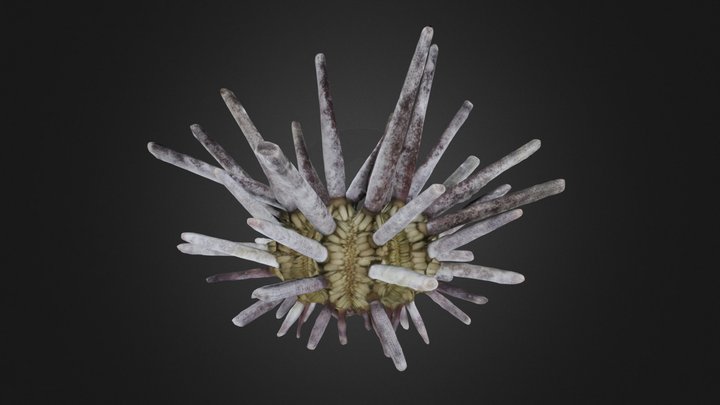
3D model
- Source
- Sketchfab
- Licence
- CC0 Public Domain
- Commercial use
- the licence allows it
Smithsonian Open Access and MorphoSource were not reached for this taxon, so this list is what the others held rather than everything there is.
The description on this site
- Source
- Wikipedia, “Echinoderm”
- Licence
- CC BY-SA 4.0
This is what the site found, which is not the same as what exists.
Keep going
What may have been alongside itAmbulacraria through timeThe world it lived on
Occurrence data from the Paleobiology Database, CC BY 4.0. Klein 1754