Mammuthus primigenius
The woolly mammoth is an extinct species of mammoth that lived from the Middle Pleistocene until its extinction in the Holocene epoch. It was one of the last in a line of mammoth species, beginning with the African Mammuthus subplanifrons in the early Pliocene. The woolly mammoth began to diverge from the steppe mammoth about 800,000 years ago in Siberia. Its closest extant relative is the Asian elephant. The Columbian mammoth lived alongside the woolly mammoth in North America, and DNA studies show that the two hybridised with each other. Mammoth remains were long known in Asia before they became known to Europeans. The origin of these remains was long debated and often explained as the remains of legendary creatures. The mammoth was identified as an extinct elephant species by Georges Cuvier in 1796.

Lou.gruber · Public Domain · via Wikipedia/Commons. May be a photograph of a specimen, or an artist’s reconstruction — an interpretation of a skeleton, since colour and soft tissue are almost never preserved.
On record
Recorded, not inferred- Also called
- wooly mammothPBDB
- Sits inside
- MammuthusPBDB
- Diet
- grazerPBDB, for Mammuthus
- Life habit
- ground dwellingPBDB, for Elephantidae
- Motility
- actively mobilePBDB, for Osteichthyes
- Environment
- terrestrialPBDB, for Eutheria
Time the record covers
At least 2.5 million years on record.
The record covers at least 2.58 Mya to 11.7 ka. No occurrence read is dated outside 7.246 Mya to 0 Mya.
77 occurrences of Mammuthus primigenius on record, most of them in the Pleistocene. Bar height is expected occurrences, not a count: each fossil is spread across the span it is dated to, so a tall narrow bar means tight dating and a low wide one means loose.
When
77 occurrences- Mioceneunder 1%
- Pliocene2%
- Pleistocene96%
- Holocene1%
These are dates about fossils, not the animal: the record can only begin after it arose and end before it died out, so either end may reach further. Shares are expected occurrences: a fossil dated to a span is counted partly in each period it straddles. More on what this infers.
Found in
7 formations
- Wiota Gravels Formation1
- Oberer Travertin Formation1
- Oberer Travertin I Formation1
- Cromer Forest Bed Formation1
- Tule Formation1
- Erie clay Formation1
Loading coastlines…
The named rock units Mammuthus primigenius has been recovered from, largest first. Drawn where the rock is now, not where it formed. 70 occurrences have no formation on record, which is common for older literature.
Mammuthus primigenius and its relatives
PleistoceneWhere Mammuthus primigenius and its relatives were recorded in the Pleistocene.
Found in the same rock
354 taxa- Rangifer tarandus18 sites
- Coelodonta antiquitatis14 sites
- Equus13 sites
- Bison priscus12 sites
- Bison10 sites
- Canis lupus9 sites
- Equus caballus9 sites
- Cervus elaphus8 sites
- Megaloceros giganteus7 sites
- Cervus5 sites
- Crocuta crocuta spelaea5 sites
- Ursus spelaeus5 sites
- Vulpes vulpes5 sites
- Microtus oeconomus4 sites
- Ochotona4 sites
- Panthera leo spelaea4 sites
- Rana temporaria4 sites
- Ursus arctos4 sites
- Aenocyon dirus3 sites
- Alces3 sites
- Alces alces3 sites
- Anguis fragilis3 sites
- Arctodus simus3 sites
- Balaena mysticetus3 sites
The Paleobiology Database records 77 sites for Mammuthus primigenius, and this reads all of them. The number is how many of those sites it was catalogued from too. The 24 sharing the most are listed.
This is not a list of everything alive at the time. It is only what has come out of the same ground as this animal and been written down.
Entered from
57 references- The mastodons, mammoths and other Pleistocene mammals of New York State, being a descriptive record of all known occurrences9
- The taphonomy of mammoth localities in southeastern Wisconsin (USA)4
- Die Backenzähne der Elefanten von Ehringsdorf bei Weimar (The chewing teeth of elefants from Ehringsdorf, Weimar)4
- Säugetierfunde und Pleistozänstratigraphie in der Kolyma-Niederung (Pleistocene stratigraphy from the Kolyma fluvial plain and it's mammal fossils)3
- Fossil and subfossil mammals from the Quaternary of British Columbia3
- The Kor & Bot collection revisited, with a biostratigraphic interpretation of the Early Pleistocene Oosterschelde Fauna (Oosterschelde Estuary, the Netherlands)2
- Polar bear and mammoth on the Pribilof Islands2
- Pleistocene mammals of Montana and their geologic context1
- Vertebrates of the Last Interglaciation in Canada: A Review, with New Data1
- Ice Age Vertebrates in the Canadian Arctic Islands1
- A woolly mammoth (Proboscidea, Mammuthus primigenius) molar from the Hudson Bay Lowland of Manitoba1
- Late-glacial mammoth skeletons from Condover, Shropshire, England1
Each of the 77 occurrences read was entered from one of these publications, ordered by how many each accounts for. This is not a search for papers mentioning the name. 45 further references are not listed. Entries link to doi.org where the Paleobiology Database holds an identifier, and to its own record where it does not. Relayed as the Paleobiology Database holds them, not checked against what they resolve to.
Media and terms
Media content3

Picture of Mammuthus primigenius
- Source
- Wikipedia/Commons
- Credit
- Lou.gruber
- Licence
- Public Domain
- Commercial use
- the licence allows it
Structured light scan
- Source
- MorphoSource
- Licence
- In Copyright
- Commercial use
- cannot be read from the licence given — check the record
- Specimen
- Mammuthus primigenius · NHMUK:PAL:PV M 12328b
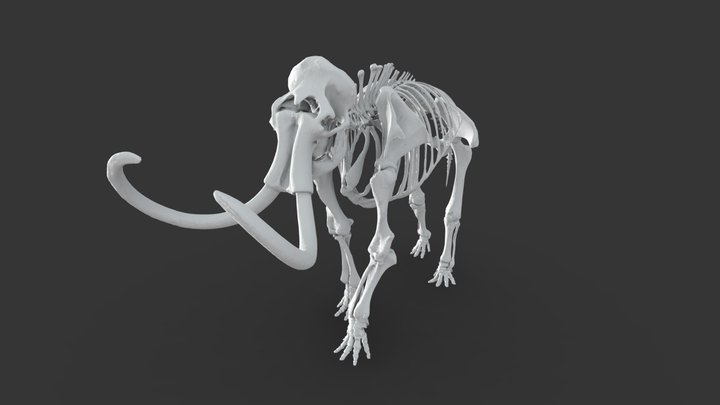
3D model
- Source
- Sketchfab
- Licence
- CC0 Public Domain
- Commercial use
- the licence allows it
Smithsonian Open Access was not reached for this taxon, so this list is what the others held rather than everything there is.
The description on this site
- Licence
- CC BY-SA 4.0
This is what the site found, which is not the same as what exists.
Keep going
What may have been alongside itMammuthus through timeFormations of the PleistoceneThe world it lived on
Occurrence data from the Paleobiology Database, CC BY 4.0. (Blumenbach 1799)