Alces alces
The moose or elk is the world's tallest, largest and heaviest extant species of deer and the only extant species in the genus Alces. It is also the tallest, and the second-largest, land animal in North America, falling short only to the American bison in body mass. Most adult male moose have broad, palmate antlers; other members of the deer family have pointed antlers with a dendritic ("twig-like") configuration. Moose inhabit the circumpolar boreal forests or temperate broadleaf and mixed forests of the Northern Hemisphere, thriving in cooler, temperate areas as well as subarctic climates.

Paxson Woelber · CC BY-SA 4.0 · via Wikipedia/Commons. May be a photograph of a specimen, or an artist’s reconstruction — an interpretation of a skeleton, since colour and soft tissue are almost never preserved.
On record
Recorded, not inferred- Also called
- moosePBDB
- Sits inside
- AlcesPBDB
- Diet
- grazer, browserPBDB, for Cervidae
- Life habit
- ground dwellingPBDB, for Cervidae
- Motility
- actively mobilePBDB, for Osteichthyes
- Environment
- terrestrialPBDB, for Artiodactyla
Time the record covers
At least 762 thousand years on record.
The record covers at least 774 ka to 11.7 ka. No occurrence read is dated outside 2.58 Mya to 0 Mya.
20 occurrences of Alces alces on record, most of them in the Pleistocene. The Paleobiology Database records this as a living group. Bar height is expected occurrences, not a count: each fossil is spread across the span it is dated to, so a tall narrow bar means tight dating and a low wide one means loose.
When
20 occurrences- Pleistocene70%
- Holocene30%
These are dates about fossils, not the animal: the record can only begin after it arose and end before it died out, so either end may reach further. Shares are expected occurrences: a fossil dated to a span is counted partly in each period it straddles. More on what this infers.
Found in
1 formation
Loading coastlines…
The named rock units Alces alces has been recovered from, largest first. Drawn where the rock is now, not where it formed. 18 occurrences have no formation on record, which is common for older literature.
Alces alces and its relatives
PleistoceneWhere Alces alces and its relatives were recorded in the Pleistocene.
Found in the same rock
398 taxa- Vulpes vulpes11 sites
- Canis lupus8 sites
- Cervus elaphus7 sites
- Ondatra zibethicus7 sites
- Bison priscus6 sites
- Bos primigenius6 sites
- Capreolus capreolus6 sites
- Equus6 sites
- Ursus arctos6 sites
- Megaloceros5 sites
- Odocoileus virginianus5 sites
- Sus scrofa5 sites
- Anatidae4 sites
- Canis familiaris4 sites
- Castor canadensis4 sites
- Castor fiber4 sites
- Cervidae4 sites
- Equus caballus4 sites
- Erethizon dorsatum4 sites
- Gulo gulo4 sites
- Martes americana4 sites
- Martes martes4 sites
- Microtus pennsylvanicus4 sites
- Rangifer tarandus4 sites
The Paleobiology Database records 20 sites for Alces alces, and this reads all of them. The number is how many of those sites it was catalogued from too. The 24 sharing the most are listed.
This is not a list of everything alive at the time. It is only what has come out of the same ground as this animal and been written down.
Entered from
16 references- I giacimenti Quaternari di vertebrati fossili nell'Italia Nord-Orientale3
- The Pleistocene vertebrates of Michigan2
- Die jungpleistozänen Säugetierfaunen aus dem Travertingebiet von Taubach-Weimar-Ehringsdorf (The Early Plestocene mammalian fauna from the travetin-area of Taubach-Weimar-Ehringsdorf)2
- First fossil record of leopard-like felid (Panthera cf. pardus) from alluvial deposits of the Po River in northern Italy1
- A 9,000 Year History of Seal Hunting on Lake Baikal, Siberia: The Zooarchaeology of Sagan-Zaba II1
- After Hopewell in Southern Québec1
- Declining foraging returns from an inexhaustible resource? Abundance indices and beluga whaling in the western Canadian Arctic1
- The Eurogeul—first report of the palaeontological, palynological and archaeological investigations of this part of the North Sea1
- The Shelton Mastodon Site: Multidisciplinary study of a late Pleistocene (Twocreekan) locality in Southeastern Michigan1
- Pleistocene and Holocene mammalian faunas from the Maasvlakete near Rotterdam (The Netherlands)1
- Quaternary vertebrate localities of Virginia and their avian and mammalian fauna1
- Pointe-du-Buisson 4: Quarante Siècles d'archives Oubiliées1
Each of the 20 occurrences read was entered from one of these publications, ordered by how many each accounts for. This is not a search for papers mentioning the name. 4 further references are not listed. Entries link to doi.org where the Paleobiology Database holds an identifier, and to its own record where it does not. Relayed as the Paleobiology Database holds them, not checked against what they resolve to.
Media and terms
Media content2

Picture of Alces alces
- Source
- Wikipedia/Commons
- Credit
- Paxson Woelber
- Licence
- CC BY-SA 4.0
- Commercial use
- the licence allows it
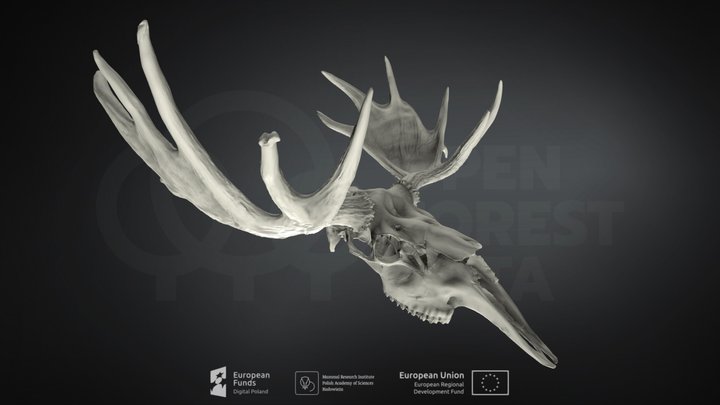
3D model
- Source
- Sketchfab
- Licence
- CC Attribution
- Commercial use
- cannot be read from the licence given — check the record
Smithsonian Open Access and MorphoSource were not reached for this taxon, so this list is what the others held rather than everything there is.
The description on this site
- Source
- Wikipedia, “Moose”
- Licence
- CC BY-SA 4.0
This is what the site found, which is not the same as what exists.
Keep going
What may have been alongside itAlces through timeFormations of the PleistoceneThe world it lived on
Occurrence data from the Paleobiology Database, CC BY 4.0. (Linnaeus 1758)