Lucanidae
Stag beetles compose the family Lucanidae. It has about 1,200 species of beetles in four subfamilies. Some species grow to over 12 centimetres, but most to about 5 cm (2 in).

fir0002 flagstaffotos [at] gmail.com Canon 20D + Sigma 150mm f/2.8 + Canon MT 24-EX · GFDL 1.2 · via Wikipedia/Commons. May be a photograph of a specimen, or an artist’s reconstruction — an interpretation of a skeleton, since colour and soft tissue are almost never preserved.
On record
Recorded, not inferred- Also called
- stag beetlePBDB
- Sits inside
- ScarabaeoideaPBDB
- Motility
- actively mobilePBDB, for Arthropoda
- Environment
- terrestrialPBDB, for Insecta
Time the record covers
At least 154 million years on record.
The record covers at least 154.8 Mya to 774 ka. No occurrence read is dated outside 165.3 Mya to 129 ka.
53 occurrences of Lucanidae on record, most of them in the Early Cretaceous. The Paleobiology Database records this as a living group, and the chart stops with its fossils rather than at the present. Bar height is expected occurrences, not a count: each fossil is spread across the span it is dated to, so a tall narrow bar means tight dating and a low wide one means loose.
When
53 occurrences- Middle Jurassicunder 1%
- Late Jurassic3%
- Early Cretaceous30%
- Late Cretaceous26%
- Eocene26%
- Oligocene4%
- Miocene4%
- Plioceneunder 1%
- Pleistocene6%
These are dates about fossils, not the animal: the record can only begin after it arose and end before it died out, so either end may reach further. Shares are expected occurrences: a fossil dated to a span is counted partly in each period it straddles. More on what this infers.
Found in
11 formations
- Yixian Formation · Jehol Group10
- Eifel Formation3
- Messel Formation3
- Argun Formation3
- Highbury Silts and Sands Formation3
- Florissant Formation2
Loading coastlines…
The named rock units Lucanidae has been recovered from, largest first. Drawn where the rock is now, not where it formed. 23 occurrences have no formation on record, which is common for older literature.
Lucanidae and its relatives
Early CretaceousWhere Lucanidae and its relatives were recorded in the Early Cretaceous.
Found in the same rock
3,339 taxa- Cerambycidae5 sites
- Blattidae4 sites
- Carabidae4 sites
- Lygaeidae4 sites
- Araneae3 sites
- Buprestinae3 sites
- Buprestis3 sites
- Cercopoidea3 sites
- Coraebini3 sites
- Curculionini3 sites
- Dytiscidae3 sites
- Gerris3 sites
- Gesomyrmex hoernesi3 sites
- Helophorus3 sites
- Lanelater nicoleae3 sites
- Odonata3 sites
- Pentatomidae3 sites
- Staphylinidae3 sites
- Trichoptera3 sites
- Ablator triguttatus2 sites
- Achlyoconis heptatrichia2 sites
- Adorator hispidus2 sites
- Agrilini2 sites
- Aleocharinae2 sites
The Paleobiology Database records 36 sites for Lucanidae, and this reads all of them. The number is how many of those sites it was catalogued from too. The 24 sharing the most are listed.
This is not a list of everything alive at the time. It is only what has come out of the same ground as this animal and been written down.
Entered from
33 references- The smallest stag beetles (Coleoptera, Lucanidae): hidden paleodiversity in mid-Cretaceous Kachin amber from northern Myanmar4
- Litholamprima qizhihaoi sp. nov., a new stag beetle (Coleoptera: Lucanidae) from the Lower Cretaceous Yixian Formation, China4
- Stag beetles from the Mesozoic of Inner Mongolia, China (Scarabaeoidea: Lucanidae)4
- Nikolajev, 20074
- Taxonomic notes on Aesalinae stag beetles (Coleoptera: Lucanidae), with special reference to those in mid-Cretaceous Kachin amber3
- Marine Isotope Stage 9 environments of fluvial deposits at Hackney, north London, UK3
- Systematik, Phylogenie, Taphonomie und Paläoökologie der Insekten aus dem Mittel-Eozän des Eckfelder Maares, Vulkaneifel3
- The first representatives of Lucaninae from mid-Cretaceous Burmese amber based on two new species of Anisoodontus gen. nov. (Coleoptera: Scarabaeoidea: Lucanidae)2
- Systematische und palökologische Untersuchungen an Insekten aus dem Mittel-Eozän der Grube messel bei Darmstadt2
- Prosinodendron krelli from the Yixian Formation, China: A missing link among Lucanidae, Diphyllostomatidae and Passalidae (Coleoptera: Scarabaeoidea)1
- A new fossil species of stag beetle from Dominican Republic amber,with Australasian connections (Coleoptera: Lucanidae)1
- Une forme fossile nouvelle de Chiasognathinae: Protognathinus spielbergi (Coleoptera, Lucanidae)1
Each of the 53 occurrences read was entered from one of these publications, ordered by how many each accounts for. This is not a search for papers mentioning the name. 21 further references are not listed. Entries link to doi.org where the Paleobiology Database holds an identifier, and to its own record where it does not. Relayed as the Paleobiology Database holds them, not checked against what they resolve to.
Media and terms
Media content1
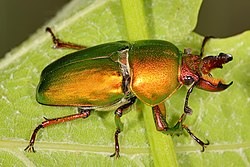
Picture of Lucanidae
- Source
- Wikipedia/Commons
- Credit
- fir0002 flagstaffotos [at] gmail.com Canon 20D + Sigma 150mm f/2.8 + Canon MT 24-EX
- Licence
- GFDL 1.2
- Commercial use
- the licence allows it
No 3D scan of Lucanidae was found in Sketchfab.
Smithsonian Open Access and MorphoSource were not reached for this taxon, so this list is what the others held rather than everything there is.
The description on this site
- Source
- Wikipedia, “Stag beetle”
- Licence
- CC BY-SA 4.0
This is what the site found, which is not the same as what exists.
Keep going
What may have been alongside itScarabaeoidea through timeFormations of the Early CretaceousThe world it lived on
Occurrence data from the Paleobiology Database, CC BY 4.0. Latreille 1804