Trichoptera
The caddisflies are a group of insects with aquatic larvae and terrestrial adults. There are approximately 14,500 described species, most of which can be divided into the suborders Integripalpia and Annulipalpia on the basis of the adult mouthparts. Integripalpian larvae construct a portable casing to protect themselves as they move around looking for food, while annulipalpian larvae make themselves a fixed retreat in which they remain, waiting for food to come to them. The affinities of the small third suborder Spicipalpia are unclear, and molecular analysis suggests it may not be monophyletic. Also called sedge-flies or rail-flies, the adults are small moth-like insects with two pairs of hairy membranous wings. They are closely related to the Lepidoptera which have scales on their wings; the two orders together form the superorder Amphiesmenoptera.

Bruce Marlin · CC BY-SA 2.5 · via Wikipedia/Commons. May be a photograph of a specimen, or an artist’s reconstruction — an interpretation of a skeleton, since colour and soft tissue are almost never preserved.
On record
Recorded, not inferred- Also called
- caddisflyPBDB
- Sits inside
- StellopteraPBDB
- Motility
- actively mobilePBDB, for Arthropoda
- Environment
- terrestrialPBDB, for Insecta
Time the record covers
At least 309 million years on record.
The record covers at least 309.8 Mya to 129 ka. No occurrence read is dated outside 315.2 Mya to 11.7 ka.
1,255 occurrences of Trichoptera on record, most of them in the Eocene. The Paleobiology Database records this as a living group. Bar height is expected occurrences, not a count: each fossil is spread across the span it is dated to, so a tall narrow bar means tight dating and a low wide one means loose.
When
1,255 occurrences- Carboniferousunder 1%
- Permianunder 1%
- Middle Triassicunder 1%
- Late Triassicunder 1%
- Early Jurassicunder 1%
- Middle Jurassic1%
- Late Jurassic3%
- Early Cretaceous11%
- Late Cretaceous12%
- Paleoceneunder 1%
- Eocene53%
- Oligocene2%
- Miocene9%
- Plioceneunder 1%
- Pleistocene6%
These are dates about fossils, not the animal: the record can only begin after it arose and end before it died out, so either end may reach further. Shares are expected occurrences: a fossil dated to a span is counted partly in each period it straddles. More on what this infers.
Found in
99 formations
- Amka Formation46
- Florissant Formation37
- Kap København Formation30
- Zaza Formation23
- Sharteg Formation22
- Don Formation20
Loading coastlines…
The named rock units Trichoptera has been recovered from, largest first. Drawn where the rock is now, not where it formed. 75 further formations hold fewer occurrences each and are not listed. 830 occurrences have no formation on record, which is common for older literature.
Trichoptera and its relatives
EoceneWhere Trichoptera and its relatives were recorded in the Eocene.
Found in the same rock
7,407 taxa- Coleoptera17 sites
- Plectrocnemia lata16 sites
- Yantaromyrmex geinitzi15 sites
- Carabidae14 sites
- Formicidae14 sites
- Gesomyrmex hoernesi14 sites
- Lype sericea14 sites
- Plectrocnemia barbata14 sites
- Prenolepis henschei14 sites
- Ctenobethylus goepperti13 sites
- Holocentropus vetustus13 sites
- Nylanderia pygmaea13 sites
- Holocentropus affinis12 sites
- Curculionidae11 sites
- Formica flori11 sites
- Lasius schiefferdeckeri11 sites
- Staphylinidae11 sites
- Tetraponera simplex11 sites
- Holocentropus incertus10 sites
- Ichneumonidae10 sites
- Pachycondyla succinea10 sites
- Plagiolepis klinsmanni10 sites
- Tetraponera ocellata10 sites
- Wormaldia aequalis10 sites
The Paleobiology Database records 328 sites for Trichoptera, and this reads 240 of them. Of that, one read hit the database's own return limit, so every count below is a floor rather than a total. The number is how many of those sites it was catalogued from too. The 24 sharing the most are listed.
This is not a list of everything alive at the time. It is only what has come out of the same ground as this animal and been written down.
Entered from
239 references- Die Trichopteren des baltischen Bernsteins357
- Wichard, 201363
- Melovye entomofauny basseyna r. Ul'i (zapadnoe Priokhot'e)46
- Köcherfliegen des Baltischen Bernsteins 1. Marilia altrocki sp. n. (Trichoptera, Odontoceridae) der Bernsteinsammlung Bachofen-Echt32
- Palaeoentomology of the Kap København Formation, a Plio-Pleistocene sequence in Peary Land, North Greenland30
- Die im Bernstein befindlichen Neuropteren der Vorwelt29
- The Tertiary Insects of North America23
- Fossil caddisflies (Insecta: Trichoptera) from the Don Formation, Toronto, Ontario, and their use in paleoecology20
- The Khasurty fossil insect Lagerstätte19
- Overview and descriptions of caddisflies (Insecta, Trichoptera) in Dominican amber (Miocene)19
- New fossil caddis flies (Trichoptera) from the Shar-Teg locality in Mongolia19
- Caddisflies (Insecta: Trichoptera) from the Middle Miocene of the Stavropol Region, Russia13
Each of the 1,255 occurrences read was entered from one of these publications, ordered by how many each accounts for. This is not a search for papers mentioning the name. 227 further references are not listed. Entries link to doi.org where the Paleobiology Database holds an identifier, and to its own record where it does not. Relayed as the Paleobiology Database holds them, not checked against what they resolve to.
Media and terms
Media content2
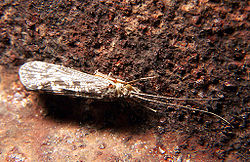
Picture of Trichoptera
- Source
- Wikipedia/Commons
- Credit
- Bruce Marlin
- Licence
- CC BY-SA 2.5
- Commercial use
- the licence allows it
3D model
- Source
- Sketchfab
- Credit
- Lolnyjkamen
- Licence
- Free Standard
- Commercial use
- cannot be read from the licence given — check the record
Smithsonian Open Access and MorphoSource were not reached for this taxon, so this list is what the others held rather than everything there is.
The description on this site
- Source
- Wikipedia, “Caddisfly”
- Licence
- CC BY-SA 4.0
This is what the site found, which is not the same as what exists.
Keep going
What may have been alongside itStelloptera through timeFormations of the EoceneThe world it lived on
Occurrence data from the Paleobiology Database, CC BY 4.0. Kirby 1815