Gopherus
Gopherus is a genus of fossorial tortoises commonly referred to as gopher tortoises. The gopher tortoise is grouped with land tortoises that originated 60 million years ago, in North America. A genetic study has shown that their closest relatives are in the Asian genus Manouria. The gopher tortoises live in the southern United States from California's Mojave Desert across to Florida, and in parts of northern Mexico. Gopher tortoises are so named because of some species' habit of digging large, deep burrows. Most notably, Gopherus polyphemus digs burrows which can be up to 40 feet (12 m) in length and 10 feet (3.0 m) in depth. These burrows are used by a variety of other species, including mammals, other reptiles, amphibians, and birds. Gopher tortoises are 20–50 cm (7.9–19.7 in) in length, depending on the species. All six species are found in xeric habitats. Numerous extinct species are known, the oldest dating to the Priabonian stage of the Late Eocene of the United States.

Uncredited · CC BY 3.0 · via Wikipedia/Commons. May be a photograph of a specimen, or an artist’s reconstruction — an interpretation of a skeleton, since colour and soft tissue are almost never preserved.
On record
Recorded, not inferred- Also called
- gopher tortoisePBDB
- Sits inside
- TestudinidaePBDB
- Diet
- herbivore, herbivorePBDB, for Testudinidae
- Life habit
- ground dwellingPBDB, for Testudinidae
- Motility
- actively mobilePBDB, for Osteichthyes
- Environment
- terrestrialPBDB, for Testudinidae
Time the record covers
At least 39 million years on record.
The record covers at least 39.7 Mya to 11.7 ka. No occurrence read is dated outside 45.9 Mya to 0 Mya.
95 occurrences of Gopherus on record, most of them in the Pleistocene. The Paleobiology Database records this as a living group. Bar height is expected occurrences, not a count: each fossil is spread across the span it is dated to, so a tall narrow bar means tight dating and a low wide one means loose.
When
95 occurrencesThese are dates about fossils, not the animal: the record can only begin after it arose and end before it died out, so either end may reach further. Shares are expected occurrences: a fossil dated to a span is counted partly in each period it straddles. More on what this infers.
Found in
27 formations
- Beaumont Formation5
- Brule Formation · White River Group4
- Chadron Formation · White River Group3
- Barstow Formation3
- Kingsdown Formation2
- Arikaree Formation2
Loading coastlines…
The named rock units Gopherus has been recovered from, largest first. Drawn where the rock is now, not where it formed. 3 further formations hold fewer occurrences each and are not listed. 54 occurrences have no formation on record, which is common for older literature.
Gopherus and its relatives
PleistoceneWhere Gopherus and its relatives were recorded in the Pleistocene.
Found in the same rock
1,094 taxa- Equus30 sites
- Odocoileus virginianus19 sites
- Lynx rufus16 sites
- Aenocyon dirus15 sites
- Dasypus bellus15 sites
- Paramylodon harlani13 sites
- Oryzomys palustris12 sites
- Rana12 sites
- Sylvilagus floridanus12 sites
- Terrapene carolina12 sites
- Canis latrans11 sites
- Hemiauchenia macrocephala11 sites
- Mammuthus columbi11 sites
- Neofiber alleni11 sites
- Procyon lotor11 sites
- Scalopus aquaticus11 sites
- Sigmodon hispidus11 sites
- Alligator mississippiensis10 sites
- Geomys pinetis10 sites
- Hesperotestudo10 sites
- Holmesina septentrionalis10 sites
- Mammut americanum10 sites
- Tapirus (Helicotapirus) veroensis10 sites
- Cryptotis parva9 sites
The Paleobiology Database records 92 sites for Gopherus, and this reads all of them. The number is how many of those sites it was catalogued from too. The 24 sharing the most are listed.
This is not a list of everything alive at the time. It is only what has come out of the same ground as this animal and been written down.
Entered from
47 references- A fossil and zooarchaeological history of the gopher tortoise (Gopherus polyphemus) in the Southeastern United States23
- Some new fossil tortoises from western North America with remarks on the zoogeography and paleoecology of tortoises10
- Skeletochronology: a method for determing the individual age and growth of modern and fossil tortoises (Reptilia: Testudines)6
- Luminescence chronology of a Mass Grave of Giant Gopher Tortoises (Gopherus hexagonatus), Willacy County, TX4
- Turtles from the Late Pleistocene of Hidalgo and Puebla and their paleobiogeographic and paleoclimatic significance3
- The fossil turtles of North America3
- Recent archaeo-palaeontogical findings from Barranca del Muerto site, Santiago Chazumba, Oaxaca, Mexico2
- A catalogue of late Quaternary vertebrates from California: Part One, nonmarine lower vertebrate and avian taxa2
- Summary of Miocene vertebrate fossils of the Granite Mountains Basin, central Wyoming2
- Geology and paleontology of a late Pleistocene basin in southwest kansas2
- The osteology of the fossil turtle Testudo praeextans Lambe, with notes on other species of Testudo from the Oligocene of Wyoming2
- A new giant turtle of the genus Gopherus (Chelonia: Testudinidae) from the Pleistocene of Tamaulipas, México, and a review of the phylogeny and biogeography of gopher tortoises1
Each of the 95 occurrences read was entered from one of these publications, ordered by how many each accounts for. This is not a search for papers mentioning the name. 35 further references are not listed. Entries link to doi.org where the Paleobiology Database holds an identifier, and to its own record where it does not. Relayed as the Paleobiology Database holds them, not checked against what they resolve to.
Media and terms
Media content2
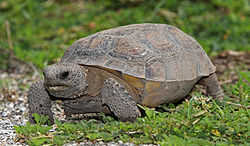
Picture of Gopherus
- Source
- Wikipedia/Commons
- Credit
- nobody named on the record
- Licence
- CC BY 3.0
- Commercial use
- the licence allows it

CT scan
- Source
- MorphoSource
- Licence
- In Copyright
- Commercial use
- cannot be read from the licence given — check the record
- Specimen
- Gopherus berlandieri · MVZ:Herp:MVZ:Herp:36747
Smithsonian Open Access was not reached for this taxon, so this list is what the others held rather than everything there is.
The description on this site
- Source
- Wikipedia, “Gopherus”
- Licence
- CC BY-SA 4.0
This is what the site found, which is not the same as what exists.
Keep going
What may have been alongside itTestudinidae through timeFormations of the PleistoceneThe world it lived on
Occurrence data from the Paleobiology Database, CC BY 4.0. Rafinesque 1832