Glabrocingulum
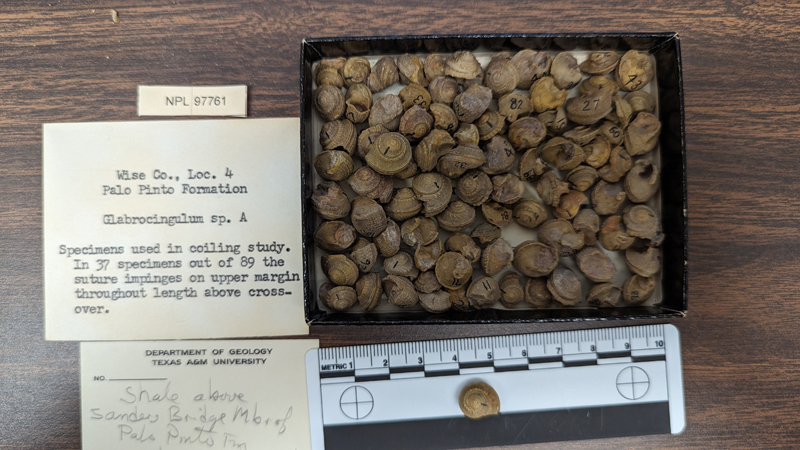
Heuer, Edward · CC0 · via GBIF. May be a photograph of a specimen, or an artist’s reconstruction — an interpretation of a skeleton, since colour and soft tissue are almost never preserved.
On record
Recorded, not inferred- Sits inside
- GlabrocingulidesPBDB
- Diet
- detritivorePBDB, for Gosseletinidae
- Life habit
- epifaunalPBDB, for Gosseletinidae
- Motility
- slow-movingPBDB, for Gosseletinidae
- Vision
- limitedPBDB, for Gosseletinidae
- Environment
- coastal,marinePBDB, for Murchisoniina
Time the record covers
At least 126 million years on record.
The record covers at least 353.7 Mya to 227.3 Mya. No occurrence read is dated outside 358.86 Mya to 205.7 Mya.
419 occurrences of Glabrocingulum on record, most of them in the Carboniferous. Bar height is expected occurrences, not a count: each fossil is spread across the span it is dated to, so a tall narrow bar means tight dating and a low wide one means loose.
When
419 occurrences- Carboniferous67%
- Permian31%
- Early Triassic1%
- Late Triassicunder 1%
These are dates about fossils, not the animal: the record can only begin after it arose and end before it died out, so either end may reach further. Shares are expected occurrences: a fossil dated to a span is counted partly in each period it straddles. More on what this infers.
Found in
116 formations
- Graham Formation · Cisco Group54
- Second Abden Shale Formation37
- Wewoka Formation25
- Allegheny Formation19
- Road Canyon Formation17
- Imo Formation17
Loading coastlines…
The named rock units Glabrocingulum has been recovered from, largest first. Drawn where the rock is now, not where it formed. 92 further formations hold fewer occurrences each and are not listed. 7 occurrences have no formation on record, which is common for older literature.
Glabrocingulum and its relatives
CarboniferousWhere Glabrocingulum and its relatives were recorded in the Carboniferous.
Found in the same rock
2,496 taxa- Crinoidea63 sites
- Crurithyris34 sites
- Trepospira illinoisensis31 sites
- Paraparchites29 sites
- Glomospira28 sites
- Rastidiscus sp.28 sites
- Meekospira peracuta27 sites
- Nuculopsis26 sites
- Crurithyris planoconvexa25 sites
- Pseudorthoceras25 sites
- Crurithyris urei24 sites
- Euphemites carbonarius24 sites
- Bairdia23 sites
- Ianthinopsis23 sites
- Composita22 sites
- Plagioglypta22 sites
- Vertebrata22 sites
- Bivalvia21 sites
- Derbyia21 sites
- Echinoidea21 sites
- Eomarginifera longispinus21 sites
- Euphemites21 sites
- Meekospira21 sites
- Hustedia20 sites
The Paleobiology Database records 362 sites for Glabrocingulum, and this reads 240 of them. The number is how many of those sites it was catalogued from too. The 24 sharing the most are listed.
This is not a list of everything alive at the time. It is only what has come out of the same ground as this animal and been written down.
Entered from
92 references- Permian Gastropoda of the southwestern United States. 7. Pleurotomariacea: Eotomariidae, Lophospiriidae, Gosseletinidae53
- The surficial geology, paleontology, and paleoecology of the Finis Shale (Pennsylvanian, Lower Virgilian) in Jack County, Texas45
- The paleoecology of a Lower Carboniferous marine transgression38
- Taxonomy and diversity of slit-band gastropods (Order Pleurotomariida) and some slit bearing Caenogastropoda from the Pennsylvanian of the USA20
- Allegheny fossil invertebrates from eastern Ohio: Gastropoda19
- Marine Communities of a Portion of the Wewoka Formation (Pennsylvanian) in Hughes County, Oklahoma18
- Gastropods (Mollusca) from the Imo Formation (Mississippian, Chesterian) of north-central Arkansas17
- Stratigraphy and Paleontology of the Uppermost Pennsylvanian and Lowermost Permian Rocks in Kansas16
- Paleoecology and taphonomy of faunal assemblages in gray "core" (offshore) shales in Midcontinent Pennsylvanian cyclothems10
- Carboniferous Mollusca from the Tamworth Belt, New South Wales, Australia9
- Early Permian fossil communities in northeastern Nevada and northwestern Utah7
- Desmoinesian Brachiopoda and Mollusca from southwest Missouri6
Each of the 419 occurrences read was entered from one of these publications, ordered by how many each accounts for. This is not a search for papers mentioning the name. 80 further references are not listed. Entries link to doi.org where the Paleobiology Database holds an identifier, and to its own record where it does not. Relayed as the Paleobiology Database holds them, not checked against what they resolve to.
Media and terms
Media content1
Picture of Glabrocingulum
- Source
- GBIF
- Credit
- Heuer, Edward
- Licence
- CC0
- Commercial use
- the licence allows it
No 3D scan of Glabrocingulum was found in MorphoSource and Sketchfab.
Smithsonian Open Access was not reached for this taxon, so this list is what the others held rather than everything there is.
This is what the site found, which is not the same as what exists.
Keep going
What may have been alongside itGlabrocingulides through timeFormations of the CarboniferousThe world it lived on
Occurrence data from the Paleobiology Database, CC BY 4.0. Thomas 1940