Eutamias
Eutamias is a genus of chipmunks within the tribe Marmotini of the squirrel family. It includes a single living species, the Siberian chipmunk. The genus is often treated as a subgenus of Tamias, which is now restricted to the eastern chipmunk of North America. Neotamias, which now includes the western North American chipmunks, has also been included in Eutamias.

AndiW 10:51:45, 2005-09-04 (UTC) · Public Domain · via Wikipedia/Commons. May be a photograph of a specimen, or an artist’s reconstruction — an interpretation of a skeleton, since colour and soft tissue are almost never preserved.
On record
Recorded, not inferred- Also called
- chipmunkPBDB
- Sits inside
- MarmotiniPBDB
- Diet
- granivore, frugivorePBDB, for Sciuridae
- Life habit
- semifossorialPBDB
- Motility
- actively mobilePBDB, for Osteichthyes
- Environment
- terrestrialPBDB, for Eutheria
Time the record covers
At least 15 million years on record.
The record covers at least 15.98 Mya to 11.7 ka. No occurrence read is dated outside 23.04 Mya to 0 Mya.
29 occurrences of Eutamias on record, most of them in the Pleistocene. The Paleobiology Database records this as a living group. Bar height is expected occurrences, not a count: each fossil is spread across the span it is dated to, so a tall narrow bar means tight dating and a low wide one means loose.
When
29 occurrences- Miocene41%
- Pliocene6%
- Pleistocene48%
- Holocene4%
These are dates about fossils, not the animal: the record can only begin after it arose and end before it died out, so either end may reach further. Shares are expected occurrences: a fossil dated to a span is counted partly in each period it straddles. More on what this infers.
Found in
4 formations
- Loh Formation6
- Bahe Formation3
- Chinji Formation · Siwalik Group1
- Lefkon Formation1
Loading coastlines…
The named rock units Eutamias has been recovered from, largest first. Drawn where the rock is now, not where it formed. 18 occurrences have no formation on record, which is common for older literature.
Eutamias and its relatives
PleistoceneWhere Eutamias and its relatives were recorded in the Pleistocene.
Found in the same rock
637 taxa- Canis latrans11 sites
- Vulpes vulpes8 sites
- Lepus townsendii7 sites
- Tamiasciurus hudsonicus7 sites
- Lemmiscus curtatus6 sites
- Lepus americanus6 sites
- Marmota flaviventris6 sites
- Microtus6 sites
- Neotoma6 sites
- Neotoma cinerea6 sites
- Peromyscus maniculatus6 sites
- Phenacomys intermedius6 sites
- Sorex6 sites
- Sorex cinereus6 sites
- Taxidea taxus6 sites
- Aenocyon dirus5 sites
- Equus5 sites
- Mictomys borealis5 sites
- Mustela5 sites
- Mustela erminea5 sites
- Myotis5 sites
- Neogale frenata5 sites
- Neogale vison5 sites
- Ochotona princeps5 sites
The Paleobiology Database records 27 sites for Eutamias, and this reads all of them. The number is how many of those sites it was catalogued from too. The 24 sharing the most are listed.
This is not a list of everything alive at the time. It is only what has come out of the same ground as this animal and been written down.
Entered from
19 references- New discoveries of Sciurids (Rodentia, Mammalia) from the Valley of Lakes (Central Mongolia)4
- Sciurid rodents from Porcupine Cave, Park Co., Colorado: Irvingtonian diversity and faunal dynamics4
- Land mammal faunal sequence of the late Miocene of China: new evidence from Lantian, Shaanxi Province3
- Oligocene stratigraphy across the Eocene and Miocene boundaries in the Valley of Lakes (Mongolia)2
- Synonymies and reidentifications of North American fossil mammals2
- A Middle Pleistocene (late Irvingtonian) mammalian fauna from Thistle Creek, Klondike Goldfields region of Yukon Territory, Canada1
- The early Pliocene Micromammalian Fauna of Bilike, Inner Mongolia, China (Mammalia: Lipotyphla, Chiroptera, Rodentia, Lagomorpha)1
- Mid-Wisconsinan vertebrates and their environment from January Cave, Alberta, Canada1
- Neogene micromammals of China1
- Quaternary vertebrate localities of Virginia and their avian and mammalian fauna1
- Pleistocene vertebrate faunas of Hungary1
- Quaternary paleontology and paleocology of Crystal Ball Cave, Millard County, Utah: with emphasis on mammals and description of a new species of fossil skunk1
Each of the 29 occurrences read was entered from one of these publications, ordered by how many each accounts for. This is not a search for papers mentioning the name. 7 further references are not listed. Entries link to doi.org where the Paleobiology Database holds an identifier, and to its own record where it does not. Relayed as the Paleobiology Database holds them, not checked against what they resolve to.
Media and terms
Media content2
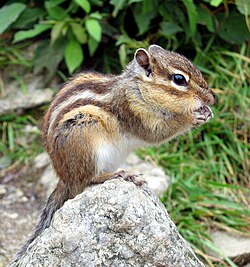
Picture of Eutamias
- Source
- Wikipedia/Commons
- Credit
- AndiW 10:51:45, 2005-09-04 (UTC)
- Licence
- Public Domain
- Commercial use
- the licence allows it
CT scan
- Source
- MorphoSource
- Licence
- not stated by the source
- Commercial use
- cannot be read from the licence given — check the record
- Specimen
- Eutamias minimus · ibm:gpp:CNMA 4503
Smithsonian Open Access was not reached for this taxon, so this list is what the others held rather than everything there is.
The description on this site
- Source
- Wikipedia, “Eutamias”
- Licence
- CC BY-SA 4.0
This is what the site found, which is not the same as what exists.
Keep going
What may have been alongside itMarmotini through timeFormations of the PleistoceneThe world it lived on
Occurrence data from the Paleobiology Database, CC BY 4.0. Trouessart 1880