Lepus townsendii
The white-tailed jackrabbit, also known as the prairie hare and the white jack, is a species of hare found in western North America. Like all hares and rabbits, it is a member of the family Leporidae of order Lagomorpha. It is a solitary individual except where several males court a female in the breeding season. Litters of four to five young are born in a form, a shallow depression in the ground, hidden among vegetation. This jackrabbit has two described subspecies: L. townsendii townsendii occurring west of the Rocky Mountains and L. townsendii campanius occurring east of the Rocky Mountains.

Connormah · CC BY-SA 2.0 · via Wikipedia/Commons. May be a photograph of a specimen, or an artist’s reconstruction — an interpretation of a skeleton, since colour and soft tissue are almost never preserved.
On record
Recorded, not inferred- Also called
- white-tailed jackrabbitPBDB
- Sits inside
- LepusPBDB
- Diet
- grazer, browserPBDB, for Leporidae
- Life habit
- ground dwellingPBDB, for Leporidae
- Motility
- actively mobilePBDB, for Osteichthyes
- Environment
- terrestrialPBDB, for Eutheria
Time the record covers
At least 762 thousand years on record.
The record covers at least 774 ka to 11.7 ka. No occurrence read is dated outside 1.8 Mya to 0 Mya.
10 occurrences of Lepus townsendii on record, most of them in the Pleistocene. The Paleobiology Database records this as a living group. Bar height is expected occurrences, not a count: each fossil is spread across the span it is dated to, so a tall narrow bar means tight dating and a low wide one means loose.
When
10 occurrences- Pleistocene89%
- Holocene11%
These are dates about fossils, not the animal: the record can only begin after it arose and end before it died out, so either end may reach further. Shares are expected occurrences: a fossil dated to a span is counted partly in each period it straddles. More on what this infers.
Found in
1 formation
Loading coastlines…
The named rock units Lepus townsendii has been recovered from, largest first. Drawn where the rock is now, not where it formed. 9 occurrences have no formation on record, which is common for older literature.
Lepus townsendii and its relatives
PleistoceneWhere Lepus townsendii and its relatives were recorded in the Pleistocene.
Found in the same rock
337 taxa- Canis latrans7 sites
- Marmota flaviventris7 sites
- Eutamias minimus6 sites
- Neotoma cinerea6 sites
- Taxidea taxus6 sites
- Vulpes vulpes6 sites
- Antilocapra americana5 sites
- Lemmiscus curtatus5 sites
- Lynx rufus5 sites
- Sylvilagus audubonii5 sites
- Cervus canadensis4 sites
- Equus4 sites
- Microtus4 sites
- Mustela nigripes4 sites
- Ochotona princeps4 sites
- Ovis canadensis4 sites
- Peromyscus maniculatus4 sites
- Spilogale putorius4 sites
- Vulpes velox4 sites
- Brachyprotoma obtusata3 sites
- Bubo virginianus3 sites
- Camelops3 sites
- Camelops hesternus3 sites
- Canis lupus3 sites
The Paleobiology Database records 10 sites for Lepus townsendii, and this reads all of them. The number is how many of those sites it was catalogued from too. The 24 sharing the most are listed.
This is not a list of everything alive at the time. It is only what has come out of the same ground as this animal and been written down.
Entered from
7 references- An Irvingtonian species of Brachylagus (mammalia: Lagomorpha) from Porcupine Cave, Park County, Colorado4
- Small mammals (Insectivora, Lagomorpha, and Rodentia) from the early Pleistocene (early Irvingtonian) Leisey Shell Pit Local Fauna, Hillsborough County, Florida1
- Quaternary paleontology and paleocology of Crystal Ball Cave, Millard County, Utah: with emphasis on mammals and description of a new species of fossil skunk1
- Faunal correlation of Pleistocene deposits in Western Canada1
- Late Pleistocene vertebrates of the Silver Creek local fauna from north Central Utah1
- New Quaternary mammal localities in the upper Clark Fork River valley, western Montana1
- The fauna of Burnet Cave, Guadalupe Mountains, New Mexico1
Each of the 10 occurrences read was entered from one of these publications, ordered by how many each accounts for. This is not a search for papers mentioning the name. Entries link to doi.org where the Paleobiology Database holds an identifier, and to its own record where it does not. Relayed as the Paleobiology Database holds them, not checked against what they resolve to.
Media and terms
Media content2

Picture of Lepus townsendii
- Source
- Wikipedia/Commons
- Credit
- Connormah
- Licence
- CC BY-SA 2.0
- Commercial use
- the licence allows it
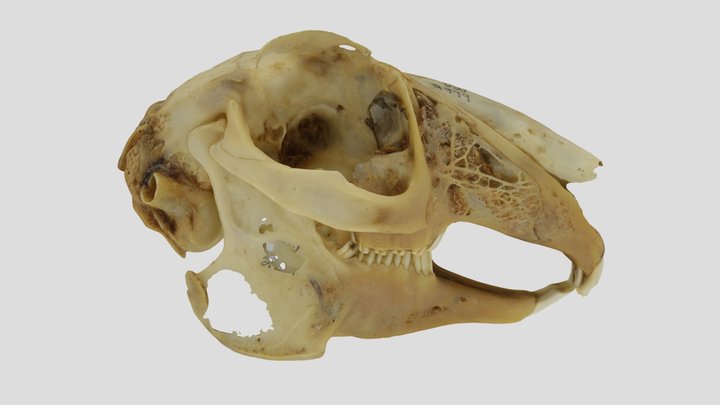
3D model
- Source
- Sketchfab
- Licence
- CC Attribution
- Commercial use
- cannot be read from the licence given — check the record
Smithsonian Open Access and MorphoSource were not reached for this taxon, so this list is what the others held rather than everything there is.
The description on this site
- Licence
- CC BY-SA 4.0
This is what the site found, which is not the same as what exists.
Keep going
What may have been alongside itLepus through timeFormations of the PleistoceneThe world it lived on
Occurrence data from the Paleobiology Database, CC BY 4.0. Bachman 1839