Dimya
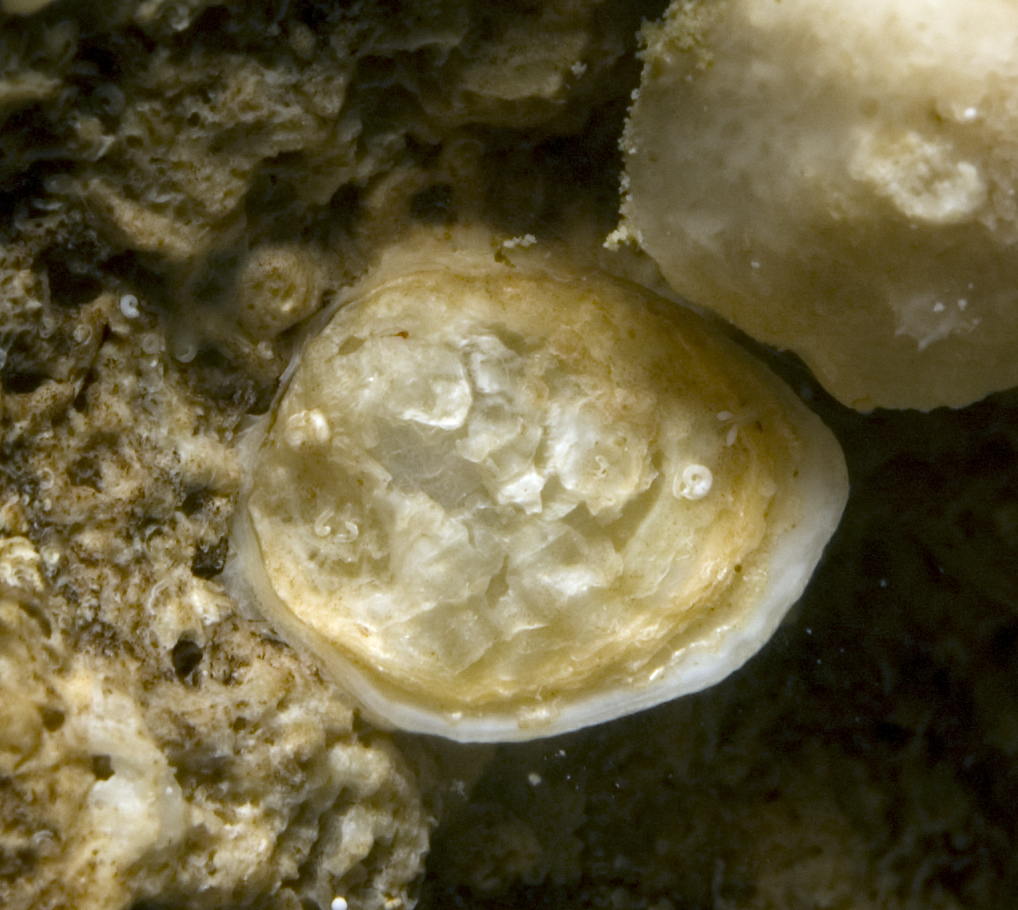
via iDigBio · CC BY-NC · via iDigBio. May be a photograph of a specimen, or an artist’s reconstruction — an interpretation of a skeleton, since colour and soft tissue are almost never preserved.
On record
Recorded, not inferred- Sits inside
- DimyidaePBDB
- Diet
- suspension feederPBDB
- Life habit
- epifaunalPBDB
- Motility
- stationary, attachedPBDB
- Vision
- blindPBDB, for Bivalvia
- Environment
- marinePBDB, for Pectinida
Time the record covers
At least 64 million years on record.
The record covers at least 66 Mya to 1.8 Mya. No occurrence read is dated outside 72.2 Mya to 774 ka.
43 occurrences of Dimya on record, most of them in the Eocene. The Paleobiology Database records this as a living group, and the chart stops with its fossils rather than at the present. Bar height is expected occurrences, not a count: each fossil is spread across the span it is dated to, so a tall narrow bar means tight dating and a low wide one means loose.
When
43 occurrences- Late Cretaceous2%
- Paleocene5%
- Eocene30%
- Oligocene23%
- Miocene15%
- Pliocene15%
- Pleistocene9%
These are dates about fossils, not the animal: the record can only begin after it arose and end before it died out, so either end may reach further. Shares are expected occurrences: a fossil dated to a span is counted partly in each period it straddles. More on what this infers.
Found in
24 formations
- Red Bluff Formation · Vicksburg Group7
- Gurabo Formation4
- Moin Formation · Limon Group3
- Glen Aire Clay Formation2
- Culebra Formation2
- Shark Hole Point Formation · Bocas del Toro Group2
Loading coastlines…
The named rock units Dimya has been recovered from, largest first. Drawn where the rock is now, not where it formed. 3 occurrences have no formation on record, which is common for older literature.
Dimya and its relatives
EoceneWhere Dimya and its relatives were recorded in the Eocene.
Found in the same rock
704 taxa- Astarte triangulata7 sites
- Mitra7 sites
- Scapharca (Scapharca) invidiosa7 sites
- Verticordia7 sites
- Corbula6 sites
- Nemocardium (Nemocardium) eocenense6 sites
- Nucula vicksburgensis6 sites
- Yoldia clydoniona6 sites
- Corbula engonata5 sites
- Eburneopecten (Eburneopecten) subminutus5 sites
- Haliris5 sites
- Nucula5 sites
- Salaputium5 sites
- Sassia5 sites
- Spheniopsis5 sites
- Turricula5 sites
- Turritella5 sites
- Venericardia (Rotundicardia) carsonensis5 sites
- Vexillum5 sites
- Acar4 sites
- Cadulus4 sites
- Caryocorbula pixidata4 sites
- Chlamys4 sites
- Dentalium4 sites
The Paleobiology Database records 25 sites for Dimya, and this reads all of them. The number is how many of those sites it was catalogued from too. The 24 sharing the most are listed.
This is not a list of everything alive at the time. It is only what has come out of the same ground as this animal and been written down.
Entered from
18 references- Unpublished census data from Atlantic coastal plain and circum-Caribbean Neogene assemblages and taxonomic opinions7
- A paleobiotic survey of Caribbean faunas from the Neogene of the Isthmus of Panama5
- Eocene bivalves and gastropods from the Pallinup Siltstone, Western Australia, with new records from the Eocene and Oligocene of southeastern Australia4
- Lower Oligocene Bivalvia of the Vicksburg Group in Mississippi4
- Paleoecological patterns in molluscan extinctions and recoveries: comparison of the Cretaceous-Paleogene and Eocene-Oligocene extinctions in North America3
- Geology and paleontology of canal zone and adjoing parts of Panama: Description of Tertiary mollusks (Pelecypods: Propeamussiidae to Cuspidariidae).3
- Karagyuleva, 19643
- Sponges and corals from the Middle Eocene (Bartonian) marly formations of the Pamplona Basin (Navarre, western Pyrenees): taphonomy, taxonomy, and paleoenvironments2
- Mesopristis nov. gen. osonensis nov. sp., nuevo género y especie de pez-sierra del Eoceno de Vic, (Catalunya, NE. de España)2
- Les Bivalvia du Danien et du Montien de la Belgique2
- Fossil associations from the middle and upper Eocene strata of the Pamplona Basin and surrounding areas (Navarre, western Pyrenees)1
- A shallow, warm-water calcitic molluscan fauna from an Early Oligocene seamount, North Otago, New Zealand1
Each of the 43 occurrences read was entered from one of these publications, ordered by how many each accounts for. This is not a search for papers mentioning the name. 6 further references are not listed. Entries link to doi.org where the Paleobiology Database holds an identifier, and to its own record where it does not. Relayed as the Paleobiology Database holds them, not checked against what they resolve to.
Media and terms
Media content2
Picture of Dimya
- Source
- iDigBio
- Credit
- via iDigBio
- Licence
- CC BY-NC
- Commercial use
- the licence does not allow it
CT scan
- Source
- MorphoSource
- Licence
- not stated by the source
- Commercial use
- cannot be read from the licence given — check the record
- Specimen
- Dimya tigrina · USNM:IZ:USNM 421695
Smithsonian Open Access was not reached for this taxon, so this list is what the others held rather than everything there is.
This is what the site found, which is not the same as what exists.
Keep going
What may have been alongside itDimyidae through timeFormations of the EoceneThe world it lived on
Occurrence data from the Paleobiology Database, CC BY 4.0. Rouault 1850