Cladocora caespitosa
Cladocora caespitosa, commonly known as mediterranean pillow coral or cushion coral, is a stony coral of the subclass Hexacorallia. This species forms the only true coral reef in the Mediterranean Sea.

Esculapio · CC BY-SA 3.0 · via Wikipedia/Commons. May be a photograph of a specimen, or an artist’s reconstruction — an interpretation of a skeleton, since colour and soft tissue are almost never preserved.
On record
Recorded, not inferred- Sits inside
- CladocoraPBDB
- Diet
- microcarnivore, photosymbioticPBDB, for Scleractinia
- Life habit
- intermediate-level epifaunal, colonial, clonalPBDB, for Scleractinia
- Motility
- stationary, attachedPBDB, for Scleractinia
- Vision
- blindPBDB, for Anthozoa
- Environment
- marinePBDB, for Scleractinia
Time the record covers
At least 3.5 million years on record.
The record covers at least 3.6 Mya to 11.7 ka. No occurrence read is dated outside 5.333 Mya to 0 Mya.
20 occurrences of Cladocora caespitosa on record, most of them in the Pleistocene. The Paleobiology Database records this as a living group. Bar height is expected occurrences, not a count: each fossil is spread across the span it is dated to, so a tall narrow bar means tight dating and a low wide one means loose.
When
20 occurrences- Pliocene16%
- Pleistocene79%
- Holocene5%
These are dates about fossils, not the animal: the record can only begin after it arose and end before it died out, so either end may reach further. Shares are expected occurrences: a fossil dated to a span is counted partly in each period it straddles. More on what this infers.
Found in
3 formations
Loading coastlines…
The named rock units Cladocora caespitosa has been recovered from, largest first. Drawn where the rock is now, not where it formed. 16 occurrences have no formation on record, which is common for older literature.
Cladocora caespitosa and its relatives
PleistoceneWhere Cladocora caespitosa and its relatives were recorded in the Pleistocene.
Found in the same rock
63 taxa- Chama2 sites
- Echinoidea2 sites
- Serpulidae2 sites
- Spondylus2 sites
- Turritellidae2 sites
- Acar1 site
- Acropora1 site
- Amphiroa1 site
- Anadara1 site
- Anomia ephippium1 site
- Arctica islandica1 site
- Astreopora1 site
- Astroides calycularis1 site
- Balanidae1 site
- Barbatia (Barbatia) barbata1 site
- Bolma rugosus1 site
- Bryozoa1 site
- Carcharhinus plumbeus1 site
- Cardiidae1 site
- Cardita1 site
- Chlamys1 site
- Chlamys (Chlamys) varia1 site
- Chlamys (Mimachlamys)1 site
- Cirripedia1 site
The Paleobiology Database records 5 sites for Cladocora caespitosa, and this reads all of them. The number is how many of those sites it was catalogued from too. The 24 sharing the most are listed.
This is not a list of everything alive at the time. It is only what has come out of the same ground as this animal and been written down.
Entered from
15 references- The Mediterranean coral Cladocora caespitosa: a proxy for past climate fluctuations?3
- Mid-latitude coralgal bioconstruction and endolithic microbialites: environmental significance during Quaternary climate variations2
- Sedimentary evolution of a Late Pleistocene temperate red algal reef (Coralligene) on Rhodes, Greece: correlation with global sea-level fluctuations2
- The "southern" Astroides calycularis in the Pleistocene of the northern Mediterranean - an indicator of climatic changes (Cnidaria, Scleractinia)2
- Exceptionally preserved coral bank and seagrass meadow from the Lower Pleistocene of Fauglia (Tuscany, Italy)1
- Paleoecology and dynamics of coralline dominated facies during a Pleistocene transgressive–regressive cycle (Capo Colonna marine terrace, Southern Italy)1
- Identification of fossil corals inhabiting an uplifted area of Ras Gunz near Jiwani, Balochistan, Pakistan1
- Growth of Mediterranean reef of Cladocora caespitosa (L.) in the Late Quaternary and climate inferences1
- Coralline red algal assemblage from the Middle Pliocene shallow-water temperate carbonates of the Monte Cetona (Northern Apennines, Italy)1
- A Holocene coral-algal reef at Mavra Litharia, Gulf of Corinth, Greece: structure, history, and applications in relative sea-level change1
- Coralline algal assemblages in upper Neogene reef and temperate carbonates in Southern Spain1
- Pleistocene raised marine terraces of the Spanish Mediterranean and Atlantic coasts: Records of coastal uplift, sea-level highstands and climate changes1
Each of the 20 occurrences read was entered from one of these publications, ordered by how many each accounts for. This is not a search for papers mentioning the name. 3 further references are not listed. Entries link to doi.org where the Paleobiology Database holds an identifier, and to its own record where it does not. Relayed as the Paleobiology Database holds them, not checked against what they resolve to.
Media and terms
Media content2

Picture of Cladocora caespitosa
- Source
- Wikipedia/Commons
- Credit
- Esculapio
- Licence
- CC BY-SA 3.0
- Commercial use
- the licence allows it
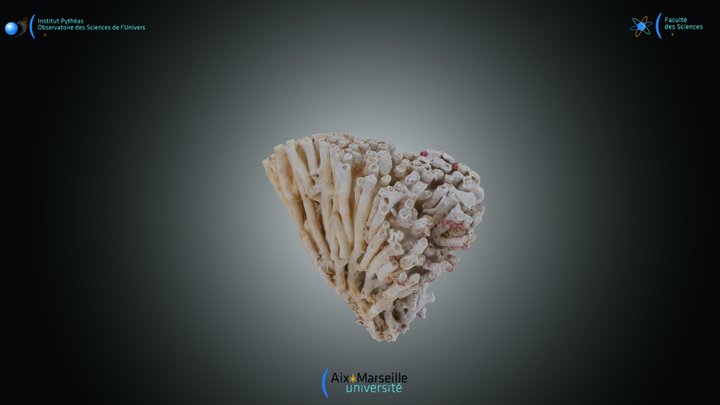
3D model
- Source
- Sketchfab
- Licence
- CC Attribution-NonCommercial-ShareAlike
- Commercial use
- the licence does not allow it
Smithsonian Open Access was not reached for this taxon, so this list is what the others held rather than everything there is.
The description on this site
- Licence
- CC BY-SA 4.0
This is what the site found, which is not the same as what exists.
Keep going
What may have been alongside itCladocora through timeFormations of the PleistoceneThe world it lived on
Occurrence data from the Paleobiology Database, CC BY 4.0. (Linne 1767)